Eyes On The Solar System

Eyes On The Solar System

Website

WISE
96%

WISE Score

The closest thing to a personal spaceship without the multi-billion dollar price tag.

Screenwise Verdict

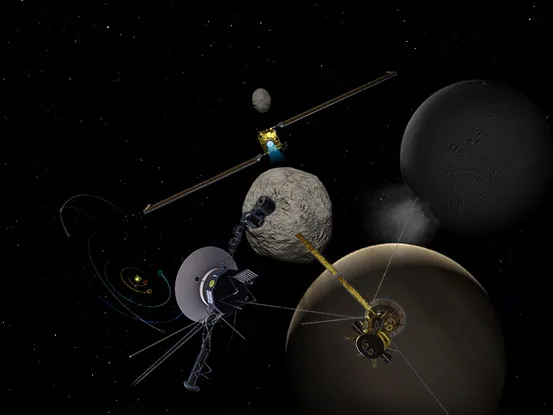
NASA’s Eyes on the Solar System is essentially a high-end space simulator that they just happen to give away for free. It’s the gold standard for what educational tech should be: immersive, accurate, and genuinely cool.

Instead of reading a textbook about the solar system, your kid can literally follow the Voyager probes out of the heliosphere or watch the Mars rovers crawl across the red planet. It’s one of the few corners of the web where you can let a kid wander entirely unsupervised and know they’ll come back smarter.

Age Fit

Perfect for ages 7 and up. Younger kids can enjoy 'flying' around with a parent, but the interface requires some reading and coordination to really master.

WISE Breakdown
Wholesome
98

It is pure, curiosity-driven exploration. No conflict, no competition, just the awe of the cosmos modeled with scientific accuracy.

Imaginative
92

While grounded in hard data, the 'time travel' and 'fly-along' features invite kids to imagine themselves as mission controllers or explorers.

Safe
100

NASA's site is the ultimate 'walled garden.' No ads, no tracking, no social features, and no way to stumble into the weird corners of the internet.

Enriching
98

Uses real-time telemetry from actual spacecraft. It's a direct pipeline to current scientific discovery, making abstract space concepts tangible.

Parent Info
✓

Why It Might Be Great

  • Real-time mission tracking lets you see exactly where probes like Perseverance or Voyager are right this second.
  • Zero friction setup because it runs in a browser—no apps to download, no accounts to manage, and zero ads.
  • Time travel mode allows kids to scrub through decades of history to see planetary alignments or historic landings.
  • NASA-grade accuracy means if they see a moon orbiting Jupiter, it’s actually there, based on the latest telemetry.
⚠

What to Watch For

  • The learning curve for the 3D controls can be a bit steep on a laptop trackpad; it's much more intuitive with a mouse or on a tablet.
  • It is a massive rabbit hole—once a kid starts clicking on asteroids or jumping between moons, they can easily lose an hour to the 'just one more planet' effect.

Conversation Starters

  • "If you could hitch a ride on any of these spacecraft, which one would you pick and why?"
  • "Why do you think NASA is so interested in those tiny asteroids instead of just looking at the big planets?"
  • "How long do you think it would take to drive a car to where that probe is right now?"
  • "Did you see how many moons Jupiter has? Why do you think it has so many more than Earth?"

Ask Anything

Get a personalized guide on any topic