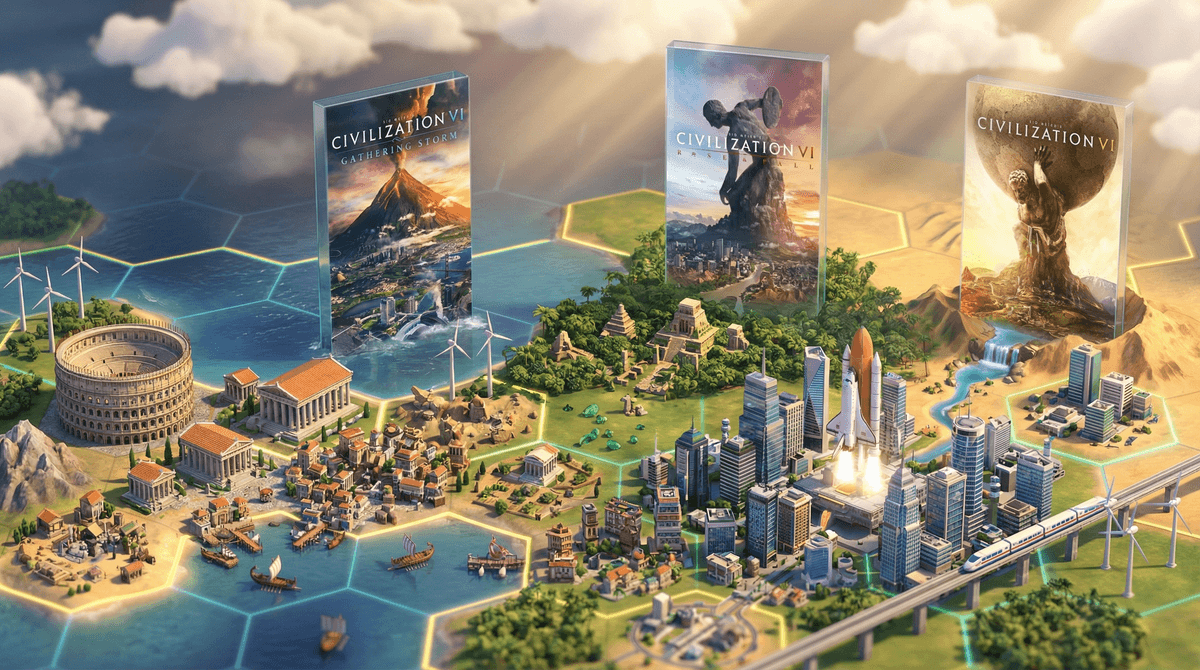
Build empires, manage climate disasters, and rewrite history in this deeply strategic expansion that's basically a graduate course disguised as a game.
Civilization VI: Gathering Storm
game
2019, Strategy, Turn-based strategy (TBS)
89%
WISE Score
83%
IGDB
Build empires, manage climate disasters, and rewrite history in this deeply strategic expansion that's basically a graduate course disguised as a game.
This is one of those rare games where 'educational' doesn't mean 'boring.' Gathering Storm adds climate mechanics that make you actually think about environmental consequences—your industrial revolution can literally flood coastal cities or trigger droughts.
The time investment is real. A single game can take 4+ hours, and the 'just one more turn' pull is strong. But unlike mindless mobile games, kids are genuinely learning systems thinking, historical context, and strategic planning. Parents consistently report kids becoming more interested in world history and geography after playing.
The complexity is both the strength and the barrier. This isn't pick-up-and-play; it requires focus, reading, and patience. But for the right kid—the one who loves building, planning, and optimizing—this is gold. It's basically SimCity meets world history meets climate science, wrapped in legitimately engaging gameplay.
Age Fit
Common Sense Media recommends 11+, which feels right. Kids need enough historical context and strategic patience to enjoy it. Younger players (8-10) with strong reading skills and interest in strategy games can handle it with parent support. Appeals to teens and adults who love deep, thoughtful gameplay.
WISE Breakdown
Wholesome
78
Turn-based strategy that rewards patience and thoughtful planning. Mild violence (units attacking) is abstracted and non-graphic. ESRB notes mild violence, drug reference, language, and suggestive themes, but parent reviews confirm these are minimal and contextual to historical civilizations. Pacing is player-controlled, never chaotic. Models cooperation through diplomacy and negotiation mechanics.
Imaginative
92
Exceptional sandbox for exploring alternate histories and 'what if' scenarios. Players chart unique paths to victory through technology trees, city planning, diplomatic strategies, and responding to dynamic environmental systems. The climate/disaster mechanics add creative problem-solving. Building civilizations from ancient era to future requires sustained creative thinking and adaptation.
Safe
88
Very safe for a strategy game. Users can interact online but no built-in chat, no in-game purchases, no loot boxes. Violence is highly abstracted (think Risk-level combat visualization). ESRB rated E10+ with appropriate content descriptors. No predatory loops or dark patterns. The turn-based nature prevents compulsive play better than real-time games, though sessions can run long by choice.
Enriching
94
Teaches geography, world history, resource management, long-term strategic planning, cause-and-effect thinking, and diplomacy. The Gathering Storm expansion specifically introduces climate science and environmental consequences, making players grapple with sustainability vs. growth. Develops systems thinking and trade-off analysis. Common Sense Media parent reviews consistently praise educational value. Genuinely builds skills while being deeply entertaining.
Parent Info
✓
Why It Might Be Great
Legitimately teaches world history, geography, resource economics, and climate science while being genuinely fun
The environmental systems make kids think about sustainability, trade-offs, and long-term consequences of decisions
Turn-based gameplay rewards patience and strategic thinking over reflexes—great for thoughtful, analytical kids
Massive replay value with different civilizations, victory conditions, and emergent scenarios
No predatory monetization, ads, or toxic social features—just pure strategy gaming
⚠
What to Watch For
Sessions easily stretch 2-4+ hours; you'll need to set clear time boundaries or use save points
Complexity can be overwhelming initially—expect a learning curve and possibly some frustration
Historical civilizations include mild references to religion, war, and conquest (all abstracted and educational)
Online multiplayer exists but requires external coordination; no built-in voice chat minimizes toxicity risk
Conversation Starters
"Which civilization did you pick and why? What makes their special abilities interesting?"
"How are you balancing growth with environmental impact? What happens when you ignore climate change in the game?"
"If you could lead any civilization in real history, which would you choose and what would you do differently?"
"What's your strategy for winning—military conquest, science victory, cultural dominance, or diplomacy?"
"How does managing a civilization in the game compare to what real leaders have to think about?"