

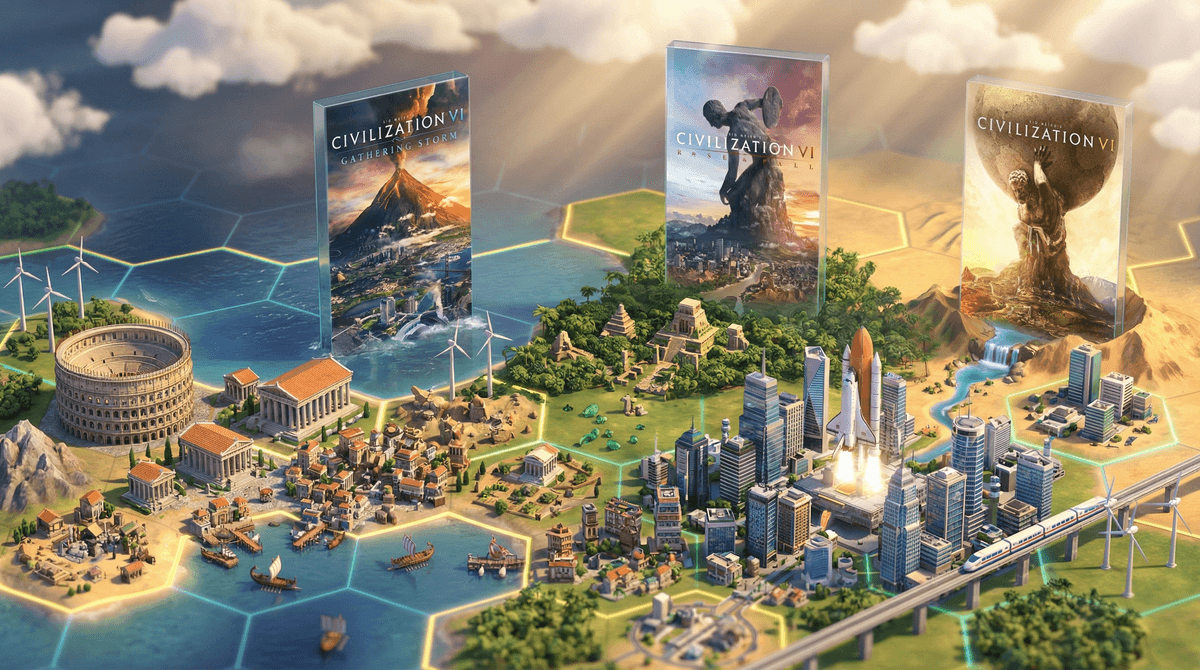
Civilization VI (often shortened to Civ VI) is a turn-based strategy game where players build an empire from the ground up—starting in the Stone Age and advancing through thousands of years of human history. Released in 2016, it's the latest entry in a legendary gaming franchise that's been around since 1991.
Here's the basic premise: You pick a historical civilization (from Ancient Rome to Aztec to Japan to Scotland), choose a leader (think Gandhi, Cleopatra, or Teddy Roosevelt), and then compete to become the dominant world power. You'll found cities, research technologies, build wonders like the Pyramids or the Eiffel Tower, engage in diplomacy, wage wars, and try to win through one of several victory conditions—military conquest, scientific advancement, cultural dominance, religious conversion, or diplomatic victory.
Unlike fast-paced action games, Civ VI is methodical and cerebral. Each turn requires decision-making: Where should I expand my borders? Should I invest in science or military? Is it worth going to war with my neighbor? It's basically a digital board game on steroids, and yes, one more turn really does turn into three more hours.
The "just one more turn" phenomenon is real. Civ VI is genuinely addictive in a way that few strategy games achieve. Kids who get into it often describe feeling like a real leader making consequential decisions. There's something deeply satisfying about watching a civilization you built from a single settler grow into a sprawling empire with multiple cities, advanced technology, and global influence.
The appeal breaks down into a few key elements:
- Complexity that respects intelligence: This isn't a dumbed-down game. It treats players like they can handle intricate systems, which older kids and teens find validating.
- Historical immersion: Kids learn about real civilizations, leaders, technologies, and wonders. It's not perfectly historically accurate, but it sparks genuine curiosity about history.
- Multiple paths to success: There's no single "right" way to play, which appeals to different personality types and play styles.
- The satisfaction of long-term planning: Unlike games with instant gratification, Civ VI rewards patience and strategic thinking over hundreds of turns.
It's worth noting that this game has a massive adult fanbase too. Don't be surprised if you sit down to "see what your kid is playing" and find yourself still playing at 2 AM.
Official rating: ESRB rated E10+ (Everyone 10 and older)
Realistic age recommendations:
- Ages 10-12: Possible with significant learning curve. Expect to sit with them for the first several games to explain mechanics. Many kids this age will find it overwhelming initially but might grow into it.
- Ages 13+: The sweet spot. Most teens have the patience, strategic thinking, and reading comprehension to really engage with the game's depth.
- High schoolers: Often become deeply invested, sometimes to the detriment of homework and sleep schedules (more on this below).
The game involves a lot of reading. Like, a truly staggering amount of tooltips, descriptions, and information. Kids who struggle with reading or have attention difficulties may find it frustrating rather than fun.
The Time Investment Is Real
This is probably the biggest concern. A single game of Civ VI can easily take 6-10 hours to complete, sometimes more. While you can save and come back, the game's addictive nature makes it hard to stop. "Just one more turn" is a meme in the Civ community for a reason.
Unlike games with natural stopping points every 15-20 minutes (like Fortnite matches), Civ VI creates a constant pull to keep playing. You're always on the verge of completing something interesting—a wonder, a technology, a military campaign.
Practical tip: Set clear time boundaries BEFORE starting a game. "You can play for 2 hours" works better than trying to pull them away mid-game when they're "about to finish researching nuclear fission."
The Educational Value Is Legitimate
Here's the thing: Civ VI actually does teach valuable skills. Kids learn:
- Historical context: Who was Pericles? What made the Mongol Empire so powerful? Why was the printing press revolutionary?
- Resource management: Balancing multiple competing priorities with limited resources
- Strategic planning: Thinking 50-100 turns ahead
- Cause and effect: Understanding how early decisions impact late-game outcomes
- Geography and terrain: How mountains, rivers, and coastlines affect civilization development
Is it a substitute for actual history class? No. But it sparks curiosity that leads kids to learn more about historical civilizations and events .
.
Violence and War
The game includes military units and warfare, but it's highly abstracted. When units fight, there's no blood or graphic violence—just animations of soldiers or tanks engaging, with the loser disappearing. It's less visceral than most Minecraft combat.
That said, the game does involve concepts of conquest, colonization, and empire-building. Depending on your family's values, you might want to discuss how the game presents historical imperialism and whether that aligns with your worldview.
Multiplayer Considerations
Civ VI has online multiplayer, but it's not where most kids spend their time. Multiplayer games take even longer than single-player (since you're waiting for other players' turns), and the community skews older. Most kids play against AI opponents.
If your kid does play online, know that there's text chat, which means potential exposure to inappropriate language or behavior from strangers. The game doesn't have voice chat built-in, which is actually a plus from a safety perspective.
DLC and Expansions
The base game is complete, but there are two major expansions (Rise and Fall, Gathering Storm) and numerous DLC packs adding new civilizations and leaders. These aren't necessary but do add significant content.
Unlike games with predatory monetization (Roblox, Fortnite), Civ VI's DLC is traditional expansion content—you buy it once, and that's it. No ongoing pressure to spend money.
Mods and Community Content
The game has an active modding community. Mods can add new civilizations, change game mechanics, or even add entirely new scenarios. Most are harmless, but as with any user-generated content, there's potential for inappropriate material. If your kid is interested in mods, it's worth checking what they're downloading.
If your kid is interested in Civ VI or already playing, here are some conversation starters:
- "Which civilization did you choose? Why?"
- "What's your strategy for winning?"
- "What's the coolest wonder you've built?"
- "Have you learned anything about history from the game?"
- "How do you decide when to go to war versus making peace?"
These questions show genuine interest and give you insight into how they're engaging with the game's systems. You might be surprised by how thoughtful their answers are.
Civilization VI is one of those rare games that parents can feel genuinely good about—with one major caveat about time management. It's intellectually engaging, genuinely educational, and teaches strategic thinking in ways few other games do.
The ideal Civ VI player is a patient, thoughtful kid who enjoys complex systems and doesn't need constant action. If your child loved building elaborate structures in Minecraft, enjoyed Stardew Valley, or likes board games like Settlers of Catan, they'll probably love Civ VI.
Red flags: If your kid already struggles with time management, has difficulty with transitions, or tends toward obsessive gaming behavior, Civ VI's addictive nature could be problematic. The "just one more turn" pull is strong, and the lack of natural stopping points makes it harder to enforce boundaries than with other games.
If you're considering letting your kid play:
- Watch a gameplay video together to see if it's their style
- Set clear time boundaries before the first game
- Consider playing together initially to help them learn the systems
- Check in after a week to see if it's becoming all-consuming or just a healthy hobby
If they're already playing:
- Ask them to show you their current game and explain their strategy
- Discuss time limits if you're noticing homework or sleep suffering
- Explore whether they're interested in actual history books or documentaries about the civilizations they're playing
If you want alternatives: Age of Empires, Europa Universalis, and Crusader Kings are similar strategy games, though some are more complex or mature-rated.
The reality is that Civ VI is probably one of the better games your kid could be obsessed with—just make sure "obsessed" doesn't mean "playing until 3 AM on school nights." Set those boundaries early, and you might find yourself genuinely impressed by what they're learning.