

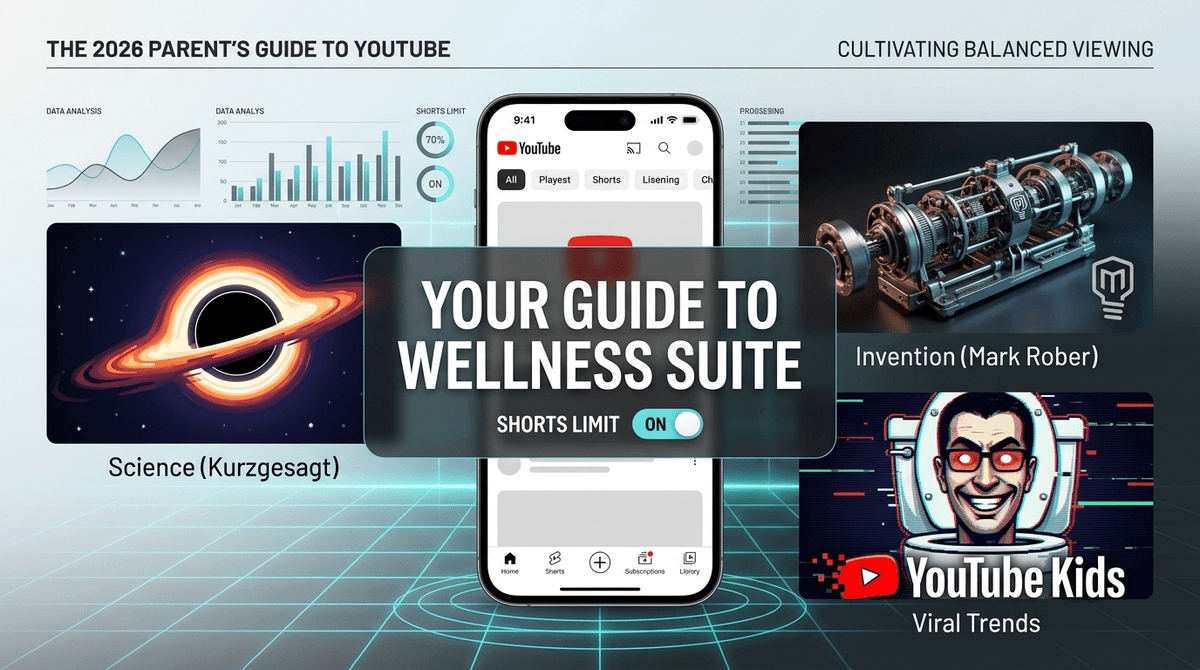
TL;DR: The 2026 YouTube Survival Kit
If you only have thirty seconds before your kid asks for your phone, here is the "cheat sheet" for YouTube right now:
- The Big News: YouTube finally launched the "Shorts Limit" tool this year, allowing you to cap the infinite scroll specifically for short-form video without blocking the whole site.
- The Content: "Brainrot" (Skibidi Toilet, Ohio memes) is still the dominant currency, but it’s mostly harmless absurdist humor.
- Top "High-Value" Recommendations:
- Mark Rober (Science/Engineering)
- Kurzgesagt – In a Nutshell (Big picture science)
- Art for Kids Hub (Drawing tutorials)
- Cosmic Kids Yoga (Movement for younger kids)
- Next Step: Take our survey to see how your kid's YouTube usage compares to your school's community.
By now, we all know YouTube isn't just a video site; it’s the primary search engine, television network, and social club for anyone under the age of 18. In 2026, the platform has bifurcated into two distinct experiences: Long-form content (the 10–20 minute videos we grew up with) and Shorts (the TikTok-style vertical feed that is currently winning the war for your child’s attention span).
The biggest shift this year is the integration of AI-generated summaries. If you’re looking at a 30-minute Minecraft video, YouTube now provides a "Parental AI Summary" that flags questionable language or themes before you even hit play. It’s not perfect, but it’s a massive upgrade from the "guess and check" method we used to rely on.
If you’ve heard your kid describe a burnt piece of toast as "so Ohio" or mention a "Skibidi" something-or-other, you’re witnessing the "Brainrot" era of 2026.
Skibidi Toilet started as a weird animation of heads popping out of toilets, but it has evolved into a massive, lore-heavy cinematic universe. It’s the "Star Wars" of the Gen Alpha generation—absurdist, loud, and slightly unsettling to anyone over 25.
Why do they love it?
- Community Language: Using terms like "Sigma," "Rizz," and "Ohio" (which basically just means "weird" or "low quality" now) makes them feel like they belong to a digital tribe.
- The Dopamine Loop: YouTube Shorts are designed to provide a "hit" of novelty every 15 seconds. It is incredibly hard for a developing brain to opt-out of that loop once it starts.
- Para-social Relationships: They feel like they actually know creators like MrBeast. When these creators tell them to buy a chocolate bar or join a challenge, it carries the weight of a recommendation from a best friend.
The most significant update for intentional parents this year is the Shorts Limit feature. For years, we could set a general timer for YouTube, but that didn't help when a kid spent 55 minutes of their hour-long limit mindlessly scrolling Shorts.
Now, within the YouTube Parental Controls, you can specifically cap "Vertical Feed" time. This allows a kid to watch a full-length NASA documentary or a coding tutorial without the algorithm baiting them into a three-hour Shorts spiral.
Additionally, YouTube has introduced "Digital Wellness Check-ins" that pause videos every 15 minutes to ask the user a reflective question. It’s a small speed bump, but it’s better than the old "Autoplay" which was essentially a firehose of content.
Ages 2–6: The "YouTube Kids" Only Zone
At this age, the main YouTube app is a literal minefield of "Elsagate" style knock-offs—creepy, AI-generated videos designed to trick the algorithm. Stick exclusively to YouTube Kids and use the "Approved Content Only" setting.
- Recommendation: PBS Kids content or Storyline Online.
Ages 7–12: Supervised Accounts
This is the "Middle School Lite" phase. They want to see what the older kids are watching. Use YouTube Supervised Accounts, which filters out most mature content but gives them the "grown-up" interface.
- Recommendation: Mark Rober or Hacker101 if they’re into tech.
Ages 13+: The Wild West
By 13, the filters mostly come off. This is the time for "Co-Watching." Sit with them. Ask them why they like a certain creator. If they’re watching MrBeast, talk about the economics of his videos. Is he being generous, or is he buying views?
Not all YouTube is created equal. I like to categorize content into two buckets: Brainrot and Build.
Brainrot isn't necessarily "evil." It’s the digital equivalent of eating a bag of Cheetos. It’s fine in moderation, but if it’s all they eat, they’re going to feel like garbage. Skibidi Toilet and generic "reaction" channels fall here.
Build content is anything that inspires them to close the laptop and do something.
- Watching a Minecraft tutorial to learn about redstone circuitry? That's a build.
- Watching 5-Minute Crafts (even though half of them don't work)? That's a build.
- Learning a dance from Kidz Bop? That's a build.
Get a list of "Build" channels tailored to your kid's hobbies .
.
The YouTube algorithm has one goal: Watch Time. It does not care about your child's mental health, their sleep schedule, or whether the video they are watching is radicalizing them into a weird corner of the internet.
In 2026, we’re seeing more "Deepfake" content where popular creators' voices are used to sell scams or spread misinformation. Teach your kids the "Three-Second Rule": If a video seems too crazy to be true, wait three seconds and look at the channel name. Is it the verified creator, or a bot account with 12 followers?
Instead of saying "YouTube is rotting your brain," which will result in an immediate eye-roll, try these conversation starters:
- "I saw a headline about the 'Shorts Limit'—do you feel like those videos are harder to stop watching than the long ones?"
- "What’s the weirdest thing you’ve seen in 'Ohio' lately?" (Speak their language, even if it feels cringey).
- "If you were going to start a channel, what would you actually teach people?"
YouTube in 2026 is a tool. In the hands of a kid with no boundaries, it’s a dopamine-shredder that can lead to some pretty dark rabbit holes. In the hands of a kid with an intentional parent and a "Shorts Limit" enabled, it’s the greatest library in human history.
If you feel like your kid is currently "stuck" in the YouTube loop, it might be time for a digital detox. Try pivoting them toward games that require more active brain power and less passive consumption, like Stardew Valley or Terraria.
- Check the Settings: Go into your child's YouTube app and look for the new "2026 Wellness Suite" to enable the Shorts Limit.
- Audit the Feed: Spend 10 minutes scrolling their feed with them. If it’s all toilets and screaming, help them subscribe to three "Build" channels.
- Compare Notes: See what other parents in your grade are allowing on YouTube. You might find you're being too strict—or that you're the only one letting your 8-year-old watch uncurated Shorts.
Check out our full guide on YouTube vs. YouTube Kids for a deeper dive into the technical setup.