

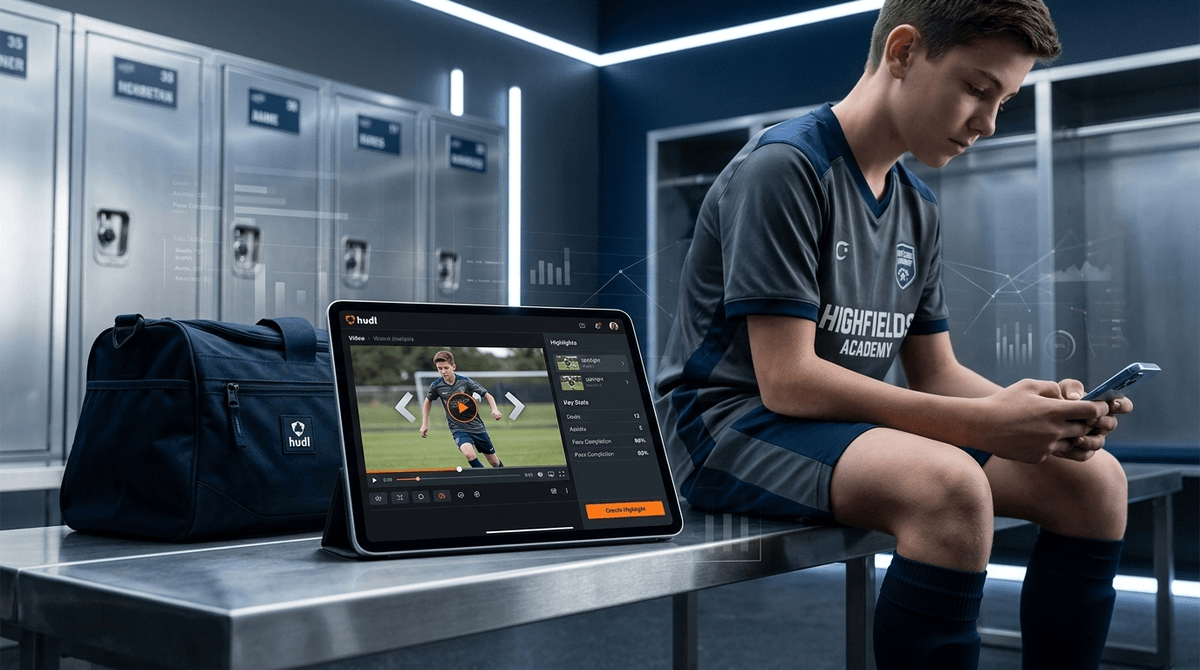
TL;DR: Your kid’s sports team just moved to Hudl, and suddenly your 12-year-old has a "digital resume." It’s a powerful tool for improvement and recruiting, but it also brings social media pressures into the locker room. Balance the "grind" with healthy media like The Crossover or Hustle, and keep an eye on the team messaging features.
See how to balance sports apps and wellness
Remember when the biggest tech challenge in youth sports was making sure the group text didn't blow up your phone at 6:00 AM on a Saturday? Those days are gone. Now, if your kid is playing competitive soccer, football, volleyball, or basketball, you’ve probably been hit with an invite to Hudl.
Suddenly, your middle schooler isn't just playing a game; they’re "watching film," "tagging stats," and "building a highlight reel." It feels very professional, very high-stakes, and—let’s be honest—a little bit like another thing we have to manage.
If you’re feeling like the "digital resume" era of youth sports arrived before you were ready, you’re not alone. Here’s the breakdown of what Hudl actually is, why your kid is obsessed with it, and how to make sure it doesn't turn your athlete’s hobby into a 24/7 performance anxiety machine.
At its core, Hudl is a video review and performance tool. Coaches upload game footage, and players can log in to watch themselves (and their opponents). But it’s evolved into much more than a digital film room. It’s now a social-professional hybrid where kids can:
- Create Highlights: Clip their best plays, add music, and spotlight themselves with "spotlight arrows."
- Recruit: Share those highlights directly with college coaches (even for kids who are years away from college).
- Communicate: Use built-in team messaging to talk to coaches and teammates.
- Analyze: See "stats" and "data" that used to be reserved for the pros.
It’s basically LinkedIn meets Instagram for the jersey-wearing set.
If your kid says their Hudl highlights are "only in Ohio," they probably mean they’re weirdly good or just plain bizarre. Kids love Hudl because it validates their hard work. In a world where everything is documented, having a professional-looking clip of that three-pointer or that slide tackle is social currency.
It’s also about the "grind." There is a massive subculture on YouTube and TikTok centered around "athlete aesthetics"—the idea that you are always training, always improving, and always "on." Hudl is the platform where they prove that grind is real.
While Hudl is a "productive" app, it carries many of the same risks as traditional social media.
1. The Highlight Reel Effect
Just like Instagram makes everyone else’s life look perfect, Hudl makes every other kid on the team look like a D1 prospect. Your kid might spend hours watching a teammate’s highlights and feeling like they don’t measure up. This can lead to "stat-padding" behavior during actual games—where a kid is more worried about getting a "clip" than playing as a team.
2. The "Always On" Mentality
When the coach sends a notification at 9:00 PM that "film is ready," your kid feels the pressure to watch it immediately. It blurs the line between extracurricular fun and a job.
3. Public Profiles and Privacy
By default, Hudl profiles can be public so recruiters can find them. But that also means anyone can find them. You’ll want to sit down and decide exactly how much personal info (school name, graduation year, etc.) you want out there.
If your kid is spending a lot of time on Hudl, GameChanger, or watching sports influencers, they need some narrative balance. You want media that shows the human side of sports—the failure, the teamwork, and the life outside the lines.
The Crossover (Disney+)
Ages 10+ Based on the Newbery Medal-winning book by Kwame Alexander, this show is the perfect antidote to "highlight culture." It deals with brotherhood, health, and the reality that basketball is just one part of a person's identity. It’s stylish enough that your kid won't think it's "brain rot," but deep enough to spark a real conversation.
Ted Lasso (Apple TV+)
Ages 14+ (due to language) If you have a teen, this is the gold standard for sportsmanship. It’s not about the "grind"; it’s about being a good person. It deconstructs the "winning is everything" mentality that apps like Hudl can accidentally reinforce.
Hustle (Netflix)
Ages 13+ Adam Sandler plays a scout, and while it celebrates the "grind," it also shows the grueling, unglamorous reality of professional sports. It’s a great "watch together" movie to talk about what it actually takes to move to the next level beyond just having a cool Hudl clip.
The Playbook (Netflix)
Ages 10+ This is a docuseries featuring legendary coaches. It’s "productive" viewing. Instead of just looking at highlights, it teaches strategy and mental toughness. It helps kids move from "look at me" to "how do I think like a pro?"
Hudl isn't Roblox—you aren't going to find "Skibidi Toilet" memes or predatory strangers in the same way. However, it has its own set of "watch-outs":
- The Messaging Feature: Hudl has a direct messaging tool. While it's intended for "Coach to Player" or "Team Chat," it’s still an unmonitored DM space. Check in on these chats just like you would WhatsApp or Discord.
- External Links: Many kids link their Hudl to their X (Twitter) or Instagram accounts to "get recruited." This is where the real "digital footprint" danger lies. A college coach might like their highlight, but they’ll stop recruiting them if their X feed is full of "brain rot" or inappropriate comments.
- Data Usage: If your kid is watching high-def game film on the bus using cellular data, your phone bill is going to be "Ohio" (and not in a good way). Make sure they know to download film over Wi-Fi.
Instead of being the "screen time police," try being the "talent scout." Ask them questions that force them to look at the app critically:
- "What did you see on the film today that isn't in your highlight reel?" (Encourages learning from mistakes, not just celebrating wins.)
- "Who on the team had a great play that didn't get a spotlight arrow?" (Encourages noticing teamwork and "invisible" effort.)
- "I noticed you’re spending a lot of time editing that clip—is it for the coach, or is it for your friends to see?" (Helps them distinguish between improvement and ego.)
Hudl is a tool, not a toy. If your kid uses it to understand the game better and bond with their teammates, it’s a win. If they use it to obsess over their "brand" and compare their behind-the-scenes to everyone else's highlight reel, it's time to bench the app for a few days.
Encourage them to follow creators like Dude Perfect for the fun side of sports, or Overtime for the culture, but remind them that the best part of sports happens when the phone is in the locker room and the kid is on the field.
- Check the Privacy Settings: Log in with your kid and see if their profile is "Public" or "Team Only."
- Set a "Film Cutoff": No watching game film 30 minutes before bed. It gets the adrenaline going too much.
- Watch Together: Once a week, have them show you their favorite play (and a play they want to improve). It turns a solo screen activity into a connection point.