

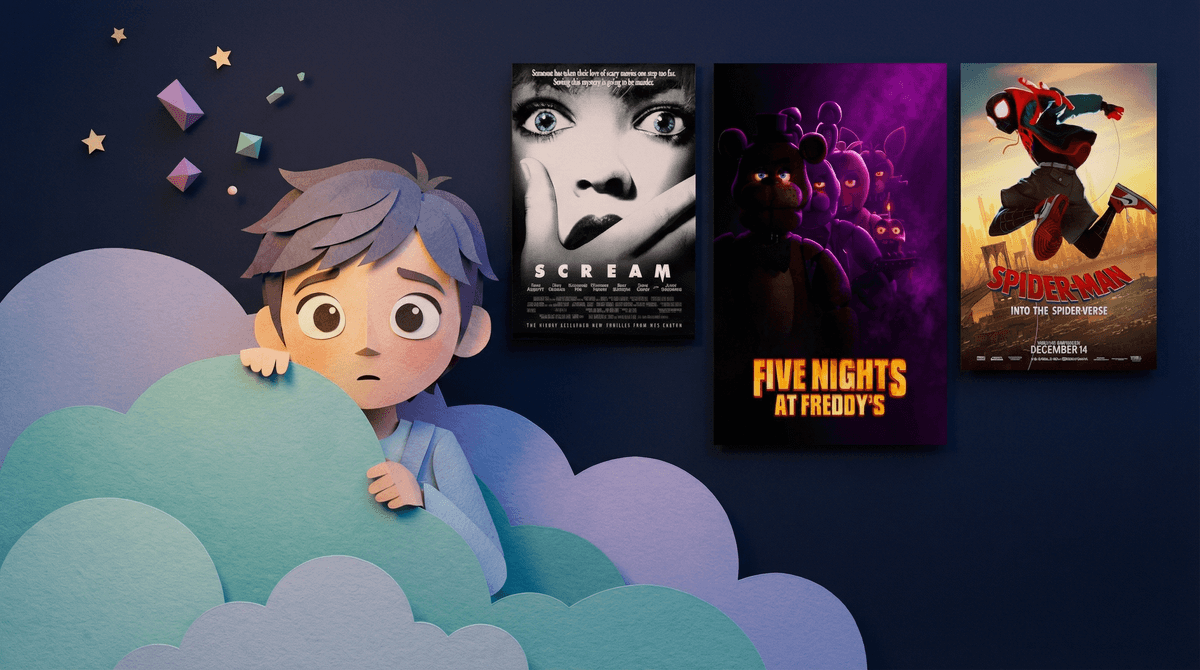
Your seventh grader still covers their eyes during trailers. Your sixth grader asks to leave the theater during the "scary parts." Your middle schooler is the only one in their friend group who hasn't seen the latest horror movie everyone's talking about. And you're wondering: is this normal? Should I be worried? Should I push them?
Here's the thing: some kids are just more sensitive to visual media, and that's completely okay. We're not talking about little kids being scared of age-appropriate content—we're talking about tweens and early teens who are genuinely frightened or overwhelmed by movies that their peers seem to handle just fine.
This isn't about being "babyish" or "immature." It's about how different brains process visual information, emotional content, and sensory input. And honestly? In a world where we're constantly worried about kids being too desensitized to violence and intensity, having a kid who's still sensitive might not be the problem we think it is.
There are a few things happening here, and none of them are character flaws:
Sensory processing differences: Some kids process visual and auditory input more intensely. Jump scares that make one kid laugh can genuinely overwhelm another kid's nervous system. The loud sounds, sudden movements, and intense imagery aren't just "startling"—they're actually difficult to process.
Vivid imagination: Kids with strong imaginations (often the same kids who are amazing creative writers or artists) can have trouble separating fiction from reality in the moment. They know it's fake, but their brain is so good at world-building that the images stick with them long after the movie ends.
Empathy levels: Some tweens feel emotions—including fear and distress—more intensely. They're not just watching characters in danger; they're feeling what those characters feel. This is actually a pretty incredible trait in humans, even if it makes movie night complicated.
Previous experiences: A kid who had a bad experience with a scary movie at age 7 might still be gun-shy at age 12. Trauma (even small-t trauma like "that one movie that gave me nightmares for weeks") has a long tail.
Developmental timing: Not all kids develop emotional regulation skills at the same pace. Your tween might be academically advanced but still working on the brain development that helps them manage intense emotions or scary scenarios.
Let's acknowledge the elephant in the room: your kid probably feels pretty self-conscious about this. When everyone's talking about Five Nights at Freddy's or the latest Scream sequel, and your kid hasn't seen it (and doesn't want to), that's socially awkward.
Middle school is already a minefield of "am I normal?" anxiety. Being the kid who's "too scared" for certain movies can feel like a huge deal, even if the other kids aren't actually being mean about it.
This is where you come in—not to push them past their comfort zone, but to help them understand that different people have different tolerances, and that's fine. Some kids can't handle scary movies. Some kids can't handle sad movies (yes, this is also a thing—plenty of tweens will watch horror but absolutely cannot deal with emotional drama). Some kids get motion sick from shaky camera work. Bodies and brains are different.
Don't force exposure therapy: "You just need to watch more scary movies to get used to them!" is not the move here. For some kids, repeated exposure to content that genuinely frightens them doesn't build tolerance—it builds anxiety.
Don't minimize their feelings: "It's not even that scary" or "you're too old to be scared of this" doesn't help. It just makes them feel bad about something they can't control.
Don't compare them to siblings or peers: "Your little brother watched this and he was fine" is a great way to make your kid feel worse while solving nothing.
Don't make it a moral issue: This isn't about bravery or maturity. It's about neurology and personal tolerance.
Validate their experience: "I know this is genuinely scary for you, and that's okay. Different people have different comfort levels with this stuff." Full stop. Let them know this doesn't make them weak or babyish.
Help them articulate their boundaries: Can they handle suspense but not gore? Are jump scares the problem, or is it existential dread? Understanding what specifically bothers them helps them make better choices about what to watch.
Offer alternatives for social participation: They can still be part of the conversation without watching the movie. Reading plot summaries, watching behind-the-scenes content, or watching funny reaction videos can give them enough context to participate in peer discussions without the actual scary experience.
Find their genre: Just because they don't like horror doesn't mean they don't like movies. Maybe they're into comedy, or action without horror elements, or thoughtful sci-fi. Spider-Man: Into the Spider-Verse is exciting without being scary. The Mitchells vs. The Machines is hilarious and heartfelt. Everything Everywhere All at Once is wild and weird without being horror.
Consider the "gradual exposure" approach—on their terms: If your kid wants to build tolerance, let them lead. Maybe they watch scary movies during daytime with friends. Maybe they start with "mild" thrillers. Maybe they watch with the sound off first. But this only works if they want to do it, not because you're pushing.
Respect the "no": If they don't want to see something, that's the end of the conversation. Their body, their brain, their boundaries.
Here's a practical issue: what happens when your kid gets invited to a sleepover and you know they're planning to watch something your kid can't handle?
Talk to your kid first: Do they want to go and just opt out of the movie? Do they want to skip this particular sleepover? What feels manageable to them?
Consider a quiet conversation with the host parent: "Hey, just a heads up—my kid doesn't do well with scary movies. Is there a plan B if they need to step out?" Most parents will appreciate the information.
Have an exit plan: Your kid should know they can always call you for a pickup, no questions asked, no judgment. This is actually a good policy for all sleepovers anyway.
Don't worry if: Your kid is otherwise functioning well, has friends, enjoys other activities, and just happens to have a low tolerance for scary media. This is a preference, not a problem.
Consider talking to someone if: The fear is expanding to other areas (avoiding all new experiences, extreme anxiety about everyday things, nightmares that interfere with sleep for extended periods). At that point, you might be looking at anxiety that's bigger than just movie sensitivity, and a therapist who specializes in kids can help.
Your tween doesn't have to like scary movies. They don't have to "get over it." They don't have to prove anything to anyone.
The goal isn't to make them exactly like their peers—it's to help them understand themselves, communicate their needs, and feel okay about having different boundaries. Those are actually incredibly valuable life skills that will serve them way better than being able to sit through a horror movie.
There are literally thousands of amazing movies, shows, games, and books out there that don't rely on fear and intensity. Help your kid find their thing. Maybe they become the friend group's comedy movie expert. Maybe they get really into documentaries. Maybe they discover they love animation or fantasy or historical drama.
And who knows? Maybe in a few years they'll develop more tolerance. Or maybe they won't, and they'll be a 30-year-old who still doesn't like horror movies. Both of those outcomes are completely fine.
- Have a judgment-free conversation with your kid about what specifically bothers them about scary content
- Help them develop language to advocate for themselves ("I'm not really into horror, but I'd love to hang out—can we watch something else?")
- Build a list of movies/shows they do enjoy so they have alternatives to suggest
- Make sure they know that having different preferences doesn't make them weird or wrong
- Consider checking out Common Sense Media together before movies to preview content and make informed decisions as a team
Your kid is going to be fine. Actually, your kid is already fine. They just need to know that you think so too.