

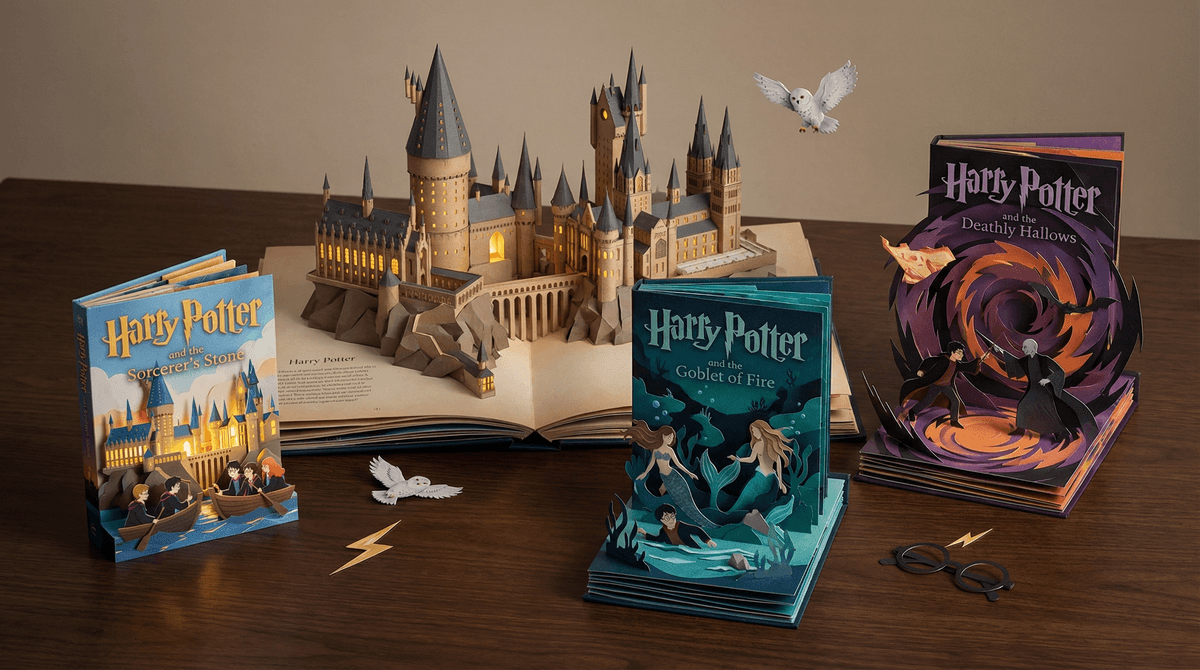
When to Start Harry Potter: A Book-by-Book Age Guide
Read-aloud starting at age 5-6: Books 1-3 work great as family read-alouds for kindergarteners and first graders who can handle mild peril.
Independent reading at 8-10: Most kids are ready to start the series on their own around third grade, though reading level varies wildly.
The dark turn happens in Book 4: Harry Potter and the Goblet of Fire is where someone dies on-page and the tone shifts dramatically. This is typically appropriate for ages 10-11+.
Books 5-7 are genuinely dark: Torture, death, war, and psychological trauma become central themes. Most kids aren't ready for these until 11-13+, regardless of reading ability.
The sweet spot? Start with Harry Potter and the Sorcerer's Stone as a read-aloud when your kid is 6-7, let them read independently through Book 3 around age 8-9, then pause before Book 4 to assess readiness for darker content.
Harry Potter is not one reading experience—it's seven increasingly mature books that grew up with their original audience. J.K. Rowling literally wrote each book for slightly older readers, which means the series ages about a year per book.
This creates a unique challenge: a kid who's absolutely ready for the whimsy and wonder of Sorcerer's Stone at age 6 is definitely NOT ready for the graphic violence and emotional devastation of Deathly Hallows at age 12.
The good news? You don't have to figure out the whole series at once. You can start early with the lighter books and then pace the darker ones based on your individual kid's emotional maturity.
Books 1-3: The Gateway
Harry Potter and the Sorcerer's Stone, Chamber of Secrets, and Prisoner of Azkaban work beautifully as read-alouds starting around age 5-6.
What makes them work for younger kids:
- The magical world-building is pure wonder (flying broomsticks, talking portraits, chocolate frogs)
- The scary parts are clearly fantastical (three-headed dogs, giant spiders, dementors)
- The emotional stakes are manageable (will Harry catch the Snitch? will Hermione ace her exams?)
- The chapter lengths are perfect for bedtime reading
What to watch for:
- Some kids find the Dursleys' emotional abuse of Harry genuinely upsetting
- The basilisk in Book 2 can be scary for sensitive kids
- Dementors in Book 3 represent depression/despair in a way that might confuse younger readers
- Kids who've experienced abandonment or foster care may need extra support with Harry's backstory
Pro tip: Reading aloud lets you gauge reactions in real-time and skip or summarize scary parts. You can also pause to explain concepts like "boarding school" or "British terms" that might confuse American kids.
Most kids with solid reading skills can tackle Books 1-3 independently around third or fourth grade. The reading level of Sorcerer's Stone is roughly 5th-6th grade, but the content is accessible to younger kids who read above grade level.
The timing question: Should you start with read-alouds and then have them re-read independently? Or wait until they can read them on their own?
There's no wrong answer, but here's what works for many families: Start as a read-aloud around age 6-7, then let them re-read independently around age 8-9 before moving forward. Kids who loved the read-aloud experience will devour the books on their own, catching details they missed the first time.
Harry Potter and the Goblet of Fire (Ages 10-11+)
This is where everything changes. Book 4 is nearly twice as long as Book 3, and the tone shifts from "magical boarding school adventures" to "actual people die and the villain returns to power."
What happens in Book 4:
- A character is murdered on-page (not off-screen or implied—actually killed in front of Harry)
- Voldemort returns in a graphic, disturbing ritual involving blood and bones
- The emotional stakes become real: grief, trauma, PTSD
- The Ministry of Magic gaslights Harry, setting up themes of institutional corruption
Age recommendation: Most kids aren't ready for this until age 10-11, and some need to wait longer. Reading level is irrelevant here—this is about emotional readiness to process death, betrayal, and the fact that authority figures don't always protect you.
The gap strategy: Many families read Books 1-3, then take a break for a year or two before continuing. This lets kids mature a bit and also builds anticipation. You can fill the gap with Percy Jackson, The Chronicles of Narnia, or other fantasy series for middle grade readers.
Books 5-7: The War Years (Ages 11-13+)
Order of the Phoenix, Half-Blood Prince, and Deathly Hallows are legitimately dark. Not "kid-dark" like Goosebumps—more like "YA dystopian fiction" dark.
What kids encounter in Books 5-7:
- Multiple beloved characters die, sometimes brutally
- Torture scenes (Umbridge's blood quill, Bellatrix torturing Hermione)
- A fascist government taking over and persecuting minorities
- Psychological trauma and depression (Harry's PTSD in Book 5 is intense)
- The revelation that Dumbledore manipulated Harry his entire life
- Suicide mission vibes throughout Book 7
Age recommendation: 11-13+ depending on the kid. Some mature 11-year-olds can handle it; some 13-year-olds aren't ready. Consider:
- Has your kid experienced loss or trauma? These books don't pull punches about grief
- Can they handle moral ambiguity? The "good guys" do questionable things
- Are they emotionally ready for beloved characters to die?
Real talk: Book 7 includes a scene where Harry watches Voldemort murder his parents through magical flashback, and another where Harry walks to his own death. These aren't light reading experiences.
This is the trap many families fall into: "My 7-year-old reads at a 6th-grade level, so they can read the whole series!"
Not quite. Reading ability and emotional readiness are completely different things.
A precocious 8-year-old might breeze through the vocabulary and sentence structure of Deathly Hallows but be completely unprepared for the emotional weight of watching characters they love get tortured and killed.
Signs your kid isn't ready for the darker books yet:
- They're still having nightmares about Books 1-3
- They ask anxious questions about whether certain characters are "safe"
- They're not ready to discuss heavy topics like death, injustice, or betrayal
- They read primarily for escapism and aren't interested in darker themes
Signs they might be ready:
- They've read other books dealing with death or loss (Bridge to Terabithia, The One and Only Ivan)
- They ask thoughtful questions about moral complexity
- They can handle suspense and delayed gratification (Book 5 is 870 pages of buildup)
- They're interested in the darker turn and asking to continue
The Harry Potter movies follow a similar progression but are generally more intense than the books for younger kids—the visual and auditory experience of scary scenes hits harder than reading about them.
Movie age guidelines:
- Movies 1-2: Age 7+ (PG)
- Movie 3: Age 9+ (PG, but genuinely creepy in parts)
- Movies 4-8: Age 11+ (PG-13, with increasing violence and intensity)
Many families do books first, then movies, which works well because kids can visualize the story on their own terms before seeing the film interpretation.
Yes, J.K. Rowling's public statements about transgender people have been controversial and hurtful to many families. This is a real thing you might need to navigate.
Some families have stopped engaging with Harry Potter entirely. Others separate the art from the artist. Others use it as an opportunity to discuss how people we admire can hold views we disagree with.
There's no right answer here—it depends on your family's values and whether you have LGBTQ+ kids or family members who might be directly impacted. The books themselves don't contain anti-trans content, but financially supporting the franchise does benefit Rowling, who continues to use her platform in ways many find harmful.
If you're looking for magical school alternatives, consider Nevermoor, Amari and the Night Brothers, or The School for Good and Evil.
If you have multiple kids at different ages, this gets tricky. The 12-year-old reading Book 7 might spoil plot points for the 8-year-old just starting Book 1.
Strategies that work:
- Institute a "no spoilers" rule with real consequences
- Let younger kids watch the movies for Books 4+ while older kids read ahead
- Create physical separation (older kid reads in their room, not in common areas)
- Lean into it: "Yes, someone dies in Book 7, but you'll have to wait to find out who"
Some families do a "everyone reads together" approach where the youngest kid's readiness determines the pace. This builds anticipation and creates shared family experiences, though older kids might chafe at the slow pace.
Start early, pace intentionally, and don't rush.
The magic of Harry Potter is that it grows with your kids—but only if you let it. Starting Sorcerer's Stone as a read-aloud at age 6 is wonderful. Pushing a 9-year-old through Deathly Hallows because they can read it is a recipe for nightmares and ruined magic.
The ideal timeline for many families:
- Ages 5-7: Read-aloud Books 1-3
- Ages 8-9: Independent re-read of Books 1-3
- Ages 10-11: Book 4 (with discussion)
- Ages 11-13: Books 5-7 (as they're ready)
But every kid is different. Some sensitive 10-year-olds need to wait until 12 for Book 4. Some mature 9-year-olds are ready. You know your kid best.
The goal isn't to rush through the series—it's to create a magical reading experience that matches where your kid is developmentally. Done right, Harry Potter can be a formative literary experience. Done wrong, it's just scary books that were too much too soon.
Trust your instincts, watch for signs of readiness (or not-readiness), and remember: the books will still be there when your kid is ready. There's no prize for finishing early.