

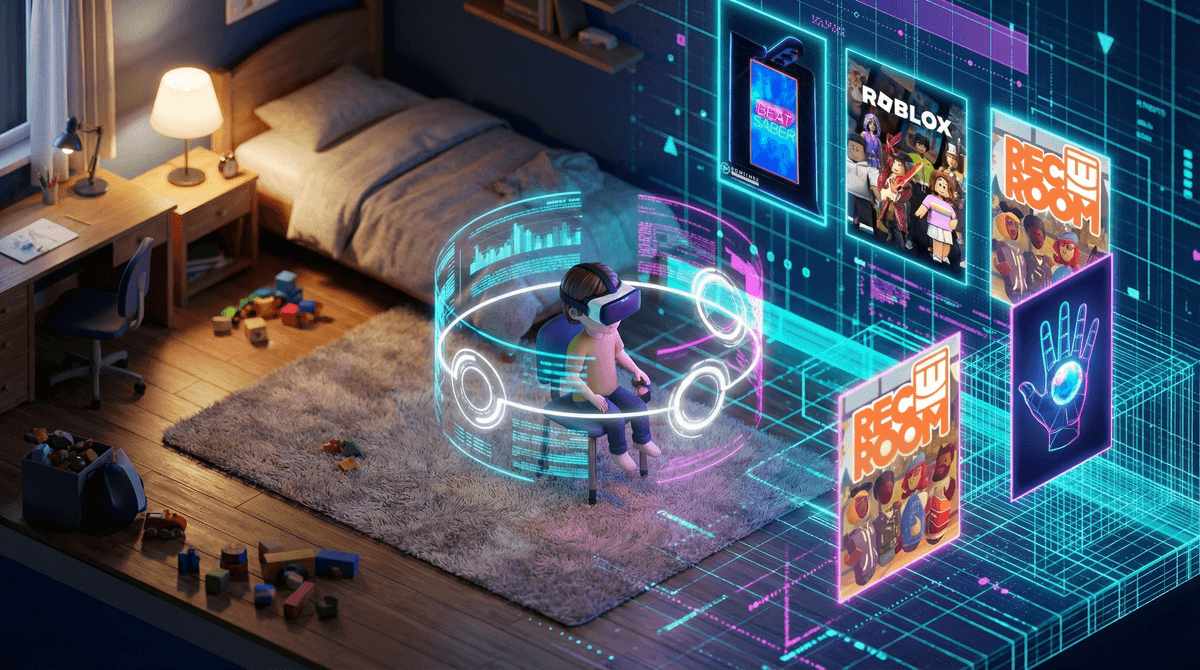
Here's the thing about VR that most parents don't realize: when your kid puts on a Meta Quest or PlayStation VR headset, they're not just playing a game. They're creating a detailed biometric profile of themselves that makes their TikTok data look quaint.
We're talking about tracking that goes way beyond "what did they search for" or "how long did they watch." VR headsets collect:
- Eye tracking data (where you look, how long, pupil dilation)
- Movement patterns (how you walk, gesture, reach, your exact height)
- Voice recordings (everything said in-game, often without obvious recording indicators)
- Room mapping (the physical layout of your home)
- Biometric identifiers (interpupillary distance, hand size, reaction times)
- Emotional responses (derived from how you move, look, and react)
This isn't science fiction. This is what current VR headsets are capable of collecting right now. And unlike a phone that sits in your pocket, VR is literally strapped to your face, tracking your physical body in 3D space.
Look, I get it. We're all exhausted by privacy warnings. Every app wants to track everything, and at some point you just click "accept" because you need to order pizza.
But VR is different for three reasons:
1. The data is uniquely identifying
Your movement patterns are as unique as your fingerprint. Researchers have shown they can identify individuals with over 95% accuracy just from how they move in VR. Your kid can't change their gait the way they might change a password.
2. Kids don't understand what's being collected
When my nephew plays Beat Saber, he thinks he's just slicing blocks. He has no concept that his physical movements, reaction times, and spatial reasoning patterns are being logged. The data collection is invisible in a way that feels more invasive than a camera you can see.
3. We don't know how this data will be used
This is the first generation creating this type of data at scale. Will movement patterns be sold to insurance companies? Will eye-tracking data inform manipulative advertising? Will emotional response data be used for who-knows-what in 10 years? We genuinely don't know, and that should concern us.
Let's get specific about the major players:
Meta Quest (Quest 2, Quest 3, Quest Pro)
Meta is, unsurprisingly, the most aggressive here. They collect everything listed above and explicitly state they use it for advertising purposes. They track:
- What you look at in VR environments
- How long you play different games
- Your physical movements and room setup
- Voice data (even when you think you're not recording)
- Social interactions in VR spaces
And here's the kicker: even if your kid has a "teen account" with restricted features, Meta is still collecting this data. They just claim they won't use it for ad targeting until the user turns 18. (Cool, so they're just... holding onto it?)
PlayStation VR2
Sony is somewhat better here, but only somewhat. They collect movement and eye-tracking data but claim it stays on-device for gameplay purposes. However, their privacy policy leaves room for "product improvement" which is code for "we might use this however we want."
Apple Vision Pro
Apple's privacy approach is genuinely better—they do more on-device processing and collect less identifiable data. But the Vision Pro costs $3,500, so this isn't exactly the kid-friendly option most families are considering.
Here's where it gets even more complicated: platforms like Roblox VR, VRChat, and Rec Room add another layer of privacy concerns.
In these social spaces, your kid isn't just sharing data with the company—they're in virtual rooms with strangers who can:
- Record their voice
- Observe their movements and behavior
- Screenshot or record their avatar and interactions
- Potentially use this information to identify or locate them
The safety considerations around Roblox are already complex, but VR adds physical presence to the equation. Kids report feeling genuinely uncomfortable when strangers get too close to their avatar or make inappropriate gestures—because VR tricks your brain into feeling like these interactions are real.
Under 10: Just Don't
Most VR manufacturers say 13+ for a reason (and it's not just about the developing eyes thing, though that's real too). The privacy implications for younger kids who can't possibly understand what's being collected are too significant.
Ages 10-12: Supervised Only
If you're going to allow VR in this age range:
- Stay in the room during play
- Use only offline, single-player games
- Create accounts with minimal real information
- Turn off voice chat entirely
- Don't connect the headset to social media accounts
Ages 13-15: With Clear Boundaries
- Have explicit conversations about what data is being collected (ask our chatbot for conversation starters
 )
) - Review privacy settings together
- Disable optional data collection (eye tracking for ads, etc.)
- Set time limits (both for health and data minimization)
- Keep social VR interactions to friends-only spaces
Ages 16+: Informed Consent
At this point, treat them like the almost-adults they are. Make sure they understand what's being collected and why it matters, then let them make informed choices.
If you already have a VR headset:
-
Review your privacy settings now. On Meta Quest: Settings > Privacy > check every single toggle. Turn off ad tracking, voice storage, and automatic data sharing.
-
Create a separate account. Don't link VR to your kid's main Facebook/Meta account if you can avoid it. Use a dedicated email with minimal personal info.
-
Disable voice storage. In Meta Quest settings, you can prevent voice recordings from being stored. Do this.
-
Turn off room mapping uploads. Your headset needs to map your room to work, but it doesn't need to upload that map to the cloud.
-
Use App Privacy settings. Review what each VR app has access to and revoke permissions that aren't essential.
If you're considering buying VR:
- Understand this is a privacy tradeoff, not a privacy-neutral choice
- Read the actual privacy policy (I know, I know—but seriously)
- Consider waiting if your kid is under 13
- Budget for games that don't require online accounts or social features
- Compare the privacy policies of different headsets
VR is genuinely cool technology. Games like Walkabout Mini Golf and Beat Saber are legitimately fun family experiences. But we need to go into this with eyes open (pun intended) about what we're trading for that experience.
The data being collected is more intimate and identifying than anything we've dealt with before as parents. And unlike social media where we can teach kids to be careful about what they post, VR data collection is passive and invisible.
This doesn't mean "never allow VR." It means be intentional. Understand what you're signing up for, minimize data collection where possible, and have real conversations with your kids about why this matters.
Because here's the truth: your kid's movement patterns, eye tracking data, and biometric information are being collected and stored. The question isn't whether that's happening—it's whether you're making that tradeoff deliberately or by default.
Want help navigating your family's specific VR situation? Screenwise can help you understand the privacy implications of specific games and headsets, create age-appropriate guidelines, and have productive conversations with your kids about digital privacy. Start with our quick survey to get personalized recommendations for your family.