

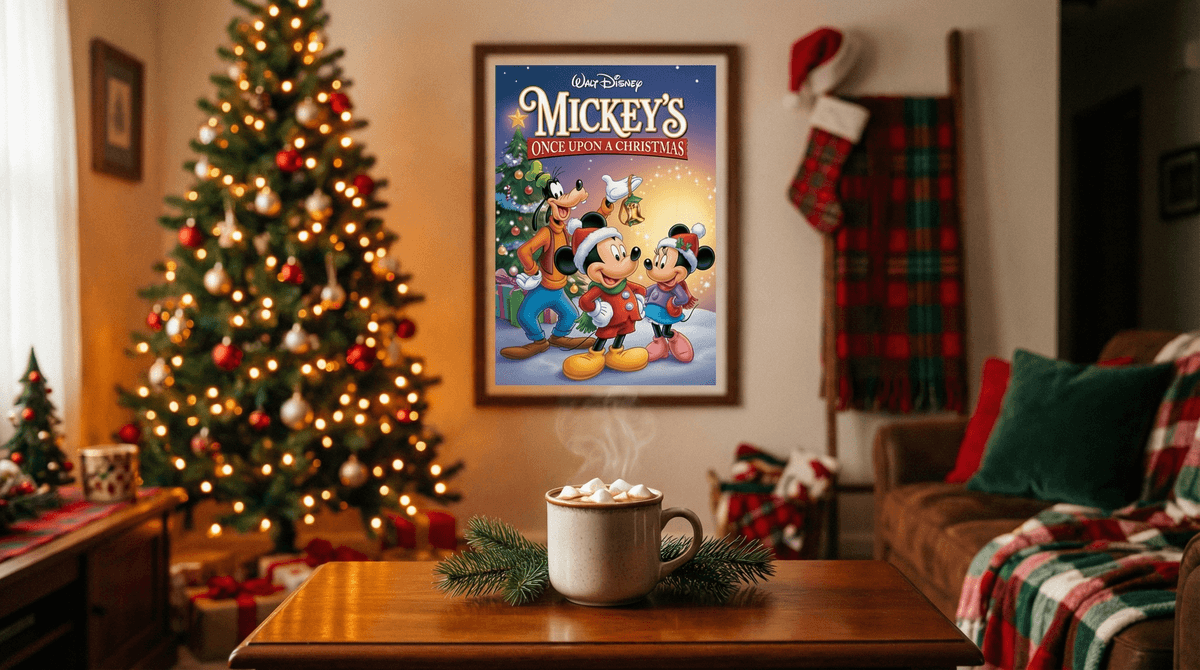
Mickey's Once Upon a Christmas: Holiday Lessons in Gratitude, Belief, and Selfless Love
TL;DR: This 1999 Disney anthology isn't just nostalgic comfort viewing—it's three surprisingly meaty stories about greed vs. gratitude, the commercialization of Christmas, and what real sacrifice looks like. Perfect for ages 4-10, and honestly? The themes hit harder as an adult than they did when we were kids.
Watch it on: Disney+
Mickey's Once Upon a Christmas is a direct-to-video anthology featuring three separate Christmas stories, each about 20 minutes long. You've got Donald Duck's nephews wishing every day was Christmas (spoiler: careful what you wish for), Goofy and Max navigating belief in Santa, and Mickey and Minnie doing a whole Gift of the Magi situation with their Christmas bonuses.
The animation style is classic—not the fancy CGI stuff, just good old-fashioned 2D animation that feels like Saturday morning cartoons. Runtime is just over an hour, making it perfect for that post-dinner, pre-bedtime window when you need something wholesome but not boring.
Here's what's wild: this movie could have been pure fluff. Disney churned out a lot of direct-to-video content in the late 90s and early 2000s, and not all of it was... great. But Mickey's Once Upon a Christmas actually has something to say.
Each story tackles a real tension kids (and let's be honest, adults) face during the holidays:
- When does wanting more become greed?
- How do we balance childhood magic with growing up?
- What does it mean to give sacrificially?
These aren't abstract Sunday school lessons—they're embedded in stories with real consequences. Huey, Dewey, and Louie don't just learn that greed is bad; they experience the soul-crushing monotony of getting exactly what they thought they wanted. Max doesn't just "believe in Santa"—he learns that sometimes protecting someone else's joy matters more than being right.
"Donald Duck: Stuck on Christmas"
The setup: Donald's three nephews wish that every day could be Christmas. A magical wishing star grants their wish, and they wake up to the same Christmas day over and over again (yes, it's basically Groundhog Day for kids).
Why it works: This segment is the strongest of the three, and it's because the consequences are real. At first, the nephews are thrilled—unlimited presents, unlimited pie, unlimited everything. But by day three or four, they're miserable. The toys pile up meaninglessly. Uncle Donald's excitement turns mechanical. Christmas music becomes torture.
The lesson: Gratitude requires scarcity. When you have everything all the time, nothing matters. This is such a relevant conversation starter for kids growing up in a world of infinite content, instant delivery, and year-round access to basically everything. Talk to your kids about delayed gratification using this story as a jumping-off point.
Age consideration: This one can actually be a little intense for sensitive kids under 5—there's a moment where the nephews genuinely despair, and Donald gets pretty frustrated. But for ages 6+, it's gold.
"A Very Goofy Christmas"
The setup: Max is getting older and starting to doubt Santa's existence. Goofy, desperate to preserve his son's childhood wonder, goes to increasingly absurd lengths to "prove" Santa is real, ultimately dressing up as Santa himself.
Why it works: This story does something smart—it doesn't actually resolve whether Santa is real or not. Instead, it focuses on Max's realization that his dad's belief (and his dad's desperate desire to protect Max's belief) is more important than being "right" about Santa.
The lesson: Belief isn't always about facts—sometimes it's about preserving wonder and protecting the people we love. This is a surprisingly mature take for a kids' movie. Max chooses to believe not because he's convinced Santa exists, but because he sees what his belief means to his dad.
Conversation starter: This is a great one if you're navigating the "is Santa real?" question in your house. The story gives you permission to say, "The magic of Christmas is real, even if the logistics are complicated." It also opens up conversations about how we balance truth-telling with preserving childhood magic.
Age consideration: Best for ages 6-10, when kids are in that liminal space between full belief and skepticism.
"Mickey & Minnie's Gift of the Magi"
The setup: Mickey and Minnie each want to buy the other the perfect Christmas gift, but they're broke. Mickey sells his harmonica to buy Minnie a chain for her watch; Minnie sells her watch to buy Mickey a harmonica case. Classic O. Henry.
Why it works: It's the simplest story of the three, but it's also the most emotionally direct. There's something about watching Mickey sadly play his harmonica one last time before selling it that just gets you.
The lesson: Real love is sacrificial. The best gifts aren't about getting the perfect thing—they're about giving up something that matters to you for someone else's joy. In a culture where Christmas has become increasingly transactional (wish lists, Amazon carts, exact specifications), this story is a quiet rebellion.
Conversation starter: Ask your kids, "What's something you have that you'd be willing to give up to make someone else happy?" or "When has someone given up something important for you?" This can lead to surprisingly deep conversations about gratitude and generosity.
Age consideration: Even 4-year-olds can grasp the basic emotional arc here, though the deeper themes land better around ages 7+.
Content-wise, it's squeaky clean: No scary moments, no inappropriate humor, nothing that'll come back to haunt you at bedtime. The biggest "scare" is probably the nephews' existential dread during the endless Christmas loop, which is more sad than scary.
Runtime is perfect: At just over an hour, you can watch the whole thing without a major time commitment, or you can watch one story at a time across three nights. Each segment is self-contained.
It's genuinely funny: Goofy's physical comedy holds up. Donald's frustration is peak Donald. There are jokes for adults scattered throughout (mostly in the Goofy segment) that don't feel forced.
The music is... fine: Not as iconic as other Disney Christmas specials, but not annoying either. "Jingle Bells" gets a workout.
Nostalgia factor is high: If you watched this as a kid in the late 90s or early 2000s, prepare for feelings. The animation style, the pacing, the whole vibe—it's a time capsule.
Before watching: Set up the themes. "We're going to watch three stories about what Christmas really means. See if you can figure out what each character learns."
During watching: Pause between segments (especially after "Stuck on Christmas") and ask, "What do you think they learned?" Let your kids articulate the lessons before moving on.
After watching:
- For younger kids (4-7): "Which story was your favorite? Why?"
- For older kids (8-10): "Have you ever wanted something so badly that you forgot to be grateful for what you already have?" or "When have you had to choose between being right and being kind?"
Extended activity: If you're feeling ambitious, do a family "Gift of the Magi" exchange where everyone makes or gives something that required real sacrifice (time, effort, giving up something else). It doesn't have to be expensive—it just has to cost something.
Ages 4-5: They'll enjoy the slapstick and the bright animation. The deeper themes will go over their heads, but that's fine. Focus on the basic "be grateful" and "be kind" messages.
Ages 6-8: This is the sweet spot. They're old enough to grasp the consequences in "Stuck on Christmas" and young enough to still be navigating the Santa question in "A Very Goofy Christmas."
Ages 9-10: They might think they're "too old" for this, but if you can get them to watch, the themes actually resonate more at this age. They're starting to understand sacrifice, delayed gratification, and the tension between childhood magic and growing up.
Ages 11+: Probably not going to choose this on their own, but it works as a nostalgic family tradition or a "let's watch something the whole family can agree on" compromise.
Mickey's Once Upon a Christmas isn't going to change your life, but it might change your kids' perspective on what Christmas is actually about. In a media landscape full of high-octane everything, there's something refreshing about a movie that trusts its audience to sit with genuine emotion and learn real lessons.
It's the kind of movie that sneaks up on you. You think you're just watching Mickey Mouse, and then suddenly you're having a conversation about whether wanting more is the same as being greedy, or what it means to believe in something you can't prove, or why giving up something you love for someone else is the whole point.
Watch it on Disney+, ideally with hot chocolate and minimal distractions. And if you find yourself getting a little misty during the Mickey and Minnie segment? Yeah, that's normal.
- Want more holiday content with actual substance? Check out our guide to Christmas movies that teach real values.
- Navigating the Santa question? Here's how to talk about Santa without lying or crushing dreams.
- Looking for more classic Disney that holds up? Try The Tigger Movie (seriously underrated) or A Goofy Movie (a masterpiece about father-son relationships).