

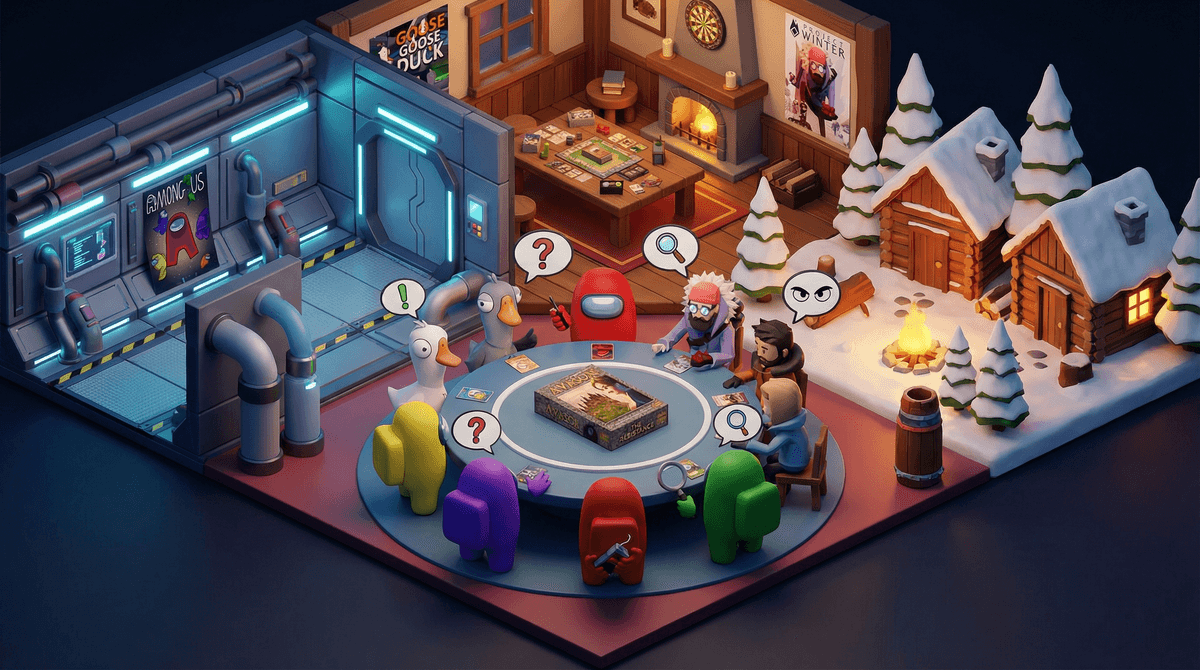
The Ultimate Guide to the Best Impostor Games for Kids
Impostor games—where players work together to find hidden traitors—are wildly popular with kids right now. Here are the best ones:
Best Overall: Among Us (Ages 9+) Best for Younger Kids: Goose Goose Duck (Ages 8+) Best for Tweens/Teens: Project Winter (Ages 12+) Best Physical Alternative: The Resistance (Ages 10+) Best for Families: Dodo Peak's Party Mode (Ages 6+)
Social deduction games teach critical thinking, reading social cues, and strategic lying (yes, really—it's actually a useful skill). But they also come with chat features and accusations that can get heated. Here's everything you need to know.
Impostor games are a digital evolution of classic party games like Mafia and Werewolf. The setup: most players are "crewmates" trying to complete tasks or survive, while one or more players are secretly "impostors" trying to sabotage the group and eliminate players without getting caught.
The crux of the game is discussion rounds where everyone debates who the impostor is, presents evidence, defends themselves, and votes someone out. Get it right, and you're one step closer to winning. Get it wrong, and you just eliminated an innocent player.
Among Us absolutely exploded during the pandemic—by late 2020, it had 500 million monthly players. Even though the initial hype has cooled, the genre is still hugely popular with elementary through high school kids. About 60% of kids ages 9-14 have played at least one impostor game.
The social drama is intoxicating. There's something thrilling about lying convincingly to your friends, or piecing together clues to catch someone in a lie. Kids are naturally drawn to games that let them test social boundaries in a safe, contained environment.
They feel mature. Unlike games where you're just shooting or jumping, impostor games require persuasion, deduction, and reading people. Kids feel smart and sophisticated when they successfully deceive others or crack a case.
Every round is different. The randomness of who gets assigned impostor, combined with player behavior, means no two games are alike. This unpredictability keeps kids coming back.
They're inherently social. These games require communication—whether through text chat, voice chat, or in-person discussion. In an era where kids spend a lot of time gaming alone, impostor games bring back that playground feeling of playing with friends.
Ages 9+ | Available on: PC, Mobile, Nintendo Switch, PlayStation, Xbox
This is the one that started the current craze. Players are crewmates on a spaceship trying to complete simple tasks (swipe a card, empty garbage) while 1-3 impostors try to kill everyone without getting caught. When a body is discovered, players discuss and vote on who to eject.
What makes it great: The tasks are simple enough for younger kids to understand, the cartoon violence is minimal (players just disappear), and rounds are quick (10-15 minutes). The game works with text chat only, so you can avoid voice chat toxicity.
Parent concerns: The chat can get heated during accusations. Kids can be mean when they're trying to convince others someone is lying. Also, public lobbies with strangers are a mixed bag—you'll encounter inappropriate usernames, spam, and occasional crude language. Solution: Set up private games with friends only, or use the game's quick chat feature that limits communication to pre-set phrases.
Teaching moment: This is actually a great opportunity to talk about how we disagree respectfully, how to present evidence vs. just accusing, and how to handle being falsely accused.
Ages 8+ | Available on: PC, Mobile
Think Among Us but with geese instead of astronauts, and more role variety. Some geese might be detectives with special abilities, others might be neutral parties with their own win conditions. The added complexity makes it more interesting for kids who've mastered Among Us.
What makes it great: The silly goose theme feels less intense than Among Us's space setting. The free-to-play model with cosmetic purchases only means kids can fully enjoy it without spending money. Built-in voice chat proximity (you can only hear players near you) adds a fun dynamic.
Parent concerns: Voice chat with strangers is the big one. The game has reporting features, but you're still dealing with random people online. Again, private lobbies with friends are the way to go.
Ages 12+ | Available on: PC, Xbox, PlayStation
This is Among Us for older kids who want higher stakes. Players are stranded in a frozen wilderness and must gather resources to repair objectives and escape. But some players are secretly traitors trying to prevent escape and eliminate survivors. There's crafting, combat, and survival elements layered on top of the social deduction.
What makes it great: The survival mechanics add real tension and complexity. Voice chat is proximity-based, so you can have private conversations away from the group (perfect for coordinating as traitors). Games last 20-30 minutes, making them feel more substantial.
Parent concerns: This one can get intense. The violence is more explicit (though still stylized), and the stakes feel higher. Voice chat with teens can get toxic fast—lots of yelling, accusations, and sometimes genuine anger when someone gets betrayed. Best for mature tweens and teens who can handle the social pressure and separate game drama from real relationships.
Ages 10+ | Available on: PC
Set in a medieval village, players are either villagers trying to identify and eliminate conspirators, or conspirators trying to take over the town. It plays out over day/night cycles—during the day, everyone discusses and votes; at night, conspirators can eliminate villagers while others use special abilities.
What makes it great: The medieval setting is appealing to kids who love fantasy. The day/night cycle creates natural rhythm and strategy. Smaller player count (4-12) makes it more intimate than Among Us's chaos.
Parent concerns: Less popular than Among Us, so finding public games can be harder (another reason to stick with friend groups). Voice chat is expected, not optional.
Ages 6+ | Available on: PC, Mobile, Nintendo Switch
This is the most family-friendly option on the list. Dodo Peak is primarily a puzzle platformer, but its party mode includes an impostor-style game where players are dodos trying to complete tasks while one player is secretly trying to sabotage. It's Among Us lite, designed for younger kids.
What makes it great: Bright, colorful, non-threatening. No chat required—you can play locally on the couch or use voice chat with people you know. Perfect for introducing younger kids (6-8) to the concept without the social complexity.
Parent concerns: Honestly, very few. This is about as safe as impostor games get.
If you want the impostor experience without screens, these board games deliver:
Ages 10+ | 5-10 players
Players are resistance fighters trying to complete missions, but some are secretly spies trying to sabotage. Pure social deduction with no player elimination—everyone stays in the game the whole time. Games last 30 minutes.
Ages 13+ | 5-10 players
Despite the provocative name (which will definitely get your teen's attention), this is a brilliant social deduction game set in 1930s Germany. Players are secretly divided into liberals and fascists, with one player secretly Hitler. The goal is to either pass liberal policies or identify and assassinate Hitler.
Note: The theme is obviously heavy and requires some historical context. But if your teen is studying this era in school, it actually prompts really good discussions about how democracies fail and how fascism takes hold. Not for everyone, but incredibly well-designed.
Ages 8+ | 3-10 players
The classic werewolf game compressed into a single round that lasts 10 minutes. Perfect for short attention spans or when you want to play multiple rounds. Everyone closes their eyes at night while different roles take secret actions, then you discuss and vote on who to eliminate.
There's a free app that narrates the night phase, which makes it easy to run without a moderator.
Ages 6-8: Stick with Dodo Peak or simple physical games like One Night Ultimate Werewolf played with family. Kids this age are still developing the social cognition needed for complex deception and can take accusations personally.
Ages 9-11: Among Us with friends only, using quick chat or supervised voice chat. Goose Goose Duck works too. Physical games like The Resistance are great for this age.
Ages 12-14: All of the above, plus Project Winter if they can handle the intensity. Voice chat with friends is generally fine, though you'll want to check in about how discussions are going.
Ages 15+: Pretty much anything goes, though you'll still want to talk about online interactions and what to do if things get toxic.
The Lying Thing
Yes, these games require lying and deception. Some parents are uncomfortable with this. Here's the thing: strategic deception in a game context is actually a valuable skill. It teaches kids to:
- Think from others' perspectives
- Construct convincing arguments
- Read body language and verbal cues
- Distinguish between game behavior and real-life ethics
The key is making sure kids understand the boundary. Lying to win Among Us is part of the game. Lying to your parents about finishing homework is not. Most kids naturally understand this distinction by age 9 or so, but it's worth discussing explicitly.
Learn more about teaching kids about strategic deception vs. lying
The Social Drama
Impostor games can create real tension. Getting falsely accused feels bad. Successfully deceiving your friends can create genuine hurt feelings. Some kids handle this easily; others take it personally.
Watch for: Kids who seem genuinely upset after games, friend groups that start having real-world conflicts stemming from in-game accusations, or kids who are always getting voted out first (which might indicate social dynamics worth exploring).
Solutions: Play together as a family first so you can model good sportsmanship. Debrief after games—"that was a good lie you told" or "I was so convinced you were innocent!" helps reinforce that it's all part of the game. If friend group drama emerges, it might be time for a break or a conversation about keeping game dynamics in the game.
Chat Safety
Most impostor games involve communication with other players. Here's the hierarchy of safety:
- Couch co-op or local play: Safest option, everyone's in the same room
- Private voice chat with known friends: Using Discord or console party chat with kids they know IRL
- Private text chat with known friends: In-game text chat limited to friend group
- Public games with quick chat only: Pre-set phrases, no free-form communication
- Public games with text chat: Higher risk of inappropriate language, spam
- Public games with voice chat: Highest risk—you're dealing with random strangers
For kids under 13, stick with options 1-4. For teens, you can venture into public games but talk about muting toxic players, reporting inappropriate behavior, and leaving games that feel uncomfortable.
Screen Time Considerations
Impostor games are intensely social, which is generally a positive. But they're also designed to be played in rounds, and "just one more game" is a powerful pull. A typical Among Us round is 10-15 minutes, but kids rarely play just one.
Strategy: Set clear boundaries—"you can play three rounds" or "you can play until 5pm"—rather than open-ended sessions. The round-based structure actually makes this easier than games like Minecraft or Roblox where there's no natural stopping point.
Impostor games are genuinely fun, and they teach valuable skills: critical thinking, persuasion, reading social cues, and strategic planning. The concerns—chat safety, social drama, and the lying component—are manageable with the right setup and conversations.
Start here:
- Play Among Us together as a family with quick chat only
- If that goes well, set up private games with your kid's friends
- Talk explicitly about game deception vs. real-life honesty
- Check in regularly about how interactions feel—fun or stressful?
- Consider physical alternatives like The Resistance for screen-free options
Most kids ages 9+ can handle these games just fine with appropriate supervision and setup. And honestly? They're pretty fun for adults too. Don't be surprised if you find yourself genuinely invested in convincing everyone you're not the impostor.