

Action Replay Cheat Devices: When Your Kid Wants God Mode
TL;DR: Action Replay and similar cheat devices (GameShark, CodeBreaker) let kids modify game code to unlock infinite health, max money, or skip grinding. They're mostly legacy tech for older consoles (DS, PSP, PS2), but the desire for shortcuts lives on through modern game trainers, mod menus, and cheat codes. The real questions: Does this ruin the learning experience? Will it get them banned online? And how do you talk about the difference between single-player fun and multiplayer cheating?
Quick Navigation:
- Modern games with built-in cheat modes: The Sims 4, Minecraft, Stardew Valley
- Games that reward mastery without grinding: Hades, Celeste
- Understanding game design and difficulty curves

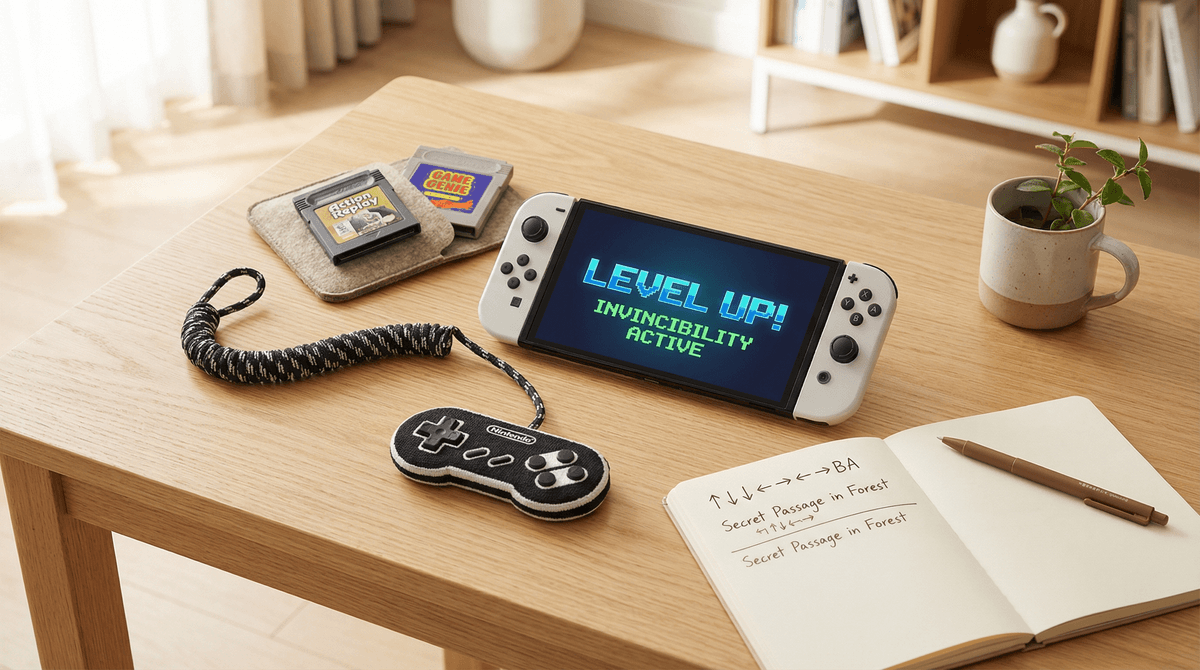
Action Replay is a physical cheat device that plugs between your game cartridge/disc and console, intercepting and modifying game code in real-time. Pop in your Pokémon Diamond cartridge, select "999 Rare Candies" from the Action Replay menu, and boom—instant level 100 Charizard.
These devices peaked during the DS/PSP/PS2 era (2000s-early 2010s) when games were offline, codes were shared on forums, and there was no risk of account bans. Similar devices included GameShark, CodeBreaker, and Game Genie (the OG from the 90s).
The modern equivalent? PC game trainers, console debug menus accessed through exploits, and mod menus in games like Grand Theft Auto V or Roblox. The spirit of "I want infinite money and I want it now" never died—it just evolved.
Let's be honest: grinding is boring.
Your 10-year-old doesn't want to spend 40 hours farming Pokédollars to buy that Master Ball. They want to experience the cool parts of the game—catching legendaries, building the dream team, battling friends—without the tedious resource management.
Sometimes this is totally reasonable:
- They're replaying a game they've already beaten and just want to mess around
- The game has artificial difficulty designed to sell microtransactions (looking at you, mobile games)
- They're stuck on one impossible boss and losing interest in an otherwise great story
- They want to be creative rather than completionist (building in Minecraft creative mode vs. survival)
Other times, it's about instant gratification in a culture that increasingly offers it. Why work for something when you can just unlock it?
1. Accessibility and Learning Differences
Some kids have motor skill challenges, attention issues, or processing speed differences that make "normal" difficulty genuinely frustrating rather than fun. Cheats can level the playing field so they experience the story, creativity, or social aspects without hitting a skill wall.
Games like Celeste build this in with "Assist Mode"—infinite stamina, invincibility, adjustable game speed. It's not cheating; it's inclusive design.
2. Creative Sandbox Play
Using cheats to unlock all building materials in The Sims 4 or spawn rare items in Stardew Valley can transform a game from "achievement checklist" to "creative playground." Some kids are architects, not adventurers.
3. Reverse-Engineering and Curiosity
Older kids who dig into how Action Replay codes work—understanding memory addresses, hexadecimal values, game architecture—are actually learning foundational programming and systems thinking. The modding community has launched countless careers in game development and software engineering.
4. Single-Player Games Are Yours to Break
If your kid wants to play The Legend of Zelda: Breath of the Wild with infinite hearts and stamina, who cares? It's their experience. No one else is affected. Games should be fun, not homework.
1. Skipping the Learning
Games are designed with difficulty curves that teach skills incrementally. When you skip the grind, you often skip the mastery. That satisfaction of finally beating a tough boss after 20 tries? That's where resilience, problem-solving, and delayed gratification live.
Research on flow states in gaming shows that challenge matched to skill level is what makes games engaging long-term. Too easy = boring. Cheats can accidentally suck the fun out.
2. Multiplayer = Cheating = Bans
Using cheat devices or trainers in online games like Fortnite, Roblox, or Call of Duty will get your kid's account permanently banned. No appeals, no second chances. Their $200 worth of skins? Gone.
Worse, it ruins the experience for other players. This is where cheating crosses from "personal choice" to "being a jerk." Understanding online ethics is critical here.
3. The Instant Gratification Trap
If every challenge can be bypassed with a code, what happens when they face a real-world problem that can't be cheated? School projects, sports, relationships—these require persistence through difficulty.
There's a balance between "games should be fun" and "games can teach valuable lessons about effort and reward."
4. Breaking the Game's Narrative
Some games are about scarcity and tough choices. Using cheats in The Last of Us to get infinite ammo fundamentally changes the survival horror experience the designers intended. You're not playing the game anymore—you're playing a different, possibly worse, version.
Ages 6-9: Built-In Accessibility Features
At this age, "cheats" should really be accessibility settings. Look for games with:
- Adjustable difficulty (Mario Kart 8 has auto-accelerate and steering assist)
- Creative modes (Minecraft Creative Mode is perfect)
- Invincibility options (Kirby games often include helper modes)
Ages 10-13: Single-Player Experiments Welcome
This is a great age to explore classic cheat codes in single-player games. Let them experience the difference between:
- Playing Pokémon "normally" and building a team through training
- Using Action Replay to instantly get level 100 shinies
Talk about why they want to cheat. Is the game too hard? Too slow? Are they bored with the story but love the mechanics? This reveals what they actually enjoy about gaming.
Make it clear: Online games = no cheats, ever. Explain permanent bans and the impact on other players.
Ages 14+: Modding, Ethics, and Consequences
Older teens can handle nuanced conversations about:
- The difference between accessibility features, single-player cheats, and multiplayer exploits
- How modding communities work and the ethics of using others' code
- Why companies ban cheaters and the real-world consequences (lost accounts, legal issues in extreme cases)
If they're interested in how cheats work, channel that into learning about game design or programming. Tools like Cheat Engine for PC games can be educational if used responsibly on single-player games.
Action Replay for Modern Consoles Is Basically Dead
The Nintendo Switch, PS5, and Xbox Series X have security measures that make traditional cheat devices nearly impossible. Action Replay still sells products for older systems (3DS, DS), but they're increasingly niche.
The Real Risk Is Online Exploits
Your kid is way more likely to encounter cheat menus in Roblox or "aimbot" hacks in Fortnite than to use a physical cheat device. These are:
- Often scams that steal account info
- Guaranteed to result in bans
- Sometimes illegal (violating terms of service can have legal consequences for distributing cheats)
Many Games Have Official Cheat Codes Built In
Before you buy a third-party device, check if the game has:
- Console commands (Skyrim, Fallout)
- Debug menus (often accessible through button combinations)
- New Game Plus modes that let you replay with maxed stats
- Sandbox/creative modes (The Sims 4, Cities: Skylines)
Instead of: "Cheating is wrong and ruins games."
Try: "Let's figure out why you want to skip this part. Is the game not fun anymore? Is this section too hard? Or do you just want to see what happens next?"
If they're stuck on difficulty:
- Suggest looking up walkthroughs or strategy guides together
- Check if the game has difficulty settings they haven't tried
- Watch a speedrun or playthrough to see how others solved it
- Consider if this game is just not the right fit right now
If they want to cheat in online games: "I get that it seems fun to have infinite V-Bucks or aimbot in Fortnite, but here's what actually happens: your account gets banned permanently, you lose everything you've bought or earned, and you ruin the game for other kids who are trying to play fairly. Plus, a lot of those 'free cheats' sites are scams trying to steal your login info. Not worth it."
If they want to experiment in single-player: "Go for it! But let's try playing it the normal way first so you can see the difference. Sometimes the challenge is what makes it satisfying."
Games That Respect Your Time:
- Hades - You get stronger with each run; failure is progress
- Stardew Valley - Cozy, no-pressure farming with optional challenges
- Splatoon 3 - Skill-based but matches are only 3 minutes
- Animal Crossing: New Horizons - Literally no way to "lose"
Games With Great Accessibility Options:
- Celeste - Assist Mode for all skill levels
- Spider-Man (PS4/PS5) - Tons of difficulty and accessibility toggles
- Forza Horizon 5 - Rewind feature, adjustable assists
If They Like the Idea of Modding:
Action Replay and similar devices are mostly relics of a pre-online gaming era, but the desire for shortcuts is eternal. The question isn't really "should kids cheat at games?"—it's "what are they trying to get out of this experience, and is cheating helping or hurting that goal?"
Green lights: ✅ Single-player games where they've already experienced the story ✅ Creative/sandbox modes in building games ✅ Accessibility features that make games playable for different abilities ✅ Learning how cheats work from a programming/modding perspective
Red lights: ❌ Any online multiplayer game, ever ❌ Skipping all challenge before they've tried to master it ❌ Third-party "free cheats" sites (they're scams) ❌ Using cheats because they're bored but then complaining the game is boring
Talk to your kid about why they want to cheat. If it's because the game is genuinely unfun or inaccessible, help them find a better game. If it's because they want instant results without effort, that's a bigger conversation about persistence and delayed gratification.
And if they just want to see what happens when you give yourself 999 Master Balls in Pokémon? Let them find out. Sometimes the best lesson is discovering that infinite resources makes the game boring.
- Check if their favorite games have built-in cheat codes or creative modes
- Set clear rules: single-player experiments = okay, online cheating = account loss
- If they're interested in how games work, explore game design resources
- Look for games that match their actual interests—maybe they'd rather build than battle
- Talk about online ethics and fair play before they encounter "free hacks" videos on YouTube
Need help finding games that are challenging but not grindy? Ask about games that respect your time. Want to understand why your kid is obsessed with grinding in Roblox? Let's dig into that.