

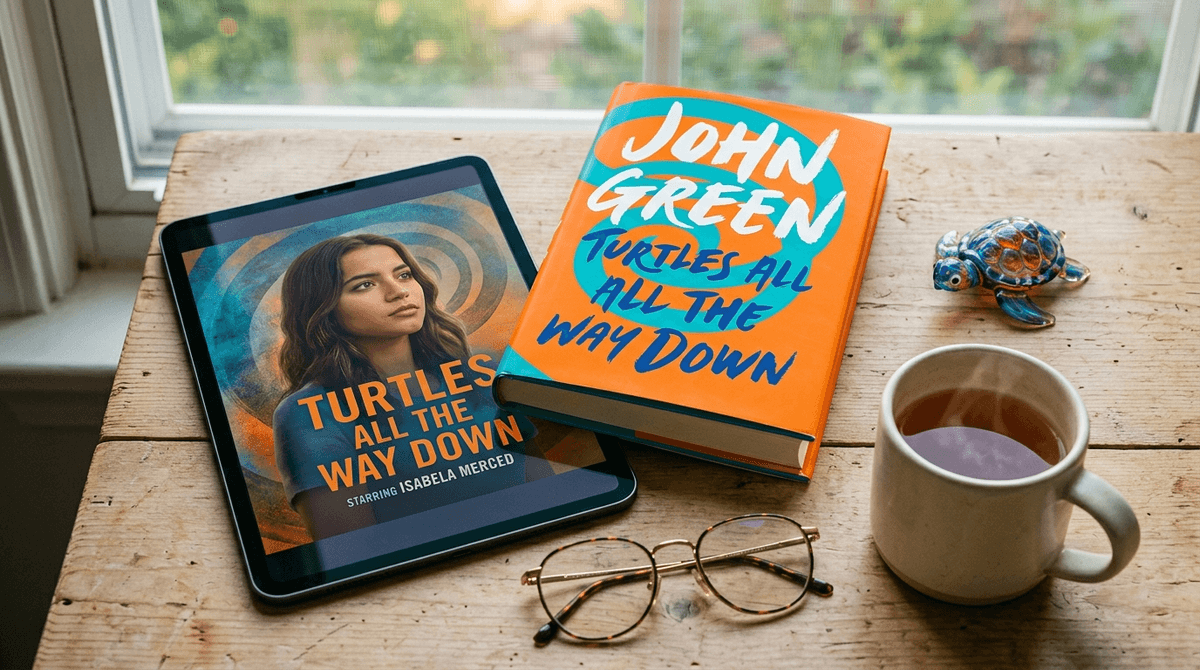
TL;DR: Turtles All the Way Down by John Green is a raw, non-glamorized look at living with Obsessive-Compulsive Disorder (OCD) and "thought spirals." Whether your teen is reading the book or watching the 2024 movie adaptation, it’s a high-quality conversation starter about mental health that avoids the "brain rot" of typical teen dramas. Best for ages 13+.
If you’ve been hanging out in the YA (Young Adult) section of a bookstore or scrolling through Max (formerly HBO Max) lately, you’ve likely seen the title Turtles All the Way Down. If your first thought was, "Is this a sequel to Finding Nemo?" or "Is this some weird new TikTok meme like 'Ohio' or 'Skibidi'?"—don't worry. It’s actually one of the most significant pieces of media regarding teen mental health to come out in the last decade.
Written by John Green—the guy who made us all sob with The Fault in Our Stars—this story is deeply personal. Green has been open about his own struggles with OCD, and this book is his attempt to explain what it actually feels like to be trapped inside your own head. With the movie adaptation hitting screens in 2024, a whole new generation of kids is discovering Aza Holmes and her "thought spirals."
The story follows 16-year-old Aza Holmes. On the surface, there’s a bit of a mystery plot: a billionaire goes missing, and Aza and her fearless best friend Daisy decide to investigate for the reward money. But the mystery is really just a backdrop.
The real story is about Aza’s brain. She lives with a severe form of OCD that manifests as a fear of microbes and C. diff (a nasty bacteria). She isn't "quirky" or "neat"—she is often paralyzed by intrusive thoughts that she can’t escape. The title comes from an old anecdote about the world resting on the back of a turtle, which rests on another turtle, and so on—it’s "turtles all the way down." For Aza, that’s what her thoughts are like: an infinite loop with no bottom.
We are living in an era of "anxiety culture." Our kids are bombarded with curated perfection on Instagram and TikTok, while also dealing with the very real pressures of school, climate change, and the general chaos of being a teenager in 2026.
Most teen media handles mental health in one of two ways: they either make it look "beautiful" (think: sad girls in flowy dresses looking out windows) or they make it the "villain" of the story. Turtles All the Way Down does neither. It’s messy. It’s frustrating. It shows how mental illness can make you a "bad" friend sometimes because you’re too stuck in your own head to listen.
For parents, this is a gift. It gives us a vocabulary to talk about "spiraling" without it feeling like a therapy session.

Usually, when a beloved book becomes a movie, fans get worried. But the Turtles All the Way Down movie is actually a rare win. It stars Isabela Merced, and it does a fantastic job of using visuals and sound design to show the audience what a "thought spiral" feels like.
Unlike some other teen movies that feel like they were written by an AI trying to sound "hip," the dialogue here feels real. It doesn't pander. It also doesn't shy away from the reality of medication—showing that while meds aren't a "magic pill" that fixes everything, they are a vital tool for many people.
Recommended Age: 13+
- The Book: It’s a solid YA read. There is some mild profanity and some "teen romance" elements (kissing, etc.), but nothing graphic. The most intense part is the psychological distress. Aza occasionally engages in mild self-harm (picking at a callus on her finger to "drain" perceived bacteria), which could be a trigger for some kids.
- The Movie: Rated PG-13. It follows the book closely. It’s emotional, but it’s not "trauma porn." It’s much more grounded and responsible than something like 13 Reasons Why, which many parents (rightfully) found problematic.
In the Screenwise community, we talk a lot about "digital wellness," but mental wellness is the foundation. One of the most important things this book/movie teaches is the concept of the intrusive thought.
Most kids (and adults) think that if they have a "bad" or "weird" thought, it means something about their character. Turtles All the Way Down explains that thoughts are often just "noise."
If your kid starts using the term "spiraling," they are likely referencing this idea of one negative thought triggering another until they feel like they’ve lost control. Instead of saying "just don't think about it" (which is the worst thing you can say to someone with OCD), you can use the book’s framework: "I see you're in a spiral right now. Do you want to talk about the turtles, or do you need a distraction?"
If your teen enjoyed Turtles All the Way Down, or if you're looking for more ways to engage with them on these topics, here are a few more items to check out:
While it’s animated and "for kids," the way this movie personifies Anxiety is incredibly sophisticated. It’s a great "entry-level" version of the themes in Turtles.
If they liked John Green’s writing style, this is the classic. It deals with physical illness rather than mental, but the emotional depth is the same.
If the "thought spiral" conversation leads to your teen wanting to try mindfulness or meditation, this is the gold standard. They even have specific tracks for "navigating change" and "anxiety."
Another excellent movie that deals with a heavy mental health diagnosis (schizophrenia) in a way that is respectful and teen-friendly.
If you watch the movie or read the book with your kid, here are three non-cringe questions to ask:
- "Aza feels like she isn't the 'author' of her own life because of her thoughts. Do you ever feel like your phone or social media makes you feel that way?" (This bridges the gap between mental health and digital habits.)
- "What did you think about the way Daisy (the best friend) handled Aza’s spirals? Was she being a good friend or was she being selfish?" (This is a great debate because Daisy isn't perfect, and it helps kids think about friendship boundaries.)
- "The ending isn't a 'happily ever after' where the OCD goes away. How did that make you feel?"
Turtles All the Way Down is the opposite of "brain rot." It’s "brain growth." It’s a challenging, honest, and ultimately hopeful look at what it means to live with a brain that doesn't always cooperate.
In a world where kids are often told to "just be positive" or "ignore the haters," John Green offers a more realistic path: acknowledging the spiral, taking the meds, leaning on friends, and realizing that even if it's turtles all the way down, you can still find a way to live a meaningful life.
Next Steps:
- Watch: The movie on Max if you want a 2-hour introduction.
- Read: The book together (or via audiobook) for a deeper dive.
- Discuss: Use the "spiral" terminology next time your teen seems overwhelmed.
Explore our full guide on navigating teen mental health in the digital age