

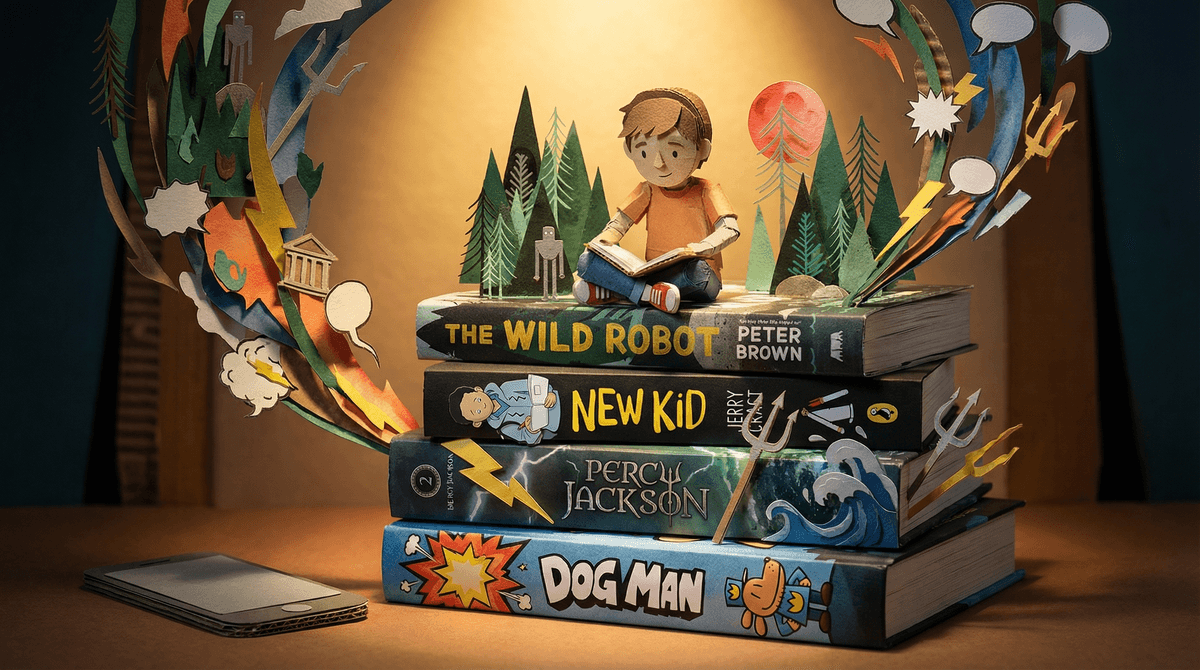
Let's be real: you're competing with Roblox, YouTube, and whatever the current TikTok dance craze is. Fourth graders (typically ages 9-10) are at this fascinating crossroads where they're developing real reading stamina and taste, but also discovering that screens are really compelling.
The good news? Books can absolutely hold their own. The trick is finding ones that meet kids where they are—whether that's obsessed with gaming, drowning in feelings about friendships, or just wanting to laugh at fart jokes (which, honestly, never gets old for this age group).
This isn't about banning screens to force reading. It's about finding books that feel as engaging as their digital alternatives. Think of it as expanding their entertainment portfolio, not replacing one thing with another.
Fourth grade is when kids transition from "learning to read" to "reading to learn." Their brains are literally building neural pathways that will affect how they process information for life. But here's what's wild: reading fiction specifically builds empathy and emotional intelligence in ways that watching videos doesn't. When kids read, they're actively constructing the story in their minds—they're the director, casting agent, and special effects team all at once.
Plus, unlike a YouTube video that controls the pacing, reading lets kids slow down, speed up, or reread confusing parts. They're building executive function skills without even realizing it.
For the Minecraft/Roblox Obsessed
The Last Kids on Earth series by Max Brallier - This is basically a video game in book form. Post-apocalyptic adventure, monster battles, and illustrations that look like a graphic novel had a baby with a comic book. If your kid thinks reading is boring, start here.
Hatchet by Gary Paulsen - Survival story that reads like a hardcore Minecraft playthrough. A kid alone in the wilderness with nothing but a hatchet? It's basically creative mode meets survival mode, but with actual stakes.
For Kids Navigating Friendship Drama
Wonder by R.J. Palacio - Yes, it's everywhere. Yes, it's been out for years. But there's a reason this book hits: it tackles kindness, difference, and middle school social dynamics without being preachy. Fair warning: you might cry. Your kid might cry. It's fine.
The Vanderbeekers series by Karina Yan Glaser - A big family in Harlem dealing with real stuff—eviction, neighborhood gentrification, sibling dynamics. It's diverse, warm, and shows kids working through problems together.
For the Funny Bone Kids
Diary of a Wimpy Kid series by Jeff Kinney - If they haven't discovered these yet, fourth grade is peak Wimpy Kid age. Part comic, part novel, 100% relatable middle school chaos.
Dog Man series by Dav Pilkey - These graphic novels are legitimately hilarious. Yes, there's toilet humor. Yes, they're "easy" reads. But they're also clever, and they keep reluctant readers actually reading.
For Future Fantasy Nerds
Percy Jackson series by Rick Riordan - Greek mythology meets modern-day adventure. The main character has ADHD and dyslexia, which is huge for kids who struggle with reading. Plus, the Disney+ show just came out, so you can do a book-to-screen comparison.
Nevermoor by Jessica Townsend - If your kid loved Harry Potter but you're looking for something new, this is it. Magical world, chosen one narrative, but with more whimsy and less darkness.
For Kids Who Want Real Stories
Ghost by Jason Reynolds - A kid dealing with trauma who finds running. It's about sports, but it's really about processing hard stuff. Short chapters, quick pacing, emotional depth.
New Kid by Jerry Craft - Graphic novel about a Black kid navigating a predominantly white private school. Tackles microaggressions and code-switching in a way that's accessible for this age.
For the Science-Minded
The Wild Robot by Peter Brown - A robot learns to survive on a deserted island. It's about AI, nature, and what it means to belong. Beautiful illustrations, philosophical questions, adventure story. The movie adaptation just came out and it's actually good.
Don't force it. Seriously. The fastest way to kill a love of reading is to make it homework.
Audiobooks count. If your kid would rather listen to Percy Jackson while building in Minecraft, that's still reading. Their brain is processing story, building vocabulary, and engaging with narrative.
Graphic novels are real books. I will die on this hill. Dog Man, Amulet, Smile by Raina Telgemeier—these are legitimate literature that happen to have pictures.
Let them read "easy" books. If your kid is reading at a 6th grade level but wants to read Captain Underpants, let them. Reading for pleasure builds fluency differently than reading for challenge.
Make it social. Can they text a friend about the book? Can you read the same book and talk about it? Can they watch the movie after finishing the book? Reading doesn't have to be solitary.
Here's the thing: reading and screen time aren't enemies. Some of the best reading motivation comes from screens:
- Kids who watch Avatar: The Last Airbender might love the graphic novel series
- Minecraft players often devour Minecraft guidebooks and novels
- YouTube book reviewers (yes, BookTube is a thing) can get kids excited about new releases
The goal isn't books instead of screens. It's books alongside screens, as part of a rich media diet.
Fourth grade readers need books that respect their growing sophistication while still being fun. They're not little kids anymore, but they're not quite ready for full YA either. This is the sweet spot where reading habits either solidify or fall away.
The best book is the one they'll actually read. Not the one with the most awards, not the one you loved as a kid, not the one their teacher recommended. The one that makes them want to keep turning pages.
Start with their interests—gaming, sports, fantasy, real life, comedy—and go from there. Hit up your library (librarians are basically book wizards), try a few different genres, and don't stress if it takes some trial and error.
And hey, if they're reading the same book for the third time? That counts too. Rereading is how kids build comprehension and find new layers they missed before.
Take the Screenwise survey to understand how your family's reading habits compare to others in your community. You might be doing better than you think—or you might discover some easy wins for building more reading time into your routine.
Check out our guide to balancing screen time and reading for practical strategies that don't involve becoming the fun police.
And if you're wondering whether your kid's current screen habits are actually problematic or just normal for their age, See if your 4th grader's screen time is normal —it's got data on what other families are doing, which honestly helps put things in perspective.