

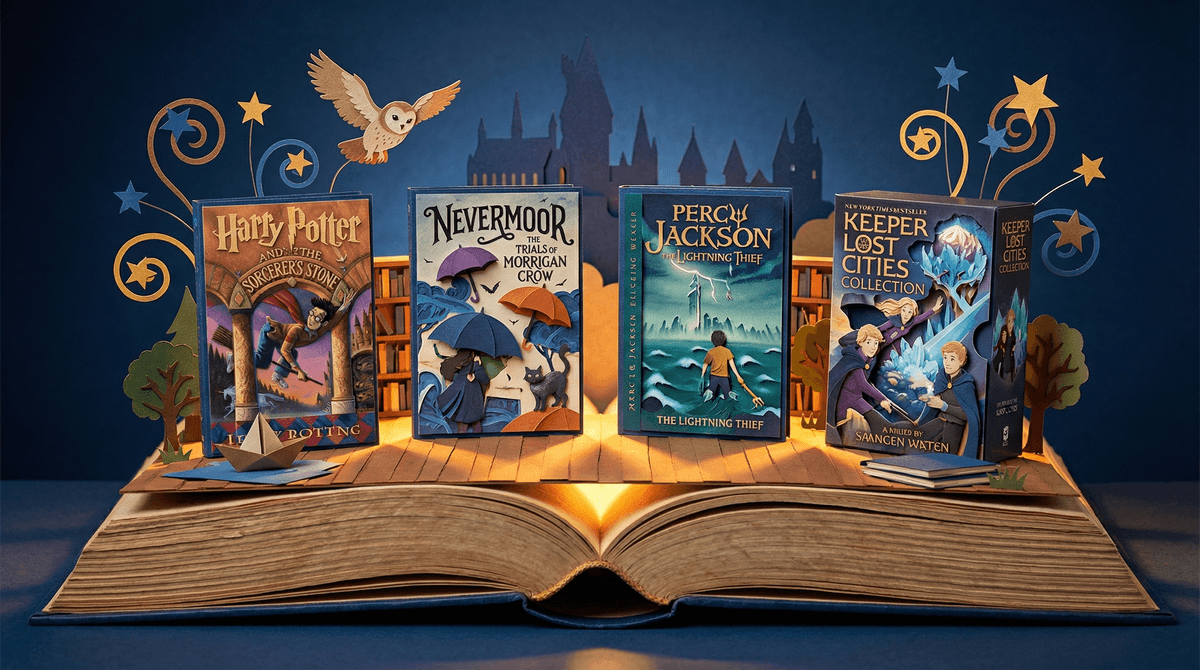
Your kid just finished Harry Potter for the third time and is now wandering around the house looking lost, asking "what do I read now?" in the same tone they'd use to ask "what's the meaning of life?"
Here's the thing: finding the next great book series after Harry Potter is genuinely hard. Not because there aren't amazing books out there—there are tons—but because Harry Potter hit a very specific sweet spot of magic, friendship, mystery, humor, and genuine stakes that's tough to replicate. It's like trying to find another first crush. Nothing quite hits the same way.
But that doesn't mean we can't find books that capture different kinds of magic. Books that make your kid want to read under the covers with a flashlight (or more realistically, their phone flashlight). Books that create that same "just one more chapter" feeling at 10 PM on a school night.
This guide will help you navigate the "what's next" conversation with actual recommendations organized by what specifically your kid loved about Harry Potter—because not every Potter fan is looking for the same thing.
First, let's acknowledge: getting your kid to voluntarily read anything in 2026 feels like winning the lottery. Between YouTube Shorts, Roblox, and whatever new app just dropped, books are competing with literally infinite digital dopamine hits.
So when your kid actually wants to read? That's momentum you don't want to lose. The window between "I loved that book!" and "eh, I'll just watch TikTok" can be surprisingly short.
Also, here's something schools won't always tell you: the reading level jump between middle grade and YA (young adult) is significant. A 10-year-old who crushes Harry Potter might not be ready for some of the darker YA fantasy that gets recommended. And that's totally fine! Better to find books at the right emotional maturity level than push them into content that feels too heavy.
Before we dive into recommendations, it helps to figure out what specifically hooked your kid. Because Harry Potter does a lot of things:
- The magic system and world-building (wands, spells, magical creatures)
- The school setting (classes, houses, teachers, rules to break)
- The friend group dynamics (Harry, Ron, Hermione figuring it out together)
- The mystery/detective elements (who's behind the attacks? what's the secret?)
- The chosen one narrative (you're special and destined for greatness)
- The humor (yes, even in the darker books)
- The progressive darkness (starting cozy, getting real)
Most kids don't love all of these equally. Some kids are here for the magic and don't care about the mystery. Others love the school drama more than the actual plot. Figuring this out will help you nail the next recommendation.
If They Want More Magic School Vibes
Nevermoor by Jessica Townsend (Ages 8-12)
This is probably the closest spiritual successor to early Harry Potter. Morrigan Crow is cursed to die on her eleventh birthday but gets rescued and taken to a magical city where she competes to join the Wundrous Society. It's got the school setting, the found family, the magical world-building, and that same sense of wonder. The main character is more actively defiant than Harry, which some kids love. Three books in the series so far, with more coming.
The School for Good and Evil by Soman Chainani (Ages 10-14)
Two best friends get kidnapped and taken to a school that trains fairy tale heroes and villains. The twist: the "good" girl gets sent to the Evil school and vice versa. It's clever, it's got great friendship dynamics, and it plays with the chosen one narrative in interesting ways. Fair warning: this series is LONG (six books) and gets progressively more complex. Also, there's a Netflix movie adaptation that... exists. The books are way better.
If They Want Epic Fantasy Adventure
Percy Jackson series by Rick Riordan (Ages 9-14)
If your kid hasn't read Percy Jackson yet, start here. Greek gods are real, their kids are demigods with powers, and Percy discovers he's one of them. It's got the chosen one narrative, the friend group, the mystery elements, and legitimately funny writing. Riordan's humor is more contemporary than Rowling's, which some kids find more accessible. Bonus: there are like 15+ books across multiple series set in this universe, so if they're hooked, you're set for a while. The Disney+ show is also actually good.
Keeper of the Lost Cities by Shannon Messenger (Ages 10-14)
Sophie discovers she's not human—she's an elf with special abilities who was hidden in the human world. She gets whisked away to elf school where nothing is quite what it seems. This series has NINE books (with more coming), so it's a serious commitment. The world-building is intricate, maybe even overly so. Some kids love getting lost in all the details; others find it exhausting. The friend dynamics are strong, and there's a slow-burn romance subplot that develops over many books.
If They Want Mystery and Detective Vibes
The Mysterious Benedict Society by Trenton Lee Stewart (Ages 8-12)
Four gifted orphans are recruited for a secret mission to infiltrate a mysterious institute and stop a villain. This is more puzzle-mystery than magic, but it's got that same "kids figuring out adult problems" energy. The friendships are beautifully written, and each kid has distinct strengths. Less action than Harry Potter, more brain games. There's also a Disney+ series that's charming but got canceled after two seasons.
Greenglass House by Kate Milford (Ages 9-13)
A cozy mystery set in an inn during winter break where strange guests arrive and secrets unfold. It's got the mystery-solving element of Harry Potter without the epic stakes. Great for kids who loved the detective work but don't need world-ending drama.
If They Want Found Family and Friendship
The Wingfeather Saga by Andrew Peterson (Ages 9-14)
Three siblings discover they're actually royalty in hiding and must escape an evil empire. The sibling dynamics are chef's kiss—realistic bickering mixed with genuine love. It's got adventure, humor, and surprisingly deep emotional moments. Some families love that it has Christian themes woven in (not preachy, just present); others don't care either way. Four books total, complete series.
Fablehaven by Brandon Mull (Ages 9-13)
Siblings discover their grandparents run a secret preserve for magical creatures. Each book is a new adventure/mystery on the preserve. Strong sibling relationship, lots of creative magical creatures, and genuine danger. Five books total, complete series. Gets progressively darker, which some kids love and others find too intense.
If They Want Something Darker and More Mature
His Dark Materials by Philip Pullman (Ages 12+)
Starting with The Golden Compass, this trilogy is for kids who are ready for more complex themes. Parallel universes, animal companions that are part of your soul, and a story that gets progressively more philosophical. Fair warning: this series is openly critical of organized religion, which some families embrace and others avoid. It's beautifully written but definitely more challenging than Harry Potter emotionally and thematically.
The Hunger Games by Suzanne Collins (Ages 13+)
If your kid is ready for dystopian violence (kids forced to fight to the death on TV), this trilogy is gripping. It's got the chosen one element, the romance subplot, and social commentary about power and media. But let's be clear: this is significantly darker than Harry Potter. Some 11-year-olds are ready for it; many aren't until 13-14. You know your kid.
Here's a real thing: some kids loved Harry Potter because someone read it to them, or they listened to the audiobooks, or they saw the movies first and then read the books. That's completely valid.
If your kid struggles with reading or has dyslexia or just finds it hard to focus, here are some moves:
Audiobooks are reading. Full stop. The Jim Dale and Stephen Fry versions of Harry Potter are legendary for a reason. Most of the books I recommended above have excellent audiobook versions. Libraries offer free audiobook apps like Libby.
Graphic novels count too. Try Amulet by Kazu Kibuishi or The Witch Boy by Molly Knox Ostertag. They're not "lesser" books—they're just a different medium.
Read together, even with older kids. Taking turns reading chapters out loud, or you reading while they follow along, keeps the momentum going without making it feel like homework.
Let me be honest about a few popular recommendations that don't quite hit:
The Inheritance Cycle (Eragon) - Look, some kids love these books. But they're long, the writing is... fine, and the plot is basically Star Wars with dragons. If your kid is a dragon superfan, go for it. Otherwise, there are better options.
A Wrinkle in Time - A classic! Also written in 1962 and feels like it. Some kids connect with it; many modern readers find it slow and confusing. The 2018 movie didn't help.
The Chronicles of Narnia - Another classic that's hit-or-miss with modern kids. The Christian allegory is much more explicit than in Harry Potter, which some families love and others find heavy-handed. The writing style is also quite dated. Some kids devour these; others bounce off immediately.
The actual best "next book" depends entirely on your specific kid—their age, maturity level, what they loved about Harry Potter, and honestly just their vibe.
Start with Percy Jackson if you want the safest bet. It's funny, accessible, and has that same "ordinary kid discovers they're special" hook.
Try Nevermoor if they want more magic school specifically. It's the closest to early Harry Potter's tone and structure.
Go with The Mysterious Benedict Society if they loved the mystery-solving more than the magic. It's clever and cozy.
And here's permission to bail on a book if it's not working. Just because a book is popular or "should" be perfect doesn't mean it'll click with your kid. Sometimes you need to try three books before finding the next obsession. That's normal.
Ask your kid what they loved most about Harry Potter. Was it the magic? The friends? The mysteries? The school? This will narrow down options fast.
Start with one book, not a whole series. See if they connect with the first one before committing to nine more books.
Use your library. Most of these books are available at public libraries, and librarians are genuinely great at recommendations if you tell them what your kid liked.
Consider audiobooks if reading stamina is an issue. There's zero shame in this.
And if nothing clicks immediately? That's okay too. Sometimes kids need a break between obsessions. Let them sit with their Harry Potter feelings for a while. The next great book will come when they're ready.
Want more specific recommendations based on your kid's age and interests? Find books to read after Harry Potter for personalized suggestions.