

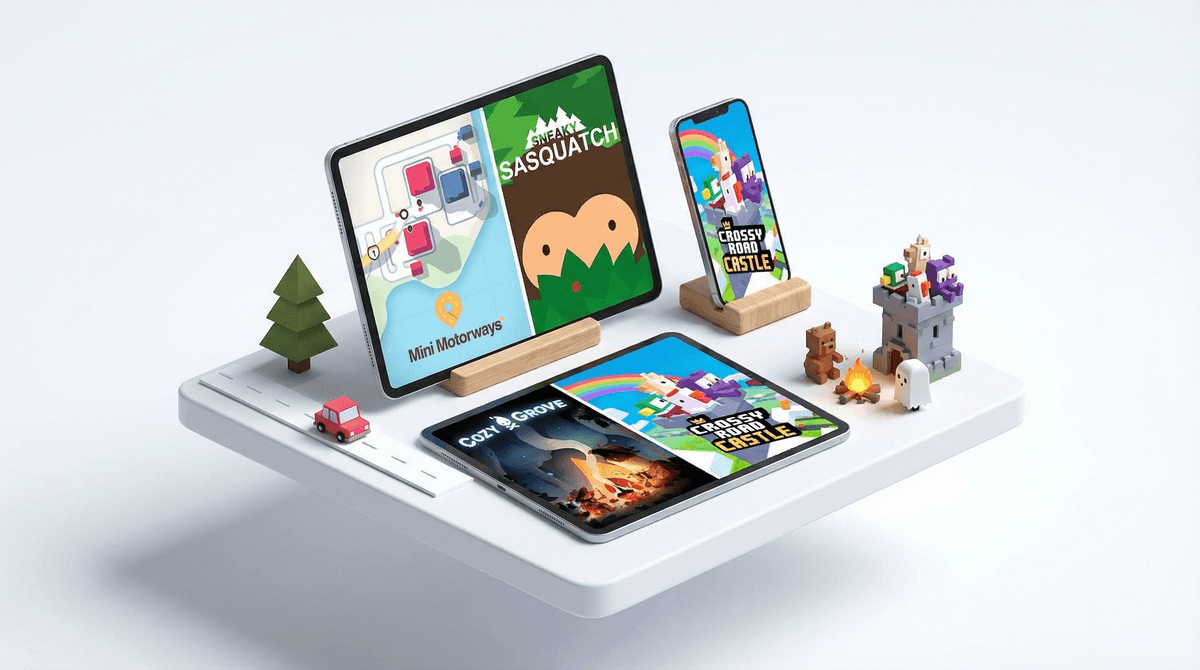
Apple Arcade is a $6.99/month gaming subscription service that gives you unlimited access to over 200 games across iPhone, iPad, Mac, and Apple TV. But here's what makes it different from the chaotic hellscape of free-to-play mobile gaming: no ads, no in-app purchases, and no surprise $99.99 charges because your kid accidentally bought a chest of gems.
Every game is premium quality, family-shareable, and playable offline. It's basically the anti-Roblox—you pay upfront, and that's it. No "Mom, can I have $20 for V-Bucks?" No predatory monetization designed to exploit kids' developing impulse control.
If you've got an Apple device and you're tired of navigating the minefield of freemium gaming, Apple Arcade is genuinely worth considering.
The mobile gaming landscape is rough. Most "free" games are engineered to extract maximum cash through psychological manipulation—loot boxes, battle passes, limited-time offers that create FOMO. Kids are especially vulnerable to these tactics.
Apple Arcade removes all of that. It's a curated library where the business model is "make good games people want to play," not "design addictive loops that drive microtransactions." For parents trying to provide quality screen time without constant negotiation over purchases, it's a legitimate solution.
Plus, many Apple Arcade games support controllers and have actual depth—they're not just mindless time-wasters. Some teach problem-solving, creativity, and strategic thinking. Others are just pure fun without the garbage.
1. Sneaky Sasquatch (Ages 6+)
An open-world adventure where you play as a sasquatch living in a national park, stealing food from campers, disguising yourself as a human, and eventually running a business empire. It's weird, charming, and surprisingly deep. Kids love the silly premise; parents appreciate that there's actual gameplay here. Easily 50+ hours of content.
Why it works: Zero violence, tons of exploration, and genuinely funny. Great for younger kids who aren't ready for complex combat systems.
2. LEGO Builder's Journey (Ages 5+)
A beautiful puzzle game about building with LEGO bricks. Minimalist, meditative, and visually stunning. Each level presents a spatial puzzle you solve by placing blocks thoughtfully.
Why it works: Encourages spatial reasoning and creative problem-solving. The aesthetic is gorgeous—this is gaming as art. Perfect for quiet time.
3. Crossy Road Castle (Ages 7+)
A cooperative platformer where up to four players work together to climb a tower. Think old-school Mario meets modern multiplayer chaos. Great for siblings playing together on the couch.
Why it works: Teaches cooperation, not competition. You literally cannot proceed without helping each other. Rare in gaming.
4. Mini Motorways (Ages 10+)
A minimalist city-building puzzle game where you design road networks to connect houses to destinations. Starts simple, becomes genuinely challenging. Basically urban planning for kids.
Why it works: Teaches systems thinking and planning. You see immediate consequences of your decisions. Surprisingly educational without feeling like homework.
5. What the Golf? (Ages 8+)
A comedy game that's technically about golf but actually about absurdist humor. You'll hit houses, cars, and yourself instead of balls. Every level subverts expectations in ridiculous ways.
Why it works: Genuinely hilarious. Kids and parents both laugh. It's creative, weird, and never takes itself seriously.
6. Grindstone (Ages 10+)
A puzzle RPG where you match colored creatures to create chain attacks. Simple to learn, hard to master. Has cartoon violence (you're defeating monsters) but it's stylized and not graphic.
Why it works: Deep strategic gameplay without overwhelming complexity. Great for kids who like games with progression systems but you don't want them in gacha hell.
7. Sonic Racing (Ages 6+)
A kart racer featuring Sonic characters. Think Mario Kart but on Apple Arcade. Solid racing mechanics, fun power-ups, and no pay-to-win nonsense.
Why it works: Scratches the Mario Kart itch if you don't have a Nintendo Switch. Family-friendly competition.
8. Spire Blast (Ages 8+)
A puzzle game where you shoot colored blocks to destroy towers. More strategic than it sounds—you have to plan shots carefully to create chain reactions.
Why it works: Good for kids who like match-3 games but want something with more spatial challenge. Relaxing but engaging.
9. The Oregon Trail (Ages 9+)
Yes, THAT Oregon Trail. Modernized but still about dysentery and broken wagon wheels. Educational gaming nostalgia for parents, genuinely fun for kids who like survival/management games.
Why it works: Teaches resource management and historical context. Plus, it's hilarious when your entire party dies of snakebite.
10. Frogger in Toy Town (Ages 6+)
Classic Frogger gameplay reimagined in a toy-themed 3D world. Simple mechanics, progressively harder levels, and that perfect "one more try" addictiveness without predatory hooks.
Why it works: Easy to pick up, hard to master. Great for developing timing and spatial awareness.
11. Illustrated (Ages 8+)
A social drawing game where you create and share illustrations based on prompts. Think Pictionary meets Instagram, but actually safe and moderated.
Why it works: Encourages creativity and self-expression. The community features are well-moderated, making it one of the safer social gaming experiences.
12. Cozy Grove (Ages 10+)
A life-sim game about camping on a haunted island and helping ghost bears. Similar vibe to Animal Crossing but designed for shorter daily play sessions.
Why it works: Teaches patience and delayed gratification (things happen in real-time). Calming, gentle, and emotionally intelligent storytelling.
13. Sago Mini Road Trip (Ages 3-6)
A simple exploration game for very young kids. Drive around, discover things, no failure states. Pure exploration and discovery.
Why it works: Perfect first game for preschoolers. No reading required, no stressful challenges, just gentle play.
14. Jetpack Joyride+ (Ages 8+)
The classic endless runner, now without ads or IAPs. Simple one-touch gameplay that's immediately accessible but has depth through upgrades and missions.
Why it works: Great for short play sessions. The progression system feels rewarding without being manipulative.
15. NBA 2K24 Arcade Edition (Ages 9+)
A streamlined version of the NBA 2K basketball franchise. Simplified controls but still captures the feel of the sport. Great for sports-loving kids.
Why it works: Legitimate sports simulation without the predatory Ultimate Team modes that plague the console versions. Just basketball.
Ages 3-6: Stick with Sago Mini Road Trip and LEGO Builder's Journey. These are specifically designed for young kids—no reading required, no failure states, just exploration and creativity.
Ages 6-8: Sneaky Sasquatch, Frogger in Toy Town, Sonic Racing, and What the Golf? are all great entry points. Simple controls, forgiving gameplay, and genuinely fun without being condescending.
Ages 9-12: This is the sweet spot for most of the list. Mini Motorways, Grindstone, Oregon Trail, and Cozy Grove all offer deeper gameplay that challenges without frustrating. Good for developing strategic thinking.
Ages 13+: Honestly, all of these work. Older kids might gravitate toward NBA 2K24 or the more complex puzzle games, but the beauty of Apple Arcade is that nothing here is inappropriate—just varying levels of complexity.
The subscription is family-shareable. One $6.99/month subscription covers up to six family members. That's honestly a steal compared to buying individual games or dealing with multiple free-to-play nightmares.
Games are actually offline-playable. Download them at home, and kids can play on long car rides or flights without needing data. This is huge for managing screen time in specific contexts.
No social pressure or FOMO. Unlike Fortnite or Roblox, there are no limited-time events, battle passes, or "everyone has this skin except me" dynamics. Games just exist. Your kid can play them or not without feeling left out.
Controller support is excellent. Many games work with Xbox or PlayStation controllers, which makes the experience feel more like console gaming and less like mobile tap-fest.
Not everything is a winner. There are over 200 games on the service. I've listed 15 worth your time, but you'll find plenty of mediocre stuff too. The good news? No risk in trying something and deleting it.
Some games have light social features. Illustrated and a few others have community aspects, but they're heavily moderated and generally safe. Still worth checking in on what your kid is doing.
Apple Arcade isn't perfect, but it's genuinely one of the better deals in family gaming. For the price of two fancy coffees per month, you get access to quality games that respect your kid's attention and your wallet.
Is it going to replace Minecraft or Roblox in your kid's heart? Probably not—those are cultural phenomena with massive social components. But as an alternative for solo play, car rides, or "I'm bored" moments, it's legitimately valuable.
The games I've listed here are worth downloading immediately. Start with Sneaky Sasquatch (seriously, it's that good), try LEGO Builder's Journey for something calming, and let your kids explore from there.
-
Start with the free trial. Apple usually offers 1-3 months free with device purchases, or you can try it for a month at $6.99.
-
Download 3-5 games based on your kid's age from this list. Don't overwhelm them with choices.
-
Set up Screen Time limits if needed. Apple Arcade games still count as screen time—they're just higher quality screen time.
-
Check in after a week. See what's getting played, what's ignored, and adjust. Gaming preferences are personal.
-
Consider this as a replacement, not an addition. If you're already spending money on in-app purchases elsewhere, shifting that budget to Apple Arcade
 might actually save you money and sanity.
Quality gaming exists. It just doesn't yell at you from the App Store's front page. Apple Arcade is where it lives.