

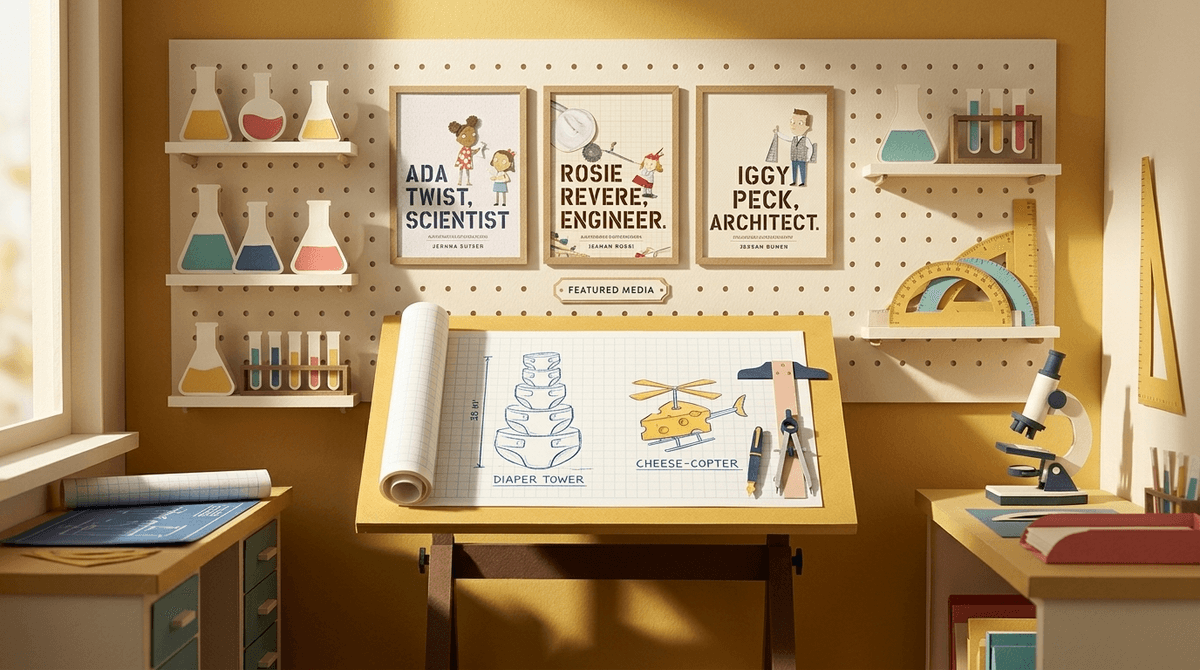
TL;DR: If you’re looking for the ultimate STEM gateway for your kids, The Questioneers is the gold standard. Start with the original picture books (Iggy Peck, Architect and Rosie Revere, Engineer), move into the Questioneers Chapter Books for your 1st-3rd graders, and use the Ada Twist, Scientist (Netflix) series as a high-quality screen time option that actually encourages curiosity rather than just numbing the brain.
We’ve all seen the "STEM" label slapped on everything from plastic blocks to cereal boxes lately. It’s become a bit of a marketing buzzword, but The Questioneers series by Andrea Beaty and David Roberts is the real deal. It’s a collection of stories centered around a group of kids in Miss Lila Greer’s second-grade class at Blue River Creek Elementary.
Each kid has a specific obsession—architecture, engineering, science, activism, art—and the books follow their journey through failure, frustration, and eventual breakthrough. What makes these books stick is that they don't treat kids like "future workers." They treat them like thinkers.
If your kid is currently obsessed with Roblox or asking a million "why" questions about how the toaster works, this series is the narrative equivalent of that curiosity.
Let’s be honest: some "educational" books are a chore to read at bedtime. They’re dry, the rhyming is clunky, and the moral is about as subtle as a sledgehammer.
The Questioneers avoid this because:
- The Rhyme Scheme is Elite: Beaty’s verse has a Seuss-level cadence that doesn't make you want to skip pages.
- The Art is Incredible: David Roberts’ illustrations are packed with mid-century modern vibes and hidden details that keep you looking.
- Failure is the Point: In Rosie Revere, Engineer, the "flop" is celebrated. That’s a massive lesson for kids who are terrified of getting a math problem wrong.
- Representation Matters: The class is diverse in every sense—ethnicity, family structure, and neurodiversity (shout out to Aaron Slater, Illustrator for a beautiful depiction of a kid who struggles with reading).
Find other books that celebrate neurodiversity
The "Questioneers Universe" has expanded quite a bit. You’ve got the picture books, the chapter books, the "Big Project" activity books, and the Netflix show. Here is how to navigate it without getting overwhelmed.
Phase 1: The Core Picture Books (Ages 4-8)
These are the foundation. You can read them in any order, but reading them in the order they were published helps you see the classroom grow.
- The one that started it all. Iggy builds towers out of diapers and bridges out of fruit leather. It’s about not letting "no" stop your creative spark.
- Arguably the most popular. Rosie builds gadgets in secret because she’s afraid of failure. Her Great-Great-Aunt Rose (a nod to Rosie the Riveter) teaches her that a first flop is something to celebrate.
- Ada is the kid who asks "Why?" then "How?" then "What?" It’s a deep dive into the scientific method and the chaos of discovery.
- This moves from STEM into "STREAMS" (adding Reading, Art, and Social Studies). Sofia wants to turn a trash heap into a park. It’s a great intro to community activism.
- A moving story about a boy who loves stories but struggles to write the words. It’s a must-read for any kid who feels "behind" in school.
- The backstory of the teacher who enables all this creativity. It deals with childhood anxiety and the impact one supportive adult can have.
Phase 2: The Chapter Books (Ages 6-10)
Once your kid is ready for longer stories (or you want a "bridge" book to read together), move to the Questioneers Chapter Books. These are great because they include non-fiction sidebars about real scientists and history.
Phase 3: The Digital Expansion
- Executive produced by the Obamas, this show is actually... good. It’s not "brain rot." It follows Ada, Rosie, and Iggy as they solve mysteries using science. It’s a great alternative to Paw Patrol or Cocomelon.
- If your kid wants more, the official site has printables and activities that are actually useful for a rainy afternoon.
Ages 3-5: Stick to the picture books. They’ll love the rhymes and the pictures of Iggy’s diaper tower. The Netflix show is also perfect for this age group as it’s paced well and isn't over-stimulating.
Ages 6-8: This is the "sweet spot." They can start reading the picture books themselves and dive into the chapter books. The themes of perseverance and dealing with "mean" kids (like in Sofia Valdez) really resonate here.
Ages 9+: They might start to feel "too old" for the picture books, but the Big Project Books (like Rosie Revere’s Big Project Book for Engine-of-Beers) are actually quite challenging and fun for older elementary kids.
Check out our guide on finding the right reading level for your child
The "Failure" Aspect
Modern parenting often involves us trying to smooth the path for our kids. The Questioneers subverts this. Rosie’s "cheese-copter" crashes. Ada’s experiments make a giant stinky mess. These books are a great opening to talk to your kids about growth mindset. When their Minecraft build collapses or they lose a level in Super Mario Wonder, you can reference Rosie Revere. "It’s a brilliant flop!"
Diversity and Inclusion
The series handles diversity perfectly—it’s just there. It isn't a "lesson" on diversity; the world of Blue River Creek just looks like the real world. Aaron Slater, Illustrator is particularly important for kids with learning differences. It shows that being a "slow reader" doesn't mean you aren't a brilliant storyteller.
The Netflix "Brain Rot" Test
We talk a lot about intentional screen time. The Ada Twist show passes the test. It includes live-action segments with real scientists (like astronauts and engineers) that bridge the gap between the cartoon and the real world. If you’re going to let them watch something while you make dinner, this is a top-tier choice.
If you’re reading these with your kids, try these prompts to get them thinking:
- "Rosie felt embarrassed when her invention didn't work. Have you ever felt like that?"
- "Ada keeps asking 'Why?' What is one thing you're curious about today?"
- "Sofia saw something that wasn't right and tried to fix it. Is there anything in our neighborhood you'd like to change?"
The Questioneers series is one of the few franchises that actually lives up to the hype. It’s educational without being boring, inclusive without being performative, and the transition from books to screen has been handled with a lot of care.
Whether you start with Iggy Peck, Architect or jump straight into the Netflix series, you’re giving your kids a framework for how to look at the world with curiosity instead of frustration.
- Check your local library for the core trio: Iggy, Rosie, and Ada.
- Queue up the show on Netflix for your next "quiet time" block.
- Use the Screenwise Survey to see how your family’s interest in STEM media compares to your community.
Take the Screenwise Family Tech Survey
Get more STEM book recommendations