

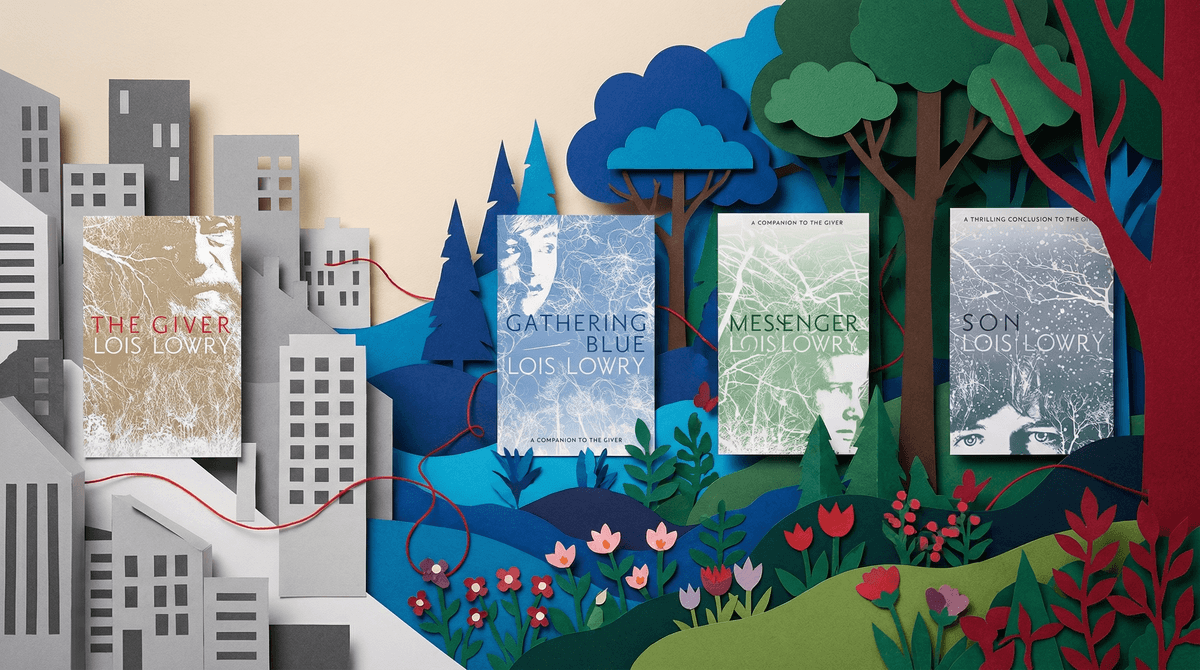
The Giver is that book you probably read in middle school and never forgot—the one about Jonas living in a seemingly perfect society where everything is controlled, emotions are suppressed, and nobody sees color. Published in 1993, Lois Lowry's dystopian novel became an instant classic and spawned three companion books: Gathering Blue (2000), Messenger (2004), and Son (2012).
Here's what throws people: these aren't exactly sequels in the traditional sense. Each book stands alone with different protagonists and settings, but they're all connected through Lowry's exploration of what happens when societies try to eliminate pain, difference, and choice in pursuit of "safety" and "sameness."
The quartet follows different characters across different communities, all grappling with versions of the same question: What are we willing to sacrifice for security, and what does it cost us to be fully human?
There's a reason The Giver has been assigned in classrooms for three decades and continues to spark heated discussions. It's not preachy, it doesn't hand-feed answers, and it trusts young readers to sit with genuinely uncomfortable questions.
The books tackle heavy themes—euthanasia, conformity, the suppression of memory and emotion, what "choice" really means—but they do it through compelling stories rather than lectures. Jonas doesn't just learn his society is messed up; he has to decide what to do about it, knowing any choice will hurt people he loves.
For today's kids growing up in an algorithm-driven world, these books hit particularly hard. The Community in The Giver isn't evil—it's trying to protect people from pain, conflict, and bad decisions. Sound familiar? It's basically the logic behind every content filter, every "for you" page, every system designed to remove friction and choice from our lives "for our own good."
The Giver (Book 1): Ages 10+
Most schools assign this in 6th-8th grade (ages 11-14), which feels right. Younger advanced readers can handle it, but the concepts—infanticide, euthanasia, the elimination of family bonds—require some emotional maturity to process. The violence isn't graphic, but the ideas are genuinely disturbing.
Gathering Blue (Book 2): Ages 10+
Similar maturity level to The Giver. This one deals with disability, abuse, and a different kind of societal control. Less widely read but equally powerful.
Messenger (Book 3): Ages 11+
Slightly more complex thematically. Deals with xenophobia, physical transformation, and sacrifice. Still appropriate for middle schoolers.
Son (Book 4): Ages 12+
The longest and most emotionally intense of the quartet. Deals with maternal love, identity, and brings the series full circle. Better for older middle school and high school readers who've invested in the series.
The 2014 movie adaptation: Ages 13+. It's rated PG-13 and adds more action and romance than the book. Honestly? It's fine but forgettable. The book is better, and that's a hill worth dying on.
These books are supposed to make you uncomfortable. If your kid finishes The Giver and isn't asking hard questions about their own world, they might have missed the point.
The most common parent concern: "Is this too dark for my child?" Fair question. The books deal with state-sanctioned killing, the suppression of human emotion, and the weaponization of "safety" as social control. But here's the thing—Lowry never makes suffering gratuitous. She's not trying to traumatize kids; she's trying to make them think.
The real gift of these books is the conversation they spark. Kids will want to talk about:
- Whether it's worth eliminating pain if it means eliminating joy
- What we lose when we let others make all our choices
- Whether their own world prioritizes comfort over freedom
- How we decide what memories and histories to preserve or erase
Heads up on specific content:
- The "Release" ceremony (euthanasia) in The Giver is the most disturbing scene—it's not graphic but it's deeply upsetting
- References to "Stirrings" (puberty/sexual feelings) being suppressed with daily pills
- Themes of infanticide (babies who don't meet standards are "released")
- Abuse and disability discrimination in Gathering Blue
- Physical transformation and body horror elements in Messenger
None of this is gratuitous. All of it serves the story. But you should know what you're walking into.
Don't ask "Did you like it?" Ask "What did it make you think about?"
Try these conversation starters:
- "If you could choose between Jonas's Community and our world, which would you pick? Why?"
- "The Community eliminated choices to protect people. Where do you see that happening in real life?"
- "Jonas's parents didn't really love him—they were assigned to be together and given children. What do you think that did to their family?"
- "Do you think Jonas made the right choice at the end?" (And be ready for genuine debate—the ending is intentionally ambiguous)
Connect it to their digital world: The algorithm-driven feeds, the content filters, the parental controls—these are all versions of the Community's attempt to protect people from difficult choices and uncomfortable content. Not saying parental controls are evil, but it's worth discussing: where's the line between protection and control? When do kids need to learn to make hard choices themselves?
Most people only read The Giver, but the other three books expand Lowry's vision in fascinating ways. Gathering Blue shows a completely different dystopia—not one of sterile sameness but of brutal hierarchy and exploitation. Messenger explores what happens when a community that once welcomed difference starts closing its borders. Son brings everything together through a mother's fierce love for her child.
Reading all four gives you the full picture: there's no one way societies go wrong, but they all tend to sacrifice humanity in pursuit of some "greater good."
The Giver quartet isn't comfort reading. It's challenging, sometimes disturbing, and intentionally ambiguous. It's also some of the most important literature your kid will encounter in middle school.
These books don't tell kids what to think—they teach them how to think critically about power, choice, memory, and what it means to be fully human. In a world increasingly designed to think for us, that's a gift.
If your kid is reading The Giver for school, read it with them. Or reread it yourself—I guarantee it hits different as an adult. Then talk about it. Argue about it. Disagree about whether Jonas made the right choice.
That's exactly what Lowry wanted.
Want to explore more dystopian reads? Check out The Hunger Games book or Divergent for similar themes with different approaches. Or if you're looking for something that grapples with technology and humanity, try Feed by M.T. Anderson.
✓ Read (or reread) The Giver yourself before your kid starts it
✓ Plan a conversation after they finish—don't let this one pass without discussion
✓ Consider reading the full quartet together if the first book resonates
✓ Connect the themes to your family's digital life—where do we prioritize comfort over growth?
Want to talk through how to discuss difficult themes in books with your kids?