

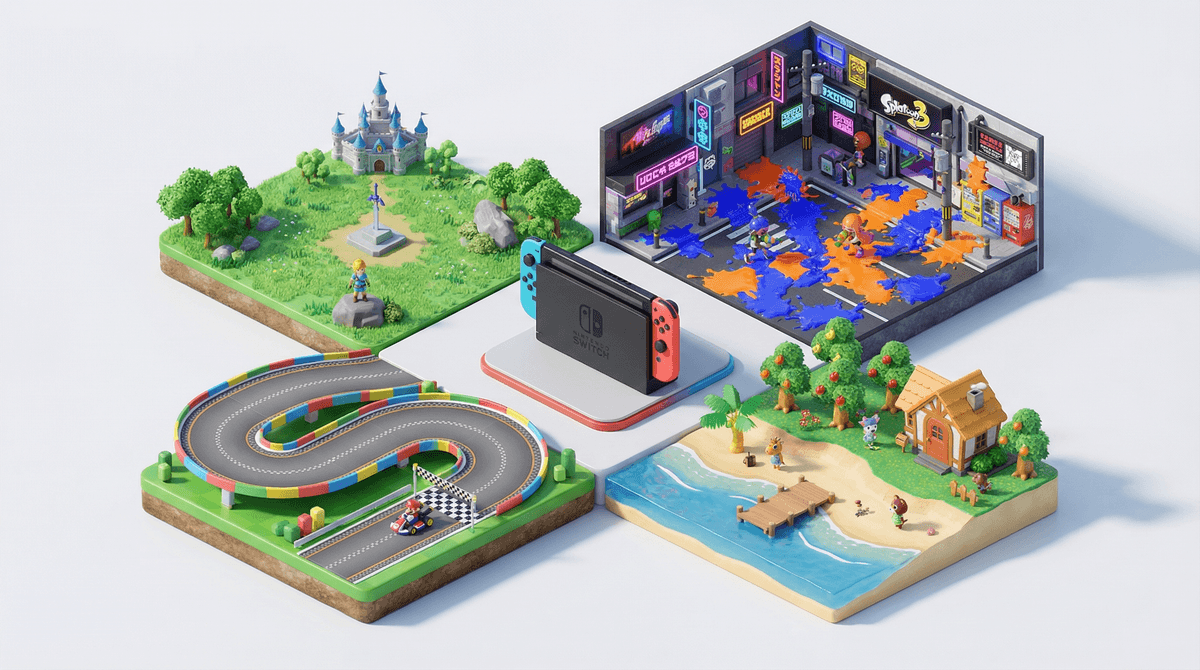
The Best Nintendo Switch Games for 10-Year-Olds
Ten is that sweet spot where kids want games that feel grown-up but aren't quite ready for the intense stuff. Here are the standouts:
Top picks:
- The Legend of Zelda: Breath of the Wild - Epic adventure with actual problem-solving (which Zelda fits which age)
- Mario Kart 8 Deluxe - Still the king of family multiplayer
- Minecraft - Creative building without the online chaos (if you set it up right)
- Splatoon 3 - Shooter vibes without the violence
- Pokémon Scarlet/Violet - Open-world exploration that hooks hard
Ten-year-olds are in this fascinating gaming phase. They're done with the purely "kiddie" stuff but not ready (and frankly shouldn't be playing) the M-rated games half their friends are somehow already on. They want challenge, they want to feel capable, and they want games that don't feel like they're being talked down to.
The Switch is actually perfect for this age. It's got depth without the toxic online culture that plagues other platforms, and there's a massive library that hits that middle ground between "baby games" and "why is a fifth grader playing Call of Duty?"
Challenge without frustration. Ten-year-olds can handle complex mechanics and actual difficulty, but they're still building frustration tolerance. Games that let them fail and learn without punishing them too harshly work best.
Autonomy and choice. This is the age where they want to make their own decisions and see consequences. Open-world games and those with multiple approaches to problems are huge hits.
Social connection (the healthy kind). They want to play with friends, but ideally in ways you can actually monitor. Local multiplayer or carefully managed online play beats the free-for-all voice chat of many popular games.
Something to master. Ten-year-olds love getting genuinely good at something. Games with skill progression that's visible and rewarding keep them engaged in positive ways.
This is the game that makes kids understand why their parents get nostalgic about gaming. It's genuinely one of the best games ever made, and ten is the perfect age to really appreciate it.
Why it works: The entire game is about experimentation and problem-solving. There's no single "right" way to do anything. Kid wants to climb that mountain? They can. Want to avoid combat entirely and sneak around? That works too. The game respects their intelligence and rewards creative thinking.
The learning angle: Serious spatial reasoning, planning, resource management, and persistence. When they finally beat a shrine puzzle they've been stuck on, that's real accomplishment.
Parent heads-up: There's combat (hitting monsters with swords), but it's very stylized and not graphic. Some kids get frustrated with the weapon durability system (weapons break), but most adapt. Plan for 50+ hours if they really get into it.
Yes, it's been around forever. Yes, your ten-year-old might roll their eyes at "another Mario game." But this is still the gold standard for family multiplayer gaming.
Why it works: The auto-steering and auto-acceleration options mean younger siblings can play too (important for family harmony), but the skill ceiling is high enough that your ten-year-old can actually get good and feel accomplished. It's one of those rare games where everyone can play together and have fun.
The learning angle: Hand-eye coordination, spatial awareness, and learning to lose gracefully (that blue shell is a lesson in life's unfairness).
Parent heads-up: Online play exists but is generally less toxic than most online games—no voice chat, just racing. Local multiplayer is where this really shines anyway.
You knew this would be here. At ten, most kids are past the "just build random stuff" phase and into actual projects—redstone contraptions, elaborate builds, adventure maps.
Why it works: It's genuinely creative and open-ended. Kids this age start building things with purpose, learning basic logic through redstone, and collaborating on bigger projects.
The learning angle: Spatial reasoning, planning, basic programming concepts (redstone), resource management, and creative problem-solving.
Parent heads-up: The online multiplayer is where things get dicey. Realms (Minecraft's private servers) are fine for playing with actual friends, but public servers can expose kids to chat they're not ready for. Setting up Minecraft parental controls is worth the 20 minutes. Also, they will 100% want to watch Minecraft YouTube videos, which is its own conversation about YouTube content for kids.
This is the answer when your kid wants to play Fortnite but you're not ready for that particular chaos.
Why it works: It's a shooter, but you're shooting ink, not people. The whole vibe is colorful and fun rather than military or violent. The online play is surprisingly wholesome—no voice chat with strangers, just squid kids painting turf.
The learning angle: Team strategy, spatial awareness, quick decision-making. It's actually quite skill-based.
Parent heads-up: This is online multiplayer, but Nintendo's approach is much more locked down than other platforms. No text or voice chat with random players, just preset phrases. The community is generally younger and less toxic. Sessions are short (3-minute matches), which is good for time management.
The Pokémon games just keep delivering for this age group. These newest ones are open-world, which is a big deal for kids used to more linear Pokémon experiences.
Why it works: It's the Pokémon collection and battle loop they love, but with more freedom to explore and tackle challenges in any order. The difficulty is adjustable based on where they go first.
The learning angle: Strategy, type matchups (basically a complex rock-paper-scissors), team building, and reading comprehension (there's a lot of text).
Parent heads-up: These games are LONG. Like 40+ hours to complete the main story, and that's before they start shiny hunting or competitive battling. The online features exist but are pretty tame—mostly just trading Pokémon with friends.
This is the game that kept everyone sane during 2020, and it's still excellent for kids who want something less intense.
Why it works: It's all about creating your own space, collecting things, and interacting with charming characters. There's no way to fail, no time pressure, just chill island life.
The learning angle: Design, planning, delayed gratification (saving up for that perfect furniture), and basic economics (the turnip market is basically the stock market for ten-year-olds).
Parent heads-up: The online play requires friend codes, so they can only visit islands of people you approve. The real-time clock means events happen at specific times, which can be annoying but also teaches time management.
A genuine masterpiece of game design that ten-year-olds can actually complete (unlike some of the more punishing platformers).
Why it works: It's got that perfect difficulty curve—easy enough to beat the main story, but with hundreds of optional challenges for kids who want to master it. The movement is incredibly satisfying once they get good at it.
The learning angle: Precision, timing, spatial reasoning, and persistence. The post-game challenges are legitimately hard.
Parent heads-up: Single-player only, which might be a plus or minus depending on your family. Some kids get frustrated with the harder optional moons, but they're not required to beat the game.
This farming sim has become a legitimate phenomenon, and for good reason.
Why it works: It's deeply satisfying to build up your farm, befriend the townspeople, and optimize your operations. Kids this age love the sense of progress and the ability to play however they want—focus on farming, fishing, mining, or relationships.
The learning angle: Planning, resource management, time management, and basic business concepts.
Parent heads-up: This game can be a time sink. The "just one more day" loop is real. Also, there are some adult themes (one character struggles with alcohol, some marriage candidates), but they're handled thoughtfully. Worth a conversation about what they're encountering.
Slightly spooky but never actually scary, this is perfect for kids who want something with a little edge but aren't ready for horror.
Why it works: It's puzzle-solving with a ghost-catching vacuum cleaner. The co-op mode (Luigi and Gooigi) is excellent for siblings or parent-kid play.
The learning angle: Problem-solving, pattern recognition, and cooperation in co-op mode.
Parent heads-up: Some kids who are sensitive to spooky stuff might find the ghost encounters a bit much, but it's all very cartoonish. The co-op is great for playing together.
Kirby games have a reputation for being easy, but this one has surprising depth while remaining accessible.
Why it works: The "Mouthful Mode" (Kirby swallowing huge objects) is hilarious and creative. The difficulty is just right for ten-year-olds—challenging enough to feel accomplished, forgiving enough not to frustrate.
The learning angle: Experimentation with different abilities, problem-solving, and some light platforming skills.
Parent heads-up: Great co-op option. The post-game content gets legitimately challenging for kids who want more.
Okay, this one's for your more patient, persistent ten-year-old who wants a real challenge.
Why it works: It's atmospheric, beautiful, and genuinely difficult. Kids who master this feel like absolute gaming gods.
The learning angle: Persistence, pattern recognition, spatial memory (the map system requires actual navigation skills), and frustration tolerance.
Parent heads-up: This game is HARD. Some kids will bounce off it, others will become obsessed. The art style is a bit dark and there are some vaguely creepy elements, but nothing inappropriate. Not recommended for kids who get easily frustrated.
The ultimate "everyone can play" fighting game. Literally 80+ characters, so everyone can find someone they like.
Why it works: Simple enough that anyone can button-mash and have fun, deep enough that dedicated players can really master it. Great for family game nights.
The learning angle: Quick reflexes, character matchups, reading opponents, and again—learning to lose gracefully.
Parent heads-up: The online mode can be competitive and occasionally frustrating. Local multiplayer is where this shines. Some characters and stages reference games you might not want them playing yet, but the actual content in Smash is cartoonish violence.
The best Mario Party in years, with classic boards and minigames.
Why it works: It's a board game with video game minigames. Everyone has a chance to win (sometimes frustratingly so), and it's genuinely fun for mixed-age groups.
The learning angle: Strategy, probability (the dice rolls and board spaces), and social skills (making alliances, friendly competition).
Parent heads-up: Games can take 60-90 minutes, so plan accordingly. The randomness can be frustrating for competitive kids who feel like they "should have won."
This is the big question for ten-year-olds. They want to play with friends, but online gaming has legitimate concerns.
The Nintendo approach is actually pretty good: No built-in voice chat with strangers (you'd need to set up Discord or something separately, which you shouldn't at this age). Most online interactions are limited to gameplay only.
For games with online features:
- Splatoon 3 - Generally wholesome, no chat
- Mario Kart 8 - Racing only, no interaction
- Minecraft - Use Realms with known friends only
- Pokémon - Trading and battles, minimal chat
The friend code system means they can only play with people you've approved, which is both annoying and reassuring.
The Legend of Zelda: Tears of the Kingdom - Amazing game, but significantly harder than Breath of the Wild. If they've beaten BOTW and want more, go for it. Otherwise, start with the first one.
Fortnite - Free to play, but the online culture, voice chat, and monetization are all concerns. If they're going to play it, wait until they're a bit older and you can have serious conversations about online behavior and spending money in games .
.
Apex Legends - Technically available on Switch but it's a mature-rated shooter with heavy online interaction. Not appropriate for ten.
The Switch's library is genuinely excellent for this age. You've got options for every type of kid—the creative builders, the competitive players, the explorers, the puzzle-solvers.
The sweet spot games for most ten-year-olds:
- Breath of the Wild for adventure and exploration
- Mario Kart 8 for family multiplayer
- Minecraft for creativity (with proper settings)
- Splatoon 3 for that shooter itch without the baggage
The key is matching the game to your specific kid. Some ten-year-olds will devour Hollow Knight's challenge, others will prefer the chill vibes of Animal Crossing. Pay attention to what frustrates them versus what engages them.
And honestly? Playing together is worth it when you can. Co-op Luigi's Mansion 3 or taking turns in Mario Odyssey gives you insight into how they problem-solve and handle challenges. Plus, it's actually fun.
Next steps: Start with one game from this list based on your kid's interests, set clear time boundaries from the start, and learn how to use the Switch's parental controls—they're actually quite good. The Switch's parental control app on your phone gives you detailed play time data and lets you set limits remotely, which is pretty handy.