

Let's be real: if your kid's bookshelf looks like mine did growing up, it's probably pretty... homogenous. White protagonists, European fairy tales, maybe some Greek mythology thrown in. And look, those stories are fine, but they're also just a tiny slice of the world's narrative traditions.
Stories set in Asia—whether they're books, movies, shows, or games—center Asian settings, characters, and cultural contexts. We're talking everything from Studio Ghibli films to contemporary novels about Korean-American kids navigating identity, from retellings of Chinese folklore to slice-of-life anime about Japanese school kids.
The key word here is centered. Not "the white protagonist goes to Asia for enlightenment" (ugh), but stories where Asian characters, cultures, and perspectives are the main event.
Here's the thing: representation isn't just a buzzword. Kids who see themselves in stories develop stronger self-identity and cultural pride. And kids who DON'T see themselves? They benefit massively from exposure to perspectives beyond their own bubble.
But there's another reason this matters in 2026: your kids are already consuming Asian media, whether you realize it or not.
Anime and manga are absolutely dominating youth culture right now. Demon Slayer, My Hero Academia, Pokémon—these aren't niche anymore. K-pop and K-dramas have exploded beyond their original audiences. Even Roblox is filled with anime-inspired games and Asian cultural references.
The question isn't whether your kids will encounter Asian stories. It's whether you're going to help them engage with these stories thoughtfully, with cultural context and awareness, or whether they'll just absorb them through the algorithm without any framework.
Ages 4-7: Picture Books and Early Readers
This is where you build the foundation. Look for books that treat Asian cultures as normal, everyday settings—not exotic or "other."
- The Paper Bag Princess isn't Asian, but Eyes That Kiss in the Corners by Joanna Ho is a gorgeous celebration of Asian eyes and intergenerational connection
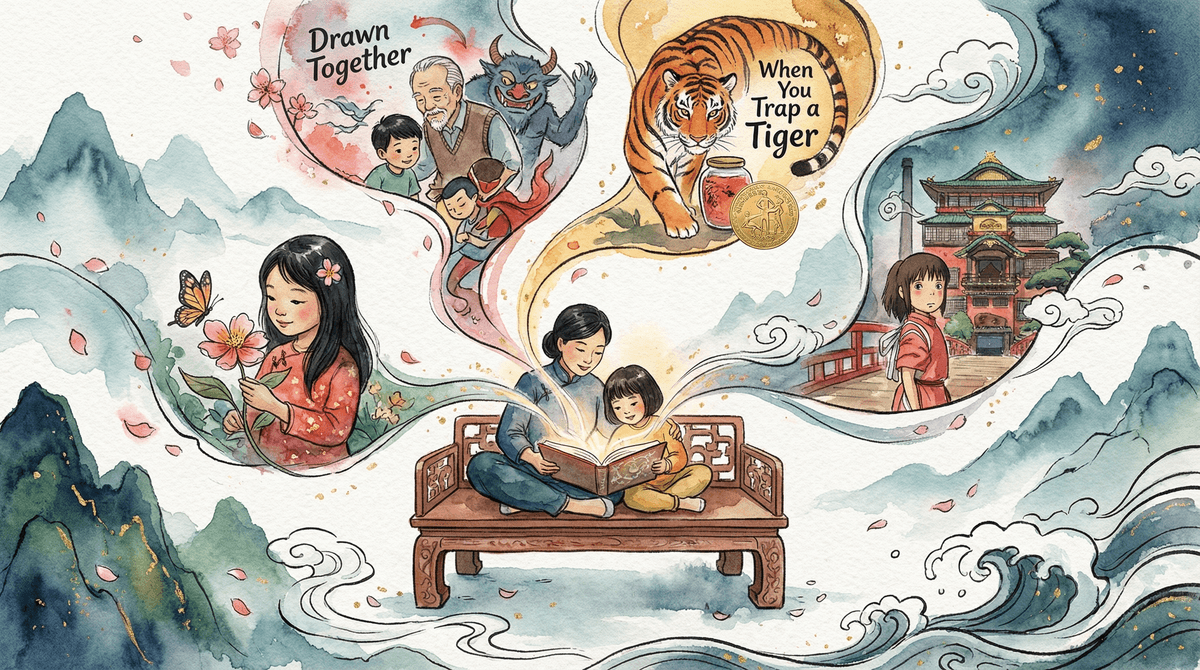
- Drawn Together by Minh Lê beautifully captures the language barrier between a boy and his grandfather, connected through art
- For shows, Bluey has an episode featuring a Balinese shadow puppet show that's actually thoughtfully done
Ages 8-12: Middle Grade Magic
This age group is READY for more complex narratives about identity, family expectations, and cultural navigation.
- Front Desk by Kelly Yang (and the whole series) follows a Chinese immigrant family running a motel in California—it's funny, heartbreaking, and deals with real issues like racism and economic struggle
- When You Trap a Tiger by Tae Keller weaves Korean folklore into a contemporary family story about a grandmother's illness
- Avatar: The Last Airbender remains one of the best examples of Western creators thoughtfully drawing from Asian cultures (though it's worth talking about cultural appreciation vs. appropriation
 )
)
Ages 13+: Teen Complexity
Teens can handle—and need—stories that grapple with identity, diaspora experience, and cultural complexity.
- The Poppy War by R.F. Kuang is dark fantasy based on Chinese history (content warning: it gets DARK, think more Game of Thrones than Harry Potter)
- Pachinko by Min Jin Lee follows four generations of a Korean family in Japan—it's technically adult lit but mature teens can handle it
- For shows, Squid Game sparked massive conversations about class and capitalism, though it's absolutely NOT for younger teens (it's rated TV-MA for very good reasons)
Here's where I'm going to push back on something: you don't need to turn every Asian story into a Teaching Moment™.
Sometimes a kid just wants to watch Pokémon because it's fun. Sometimes they want to read a graphic novel set in Seoul because the art is cool and the story is engaging. That's completely fine.
Cultural exposure doesn't have to be medicinal. In fact, the best kind of representation is when it's so normalized that kids don't even think about it as "diverse content"—it's just... content.
That said, there are moments worth pausing for conversation:
- When cultural practices show up (why do characters take their shoes off indoors?)
- When language is used (what does "arigato" mean and why does context matter?)
- When stereotypes appear (yes, even in Asian-created media—learn more about how Asian media can perpetuate its own stereotypes)
This is where it gets tricky. Asia isn't a monolith—it's dozens of countries, hundreds of languages, thousands of distinct cultural practices. A story set in Tokyo is wildly different from one set in Mumbai or Seoul or Bangkok.
Some questions to consider:
- Who created this? Own-voices stories (created by people from that culture) often have more nuanced perspectives
- Is this a stereotype or a cultural truth? (The "tiger mom" trope vs. actual exploration of different parenting philosophies)
- What's the intent? Is this culture being used as window dressing or is it integral to the story?
But also: don't let perfect be the enemy of good. A well-intentioned story that gets some details wrong is still better than no exposure at all.
Your kids are probably playing games with Asian influences whether you realize it:
- Genshin Impact draws heavily from Chinese culture and mythology
- Okami is steeped in Japanese folklore and Shinto beliefs
- Ghost of Tsushima is a Western studio's take on samurai culture (and sparked interesting debates about cultural appreciation in gaming)
Games can be incredible vehicles for cultural immersion—when done thoughtfully.
Diversifying your family's media diet with Asian stories isn't about checking a box or being "woke" (god, I hate that term). It's about giving your kids a fuller, richer understanding of the world they're growing up in.
Start small. Pick one book, one show, one game. See what resonates. Follow your kid's interests—if they're already into anime, lean into that and add context. If they love fantasy, find fantasy rooted in Asian mythology.
And remember: you're not expected to be an expert on every Asian culture. You're just expected to be curious, respectful, and willing to learn alongside your kids.
This week:
- Check out alternatives to Disney movies for Studio Ghibli recommendations
- Browse your library's "Own Voices" section (most have them now)
- Ask your kid what they already know about Asian cultures—you might be surprised
This month:
- Have a family movie night with an Asian film (subtitles are good for kids, actually—builds reading skills)
- Visit an Asian cultural center or museum if you have one nearby
- Try cooking a meal from an Asian culture you're learning about together
This year:
- Build a diverse bookshelf that reflects the actual world, not just one corner of it
- Learn about how the algorithm shapes what your kids consume and actively counter it with intentional choices
You've got this.