

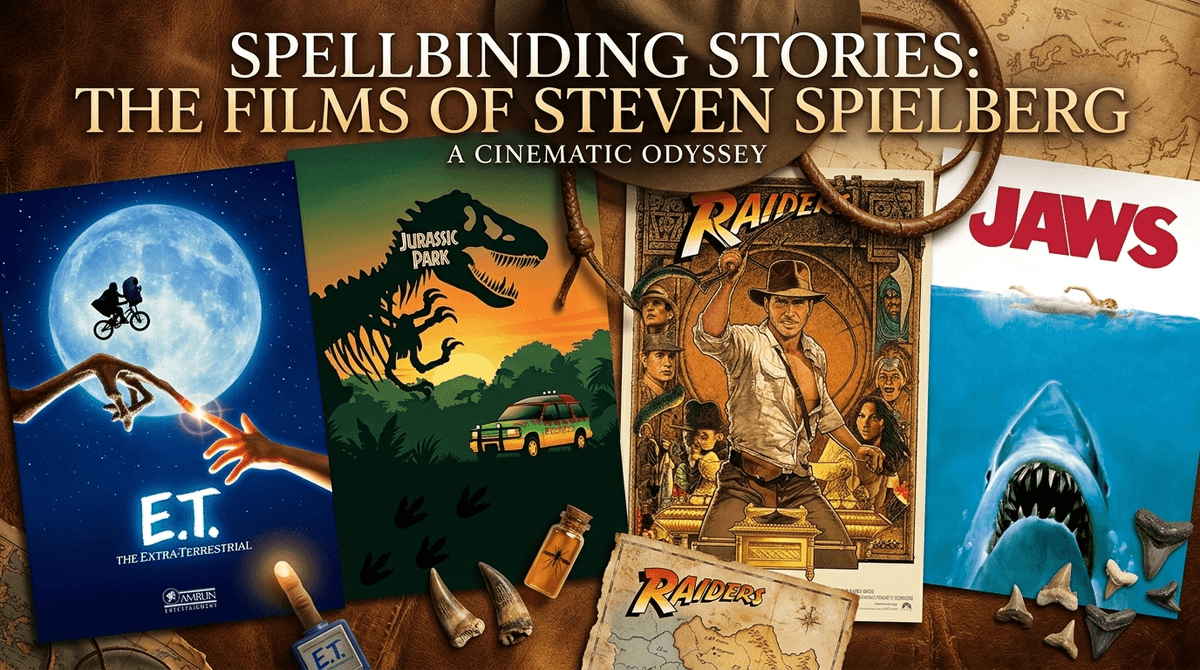
TL;DR: The Spielberg Essentials If you’re looking to move past the "brain rot" of 2-minute YouTube clips and introduce your kids to actual cinema, these are the non-negotiables:
- The "First Movie" Experience: E.T. the Extra-Terrestrial (Ages 7+)
- The Ultimate Adventure: Raiders of the Lost Ark (Ages 10+)
- The "Science is Cool/Terrifying" Pick: Jurassic Park (Ages 10+)
- The Modern Underrated Gem: The Adventures of Tintin (Ages 8+)
- The History Lesson: Schindler’s List (Ages 15+)
We spend a lot of time worrying about what our kids are scrolling through on TikTok or why they’re obsessed with Skibidi Toilet, but we often forget to offer them the "good stuff" as an alternative. Steven Spielberg isn't just a director; he’s basically the architect of the modern childhood imagination.
His films are the antidote to the over-stimulated, fast-cut editing of modern kids' media. He knows how to let a camera linger on a face to show wonder, fear, or empathy. If you want to build a family culture around "intentional viewing," Spielberg is your starting line. He handles "scary" without being traumatizing (mostly) and "emotional" without being sappy.
Plus, let’s be real: watching Jurassic Park together is a much better bonding experience than watching someone else play Roblox on a tablet.
At this age, kids are moving out of the purely animated world and starting to handle live-action stakes. Spielberg is the master of the "child’s eye view."
This is the gold standard. It’s a movie about a lonely kid and a weird-looking alien, but it’s actually a masterclass in empathy.
- The No-BS Take: It’s slow by today’s standards. Your kids might fidget for the first 20 minutes. Stick with it. The scene where E.T. is dying in the medical tent is still one of the most intense things a 7-year-old will see, but the payoff is worth the tears.
- Parental Note: There is some mild 80s-era swearing ("penis breath," anyone?) and the government guys in hazmat suits are legitimately creepy.
If your kids aren't ready for the tension of E.T., this Roald Dahl adaptation is much gentler. It’s whimsical, visually stunning, and features a giant who catches dreams.
- Why it works: It’s a great bridge if they’ve already read The BFG by Roald Dahl. It’s one of Spielberg’s "softer" films, making it perfect for sensitive kids who aren't ready for jump scares.
Okay, critics hated this movie when it came out, but for kids? It’s pure magic. Rufio, the Lost Boys, the imaginary food fight—it’s the ultimate "what if I never grew up?" story.
- The No-BS Take: It’s way too long. At 2 hours and 22 minutes, feel free to pause this halfway through for a snack break. Robin Williams is a legend, but the plot drags in the middle. Still, the "You are the Pan" moment hits home every time.
Check out our guide on finding movies for sensitive kids
This is the sweet spot for Spielberg. This is where the stakes get higher, the action gets louder, and the "cool factor" goes through the roof.
If you haven't shown your kid this movie yet, what are you waiting for? It’s the perfect film. The CGI from 1993 somehow looks better than most Marvel movies today because Spielberg used practical animatronics.
- The No-BS Take: It is scary. The T-Rex attack and the raptors in the kitchen are high-tension sequences. If your kid is still checking under the bed for monsters, maybe wait a year. But for a 10-year-old? It’s a rite of passage.
- Digital Wellness Tip: This is a great time to talk about "just because we can, doesn't mean we should"—a conversation that applies perfectly to AI and ChatGPT.
Indiana Jones is the hero we want our kids to have: he’s smart, he’s a professor, and he’s incredibly cool under pressure.
- The No-BS Take: The ending. You know the one. The face-melting. It’s gross. It’s glorious. It’s also very 1981. If you think your kid will have nightmares about melting Nazis, maybe tell them to "close their eyes" like Indy does.
This is Spielberg's only fully animated feature, and it’s basically an Indiana Jones movie for the younger set. It’s fast-paced, funny, and looks incredible.
- Why it matters: It’s a great "intro to mystery" film. It respects the source material (The Adventures of Tintin books) while amping up the action for a modern audience.
Once they hit the teen years, you can start using Spielberg to tackle the heavy stuff—history, ethics, and the complexity of the human spirit.
The original summer blockbuster. It’s less about the shark and more about the three men on the boat.
- Why it works: It teaches kids about pacing and suspense. In an era of MrBeast videos where something explodes every 3 seconds, Jaws is a masterclass in waiting for the payoff.
- Parental Note: There’s some 70s-style "rough talk" and, obviously, people get eaten. It’s a bit bloody, but mostly it’s just tense.
Leonardo DiCaprio as a teenage con artist. It’s stylish, fun, and surprisingly emotional.
- How to talk about it: It’s a perfect opening to talk about identity, divorce, and the consequences of "faking it." It’s also a great look at a pre-digital world where you could forge a check without a computer.
This isn't a "fun" family movie night pick, but it is an essential one. When your teen is learning about WWII in school, this is the definitive cinematic text.
- The No-BS Take: It’s brutal. It’s black and white. It’s three hours long. It features nudity and extreme violence. It is also one of the most important films ever made. Save this for when they are mature enough to handle the weight of the Holocaust.
Find historical movies for teens
Spielberg movies are generally "safe," but they come from a different era. Here’s what to look out for:
- Language: 80s PG was basically today’s PG-13. Movies like The Goonies (which Spielberg produced) and E.T. have kids saying things you might not want your 6-year-old repeating.
- Scare Factor: Spielberg loves "the reveal." Whether it’s a shark fin or a vibrating cup of water, he’s the king of suspense. If your kid has high anxiety, screen these first.
- Broken Homes: Almost every Spielberg movie features a kid with an absent or struggling father. If your family is going through a transition, these movies can be either very healing or a bit of a trigger.
The term "Amblin-esque" gets thrown around a lot (think Stranger Things). It refers to that specific feeling of "ordinary kids in extraordinary circumstances."
When you watch these with your kids, you’re teaching them that:
- Kids can be the heroes. They don't need superpowers; they just need a bike and a plan.
- Wonder is important. In a world of cynical memes, Spielberg unironically believes in the "magic" of the universe.
- Family is messy. His movies don't depict perfect families, and that's why they still resonate.
You don't need a fancy home theater to make these movies special. You just need to put the phones away, grab some popcorn, and let the master storyteller do his thing. Start with E.T. for the heart, move to Jurassic Park for the thrills, and use The Adventures of Tintin for a rainy Saturday afternoon.
- This Weekend: Pick one movie from the "Gateway" list and have a dedicated "No-Phone Friday."
- The Follow-Up: After the movie, ask your kid: "If you found an alien in the shed, what’s the first thing you’d show them on Earth?" (Expect them to say Minecraft or a specific YouTube video).
- Deep Dive: If they love the adventure, check out our guide on movies like Indiana Jones.