

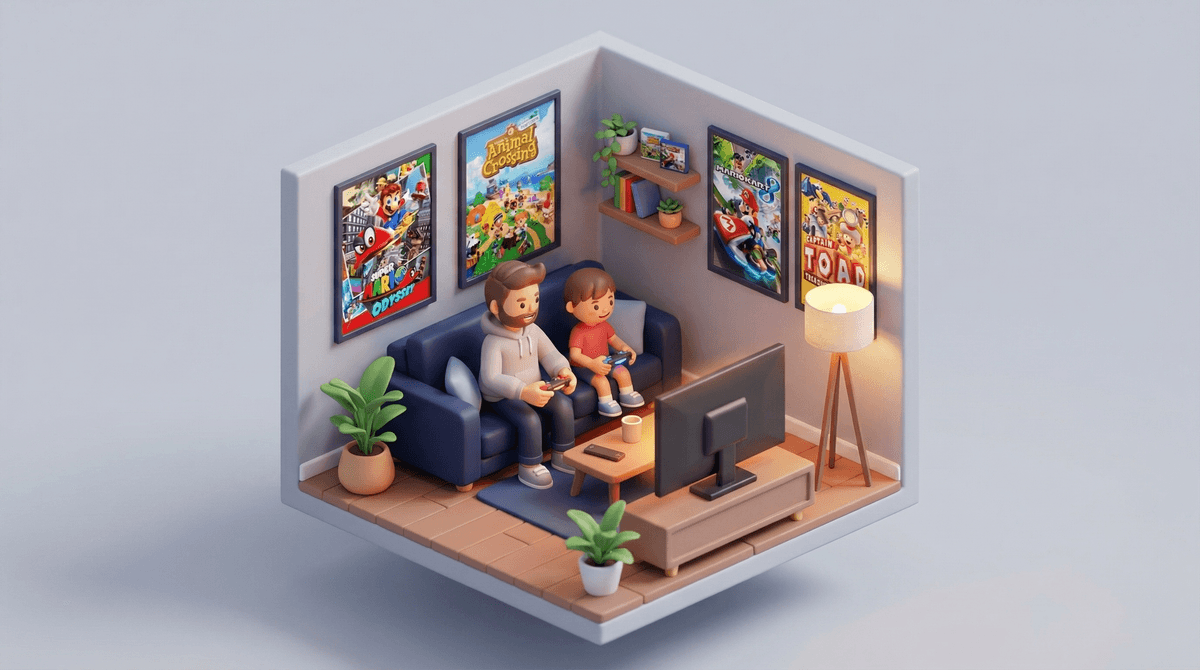
Look, if you're reading this, you've probably already realized that gaming isn't going anywhere. Your kid wants to play, their friends are playing, and you're standing there thinking "I haven't touched a controller since Mario Kart 64" (which, by the way, still holds up).
Starter games are exactly what they sound like: games that are genuinely fun for both beginners and experienced players, have intuitive controls, don't require 40 hours of commitment to understand the plot, and won't have your kid screaming into a headset at strangers. These are the games that can turn "ugh, screen time" into actual quality time together.
The best part? Starting with the right games means you're not just supervising gaming—you're actively shaping how your family approaches it. You're building shared vocabulary, establishing what good sportsmanship looks like, and honestly? You might actually have fun.
Here's the thing: most kids are going to game. According to recent data, over 90% of kids play video games by age 12. The question isn't whether they'll play, but how they'll learn to play.
When you start gaming together with beginner-friendly titles, you're:
- Building literacy in a medium that's not going away
- Creating shared experiences that actually interest your kid (revolutionary, I know)
- Establishing norms before they're deep in Fortnite asking for V-Bucks
- Modeling how to handle losing, winning, and the rage-quit moments in between
Plus, and this is key: if you understand gaming even a little bit, you'll be way better equipped to make decisions about Roblox, Minecraft, and whatever comes next.
Cozy Co-Op Games (Ages 6+)
Animal Crossing: New Horizons - This is the game that got millions of adults through 2020, and it's genuinely perfect for families. You're building an island, decorating, catching bugs, and there's literally no way to die or fail. One kid can have their own island, or you can share one and take turns. The worst thing that happens is you accidentally plant flowers in the wrong spot.
Stardew Valley - Farming simulator meets life sim. You inherit a farm, plant crops, make friends with townspeople, and gradually build your little empire. It's got more depth than Animal Crossing (there are mines to explore, relationships to build), but it's still fundamentally chill. Great for kids 8+ who like having goals and systems to optimize.
Puzzle Games That Don't Feel Like Homework (Ages 7+)
Portal 2 - Okay, hear me out. Yes, it's a puzzle game about physics and portals. But the co-op mode is brilliant for parent-kid teams. You have to actually communicate and work together to solve rooms. It teaches spatial reasoning, problem-solving, and how to say "no, the OTHER blue portal" without losing your mind. The humor is genuinely funny (not just "kid funny"), and it's appropriate for ages 10+.
Captain Toad: Treasure Tracker - This is perfect for younger kids (6-9) who are ready for 3D games but not ready for complex controls. You rotate the camera around little diorama levels and solve simple puzzles. It's forgiving, adorable, and you can easily play together by passing the controller or working through puzzles verbally.
Platformers (The Mario Effect) (Ages 5+)
Super Mario Odyssey - This is the gold standard. It's got an "assist mode" that makes it accessible for true beginners, but enough depth that experienced players stay engaged. The two-player mode lets one person control Mario and another control his hat (Cappy), which is perfect for a younger kid who's still learning controls.
Super Mario Wonder - The newest 2D Mario game, and it's fantastic for families. Up to four players can play together, it's got creative power-ups, and the difficulty curve is gentle enough for beginners while still being engaging. Kids as young as 5 can participate meaningfully with some help.
Kirby and the Forgotten Land - Kirby games are specifically designed to be beatable by everyone. You can't really die (you have tons of health), the controls are simple, and the co-op mode is drop-in/drop-out. Perfect for ages 5-8, though older kids enjoy it too.
Creative Building (Ages 7+)
Minecraft - Yes, it's everywhere. Yes, it's kind of ugly. Yes, it's actually great for families. Start in Creative Mode where you can't die and just build together. Once everyone's comfortable, try Survival Mode on Peaceful difficulty. The learning curve is real, but there's a reason this game has maintained popularity for over a decade. Check out our Minecraft parental controls guide before diving in.
LEGO games (any of them) - Pick a franchise your family likes (Star Wars, Harry Potter, Marvel, whatever) and grab that LEGO game. They're all co-op, they're all forgiving, and they're all filled with dad jokes. The games practically play themselves in terms of direction, so you can focus on smashing stuff and collecting studs together.
Party Games (Ages 6+)
Mario Kart 8 Deluxe - The definitive family racing game. It has steering assists and auto-acceleration for younger players, so even a 5-year-old can participate and not just spin out constantly. Fair warning: this game will cause some competitive feelings. Use it as an opportunity to practice gracious winning and losing.
Overcooked! 2 - Chaotic cooking game where you work together to prepare and serve meals under time pressure. It's hilarious, it requires real communication, and it's a great way to practice staying calm under pressure. Best for ages 8+ who can handle a bit of stress (it gets genuinely frantic).
About controls: Modern games often have accessibility options that weren't around when we were kids. Look for games with "assist modes," "auto-aim," or "invincibility" options. There's zero shame in using these—they're there to make games more accessible and fun for everyone.
About screen time: Gaming together is fundamentally different from solo screen time. Yes, they're both "screens," but collaborative problem-solving or playing a game together is more like doing a puzzle or playing a board game than it is like scrolling TikTok. Learn more about different types of screen time .
.
About online features: Many of these games have online components, but they're not required. When you're starting out, stick to local co-op (playing together on the same console/TV) or turn off online features entirely. You can gradually introduce online play when everyone's ready.
About cost: Gaming can get expensive fast. The games listed here range from $15-60, and you need the console (Switch, PlayStation, Xbox, or PC). But here's the thing: one $40 game that your family plays together for 20 hours is probably a better investment than four $10 movies you watch once. Libraries often have games you can borrow, and digital sales are frequent.
About difficulty: If a game feels too hard, it probably is—for now. There's no rush. Come back to it in six months. Kids' motor skills and problem-solving abilities develop fast. A game that's frustrating at 7 might be perfect at 8.
Ages 5-7: Focus on games with simple controls, clear objectives, and no real failure states. Kirby games, Super Mario Wonder, and Animal Crossing are your sweet spot. Keep sessions to 30-45 minutes.
Ages 8-10: You can introduce games with more complex mechanics and light strategy. Minecraft, Mario Kart, and LEGO games work great here. They can probably handle 60-minute sessions now, but watch for fatigue.
Ages 11+: Most of the games on this list are fair game now. You can start introducing games with more challenging puzzles (Portal 2) or light combat (Minecraft in Survival Mode). This is also when you might start having conversations about online gaming and what that looks like for your family.
The "right" starter game is the one that matches your family's interests and skill levels. Love Star Wars? Start with LEGO Star Wars. Want something chill? Go with Animal Crossing or Stardew Valley. Want to laugh together? Try Overcooked! 2.
The goal isn't to become a "gaming family" (unless you want to be). The goal is to understand the medium your kids are growing up with and to create some positive shared experiences along the way.
And honestly? When your kid inevitably asks about Fortnite or Roblox, you'll be way better equipped to have that conversation if you've actually held a controller and understand why gaming is appealing.
- Pick one game from this list based on your kid's age and interests
- Set a time to play together—make it a regular thing, like Friday pizza night but with Mario Kart
- Start simple: Use assist modes, play on easy difficulty, take breaks
- Talk about it: What was fun? What was frustrating? What should we try next?
- Build from here: Once you've got one game under your belt, you'll have a much better sense of what works for your family
Want to dive deeper into specific games or figure out what's next after you've mastered these? Get game recommendations for your family.