

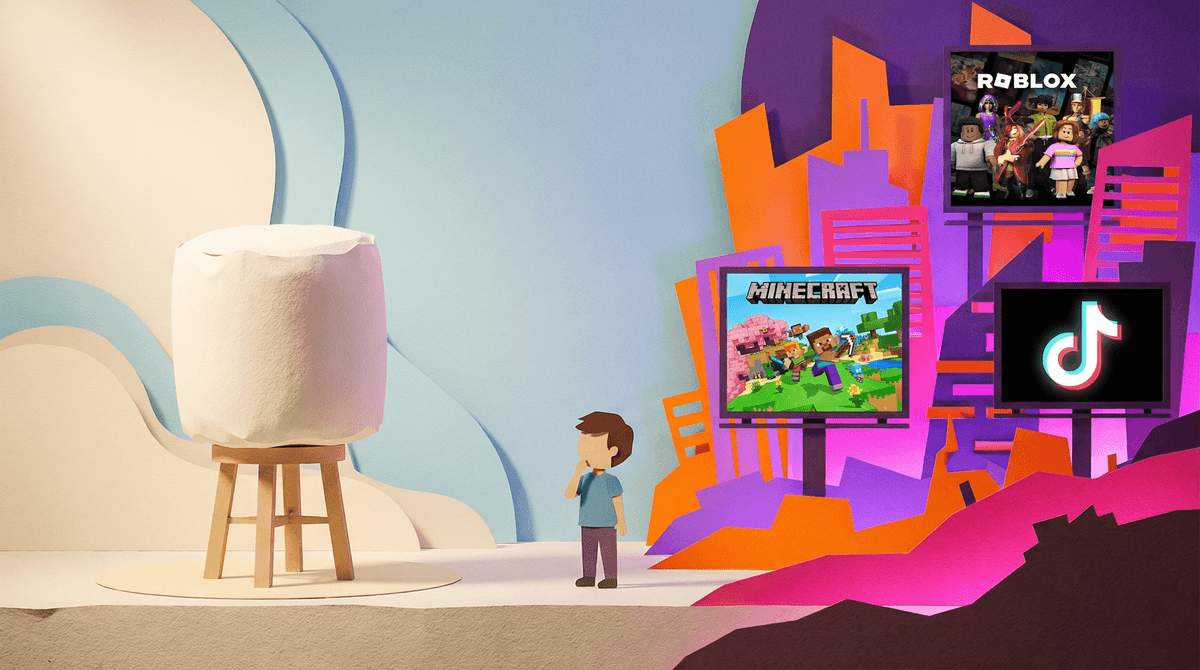
Self-control is the ability to pause between wanting something and doing something about it. It's the mental muscle that lets your kid not click "buy" on that Robux package, finish homework before opening Roblox, or turn off the TV when you say "one more episode" actually means one more episode.
In psychology circles, it's called self-regulation or executive function, but honestly? It's just the gap between impulse and action. And in 2026, when every app is literally engineered by teams of PhDs to collapse that gap, it's become the most important skill we're not teaching.
Here's what makes this fascinating: self-control isn't about being "good" or obedient. It's about being able to choose your behavior instead of just reacting to whatever stimulus is loudest. The kid who can wait for the marshmallow isn't more virtuous—they're just better at keeping their future self in mind while their present self really, really wants that marshmallow.
You know that Stanford marshmallow experiment everyone references? Turns out the ability to delay gratification at age 4 predicted SAT scores, BMI, and even substance abuse rates decades later. But here's the thing nobody mentions: those kids were tested in 1972, before every pocket contained an infinite dopamine slot machine.
Today's kids are navigating a world where:
- Every game has a store with limited-time offers creating artificial urgency
- Every video autoplays the next one before they can even think about stopping
- Every app sends notifications designed to interrupt whatever they're doing
- Every platform has infinite scroll so there's never a natural stopping point
The digital environment is specifically designed to bypass self-control. It's not a level playing field. Your kid isn't "bad at self-control"—they're up against billion-dollar companies whose entire business model depends on eroding it.
Learn more about how app design exploits kids' developing brains
Self-control lives in the prefrontal cortex, which is basically the brain's CEO. It handles planning, impulse control, emotional regulation, and thinking about consequences. Cool fact: it's not fully developed until the mid-20s. Less cool fact: it's also the first part of the brain to go offline when kids are tired, hungry, stressed, or overstimulated.
This is why your 10-year-old can show amazing self-control at 10am (finishing that math worksheet before asking for screen time) and zero self-control at 6pm (complete meltdown over having to turn off Minecraft).
Self-control is a limited resource. Every decision your kid makes—what to wear, whether to share the toy, resisting the urge to interrupt—depletes it. By evening, the tank is empty. This is called decision fatigue, and it's why the after-school/before-dinner window is when everything falls apart.
Ages 4-6: Self-control means waiting their turn, not grabbing toys, and (maybe) not having a meltdown when you say no. Screen-wise, it's learning that "5 more minutes" means 5 minutes, not 5 minutes plus negotiation plus crying. Expect to do a lot of the regulating for them.
Ages 7-9: They can start to delay gratification with a visible reward system. They understand "if you finish homework, then screens," but they'll still need reminders. They're beginning to internalize rules but haven't automated them yet. This is when you'll hear "I know, I know" as they do the thing you just told them not to do.
Ages 10-12: The self-control is there... sometimes. They can plan ahead ("I'll save my allowance for that skin") but impulse purchases still happen. They understand consequences but their brains still prioritize immediate rewards. They're also starting to develop their own systems—some kids at this age get really into tracking their screen time or setting their own limits.
Ages 13+: Self-control becomes more consistent, but it's also under more pressure from social dynamics, academic stress, and hormones. Teens can show incredible self-discipline in areas they care about (grinding in Elden Ring, practicing an instrument) while completely falling apart in areas they don't (homework, chores, sleep schedules).
1. Start with structure, not willpower
You wouldn't expect a kid to learn math through pure willpower—you'd teach them the concepts and give them practice problems. Same with self-control. Create environments that make the right choice easier:
- Charge devices outside bedrooms overnight
- Use app timers so they don't have to be the bad guy
- Create physical distance between kid and temptation during homework time
- Have a visible family calendar so "later" has a specific time
2. Practice with low-stakes decisions
Let them manage small amounts of money (physical cash works better than digital for learning). Let them choose between dessert now or a bigger dessert later. Let them budget their weekend screen time across Saturday and Sunday. The goal is repetition in situations where failure isn't catastrophic.
3. Name the skill when you see it
"You really wanted to keep playing, but you stopped when the timer went off. That's self-control." "You saved your Robux instead of spending it right away. You're thinking about future you." Kids need to know what self-control feels like so they can recognize it.
4. Reduce the number of decisions they have to make
Decision fatigue is real. If they're using all their self-control to get through the school day, they'll have nothing left for screens. Create routines that don't require decisions: homework happens at this time, screens happen after, dinner is at this time. Routines are self-control on autopilot.
5. Teach the pause
The magic of self-control happens in the pause between impulse and action. Teach them to notice the impulse: "I really want to buy this skin right now." Then pause: "Let me wait until tomorrow and see if I still want it." This is a learnable skill. Start with 10 seconds, then 10 minutes, then overnight.
Here's where this gets really practical: every screen time battle is actually a self-control teaching opportunity. When you say "time to turn off the iPad" and they can't, that's not defiance—that's a self-control skill gap.
The kid who can't stop scrolling TikTok isn't lazy or addicted—they're trying to use a skill they haven't fully developed yet against an app that's optimized to override that exact skill. It's like asking them to arm-wrestle a hydraulic press.
This is why parental controls aren't "cheating"—they're scaffolding. You're providing the external structure while their internal structure develops. Over time, you gradually remove the scaffolding as they demonstrate they can handle more autonomy.
Shame and guilt: "Why can't you just stop?" "Your sister can control herself." This doesn't build the skill, it just makes them feel bad about not having it yet.
Expecting consistency: Some days will be better than others. That's normal. Self-control is affected by sleep, stress, hunger, and how many decisions they've already made today.
All-or-nothing thinking: Self-control isn't binary. Your kid might be great at stopping video games but terrible at resisting snacks. Different contexts require different levels of the skill.
Assuming it's about motivation: "If you really wanted to, you could stop." Self-control is a skill, not a character trait. Wanting to do something doesn't automatically give you the ability to do it.
Self-control is the skill that makes every other skill possible. It's how kids learn to practice instruments, finish homework, save money, maintain friendships, and yes—manage their screen time without constant parental intervention.
But it's also a skill that develops slowly, unevenly, and with lots of practice. Your job isn't to expect perfect self-control from a developing brain. Your job is to create the conditions where that skill can grow: structure, practice, low-stakes failures, and lots of patience.
The good news? Every time your kid faces a tempting screen and chooses something else, every time they stop when the timer goes off, every time they save their money instead of spending it—they're building that muscle. It's slow, it's frustrating, and some days it feels like you're going backwards. But it's happening.
And unlike intelligence, which is pretty fixed, self-control is genuinely improvable. That's actually kind of amazing.
- Notice when your kid shows self-control and name it specifically
- Identify one area where you can add structure to reduce the number of decisions they need to make
- Pick one low-stakes opportunity for them to practice (managing allowance, choosing when to use screen time within a window, etc.)
- Explore how to set up better digital boundaries that support rather than replace self-control