

Beyond the Timer: Navigating Screen Time Guidelines for Toddlers
Ditch the guilt and discover how the latest research on joint engagement can turn screen moments into developmental wins.
TL;DR: Stop obsessing over the exact number of minutes and start looking at what they are watching and who they are watching it with. The "cheat code" for toddler development is Joint Media Engagement (JME)—basically, talking about the screen. Avoid the "brain rot" of high-speed sensory overload and stick to "slow media."
Top Picks for Littles:
- Best Show: Bluey
- Best YouTube: Songs for Littles (Ms. Rachel)
- Best App: Khan Academy Kids
- Best "Slow" Show: Trash Truck
If you’ve looked at the American Academy of Pediatrics (AAP) guidelines recently, you know they suggest zero screen time (except video chatting) for kids under 18-24 months, and then an hour a day of "high-quality programming" for kids ages 2 to 5.
That sounds great on paper. But in the real world—where you have a conference call, a stomach flu, or a toddler who refuses to let you cook dinner without clinging to your leg like a sentient barnacle—those guidelines can feel like a guilt trip.
The truth is, the quality of the media and the context of how it’s used matter much more than a rigid timer. We’re moving away from "how much" and toward "how well."

Not all toddler media is created equal. You’ve probably heard the term "brain rot" used by Gen Z, but for toddlers, it’s a very real physiological thing.
Shows like Cocomelon are often criticized because they are edited with "hyper-fast" cuts—scene changes every 1-3 seconds. This creates a dopamine loop that keeps a toddler’s eyes glued to the screen, but it’s essentially "digital candy." It’s overstimulating, and when the screen finally turns off, the "crash" often results in a massive tantrum because the real world just doesn't move that fast.
On the flip side, we have "Slow Media." These are shows with longer shots, calmer pacing, and a focus on social-emotional learning rather than just flashing colors and loud noises.
This is a masterclass in slow media. The colors are muted, the dialogue is gentle, and the pacing matches the actual speed of a toddler's life. It’s calming rather than overstimulating.
Narrated by Chris O'Dowd, this show is basically a nature documentary for toddlers. It’s beautiful, educational, and won’t leave your kid vibrating with excess energy.
The gold standard for social-emotional tools. It’s the direct descendant of Mister Rogers, and it actually gives parents a vocabulary to help toddlers handle big feelings.
Check out our guide on alternatives to Cocomelon
Research shows that toddlers have a "video deficit." They struggle to transfer what they see on a 2D screen to the 3D world. If a screen shows a ball rolling, a 2-year-old might not realize that’s the same thing as the ball in their toy box.
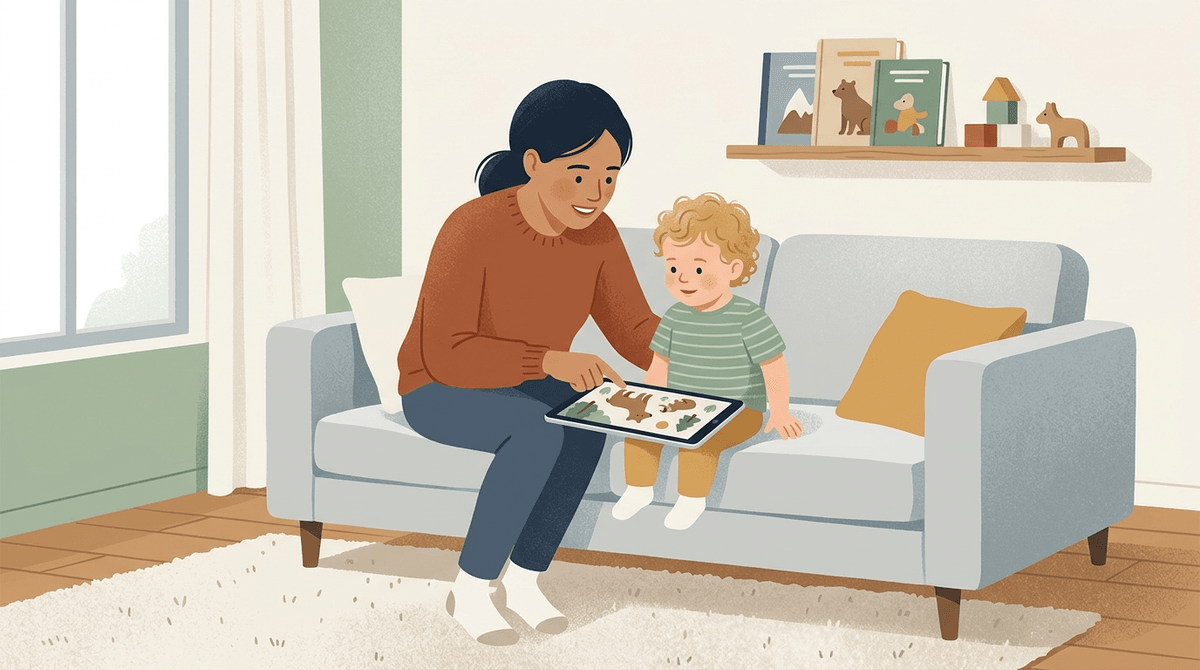
Joint Media Engagement (JME) fixes this. JME is just a fancy way of saying "watch it with them and talk about it."
When you sit with your toddler and say, "Look, the blue dog is sad. Why is he sad?" or "Can you find the yellow circle on the screen?", you are bridging that gap. You are turning a passive, numbing experience into an active, linguistic one. Even 15 minutes of co-viewing is more beneficial than two hours of a kid sitting alone in a "digital trance."
If you’re going to hand over an iPad, skip the "freemium" games that are littered with ads and "buy more coins" buttons. For toddlers, we want "open-ended" play.
This is a digital busy board. There are no levels, no winning, no losing, and no points. It’s just toys that make noise and move when you touch them. It encourages curiosity rather than "beating the game."
Sago Mini is the king of toddler apps. It’s whimsical, safe, and focuses on creative play. Your kid can give a robot a bath or fly a bird through a forest. It’s intuitive and high-quality.
If you want something purely educational that is actually free (no ads, no subscriptions), this is it. It’s incredibly well-designed and covers everything from reading to logic puzzles.
Read our full guide on the best apps for 2-year-olds
YouTube is the Wild West. Even YouTube Kids can sometimes let weird, AI-generated "Elsagate" style content slip through the cracks. If you use YouTube, we recommend sticking to specific, trusted channels rather than letting the autoplay algorithm take the wheel.
There is a reason Ms. Rachel is a billionaire-tier celebrity to the under-4 crowd. She uses techniques used by speech therapists (close-ups of the mouth, pauses for the child to respond). It is the closest thing to JME you can get when you actually have to be in the other room.
The name says it all. The animation is clean, the songs are classics, and it’s not nearly as frantic as other nursery rhyme channels.
Ages 0-18 Months
Stick to video chatting. Seeing Grandma’s face on FaceTime is a social interaction, not just "screen time." The brain treats it differently because Grandma is responding in real-time.
Ages 18-24 Months
If you introduce media, make it high-quality and co-viewed. This is the time to introduce Ms. Rachel or simple interactive books.
Ages 2-4 Years
This is where the "hour a day" guideline usually kicks in. Focus on "pro-social" content like Sesame Street or Bluey. This is also a great age to introduce "digital chores"—helping you "check the weather" or "send a photo to Dad."
The hardest part of screen time isn't the watching; it's the stopping.
Toddlers have zero impulse control. When you take the screen away, you are physically removing a high-dopamine stimulus, which often triggers a "fight or flight" response (the meltdown).
How to handle the transition:
- Give warnings: "One more episode," or "When the timer goes off, we say bye-bye to the iPad."
- Visual timers: Use a physical kitchen timer or an app so they can see the time disappearing.
- The "Bridge" Activity: Have a high-value physical activity ready for the transition. "When the show is over, we’re going to go outside and bubbles!"
- Let them push the button: Giving the toddler the "power" to turn off the TV or close the iPad lid can reduce the feeling of powerlessness that leads to tantrums.
Learn more about how to handle screen time tantrums
Screens are a tool, not a monster. If you use them to help your child learn a new skill, to calm down after a long day, or simply to give yourself 20 minutes of sanity, that is okay.
The goal of being Screenwise isn't to be a "No Screen" parent—it's to be an intentional one. Choose slow media, talk about what you see, and don't let the algorithm raise your kid.
- Audit your rotation: Swap one "high-octane" show (like Cocomelon) for a "slow" show (like Trash Truck).
- Try a "Co-Play" session: Sit down for 10 minutes and play Sago Mini World with your toddler. Ask them what the characters are doing.
- Check the community: Use Screenwise to see what other parents in your neighborhood or school district are allowing for their toddlers.