

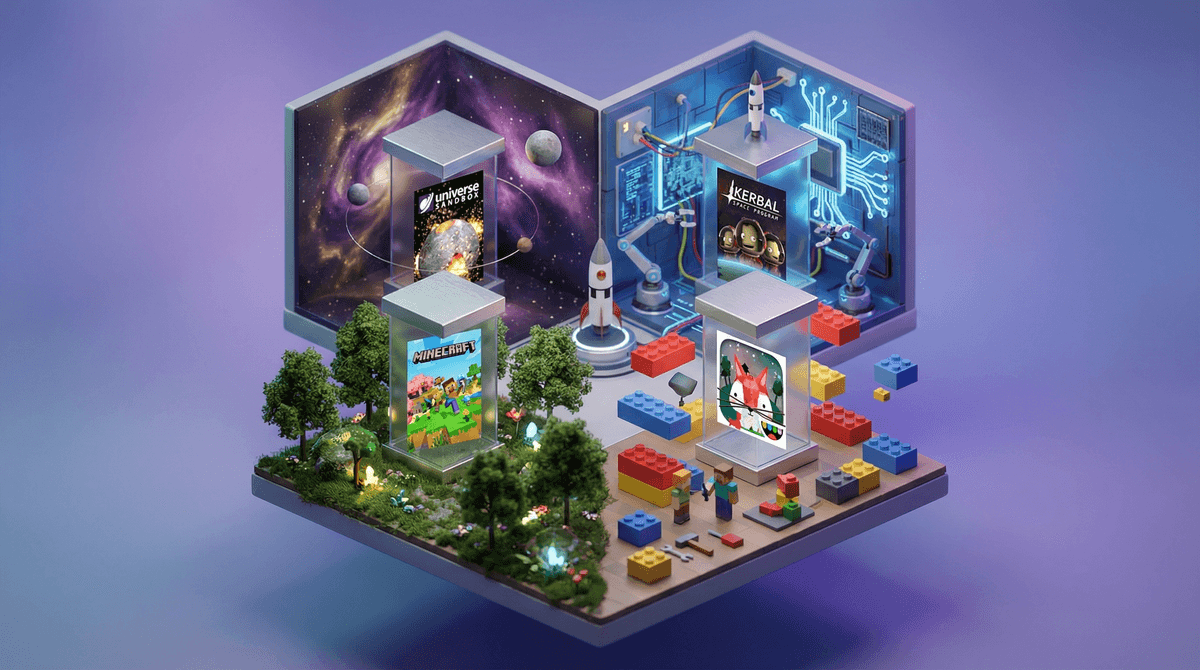
Science games are digital experiences that teach scientific concepts through interactive play—think physics puzzles, virtual chemistry labs, biology simulations, and space exploration adventures. Unlike worksheets disguised as games (looking at you, "educational" apps that are just digital flashcards), good science games make learning feel like discovery.
We're talking about games like Kerbal Space Program, where kids accidentally learn orbital mechanics while trying to launch adorable aliens into space, or Universe Sandbox, where they can literally smash planets together to understand gravity and scale. Even Minecraft can become a science lab when kids start building redstone circuits or experimenting with biomes.
The best science games don't feel like homework—they feel like play. And that's exactly the point.
Here's the thing about science games: they work because they let kids fail safely and repeatedly. In a chemistry game, you can mix the wrong compounds and watch a virtual explosion without burning down the garage. In a physics puzzler, you can test ten different solutions to see which one actually works.
This is how real science happens. Scientists don't get it right the first time—they hypothesize, test, fail, adjust, and try again. Science games naturally teach the scientific method without ever making kids memorize the steps.
Plus, these games often provide immediate feedback. Drop a virtual ball? You instantly see how gravity works. Change one variable in an ecosystem simulation? You watch the ripple effects in real-time. This cause-and-effect learning sticks way better than reading about it in a textbook.
Ages 4-7: Curiosity Builders
At this age, we're planting seeds of curiosity, not teaching the periodic table. Look for games with simple cause-and-effect mechanics and lots of "what happens if..." moments.
- Toca Nature lets little kids build ecosystems and watch how animals interact
- [Sago Mini Ocean Swimmer](https://screenwiseapp.com/media/sago-mini-ocean-swimmer-game teaches about marine life through gentle exploration
- PBS Kids Games has science-focused minigames featuring characters from shows like Wild Kratts
Ages 8-11: Hands-On Experimentation
This is the sweet spot for science games. Kids have enough reading comprehension to follow instructions but still love playful discovery.
- Kerbal Space Program (ages 10+) is legendary for teaching aerospace engineering through trial and error
- Incredible Machines teaches physics through Rube Goldberg-style puzzles
- Minecraft Education Edition has built-in chemistry and biology lessons
- The Powder Toy is a free physics sandbox where kids can experiment with elements and particles
Ages 12+: Deep Dives
Older kids can handle more complexity and abstract thinking. These games can genuinely teach high school and even college-level concepts.
- Universe Sandbox lets teens play with actual astrophysics simulations
- SpaceChem teaches chemical bonding through puzzle mechanics (it's hard, but incredibly satisfying)
- Plague Inc. might seem dark, but it actually teaches epidemiology and how diseases spread
- Human Resource Machine teaches programming logic and computational thinking
Not all "educational" games are created equal. Some are genuinely engaging learning experiences. Others are just dressed-up drill-and-kill exercises with cartoon characters. The difference? Good science games make kids want to keep playing even when learning gets hard.
Screen time for science games isn't the same as passive watching. When your kid is actively problem-solving, testing hypotheses, and building things in a physics simulator, their brain is working in fundamentally different ways than when they're watching YouTube. That doesn't mean unlimited time, but it does mean you can feel different about 30 minutes of Kerbal Space Program versus 30 minutes of random TikTok scrolling.
These games work best with conversation. The magic happens when you ask questions: "Why do you think that didn't work?" "What would happen if you changed this?" "Can you explain what you just discovered?" This turns gameplay into genuine learning moments.
Some science games have steep learning curves. Games like Kerbal Space Program or SpaceChem can be genuinely difficult. That's actually a feature, not a bug. Kids learn persistence by working through challenges. But it also means these aren't "give them the iPad and walk away" games—especially at first.
Free doesn't mean low-quality. Some of the best science games are free or cheap. The Powder Toy is completely free. Many excellent science games cost less than a movie ticket.
Science games aren't a replacement for hands-on experiments, nature walks, or reading actual books. But they're a legitimate tool in the learning toolkit—especially for kids who respond better to interactive experiences than traditional instruction.
The goal isn't to turn every kid into a future scientist (though that's cool too). It's to build scientific thinking: curiosity, hypothesis testing, comfort with failure, and understanding cause and effect. Those skills matter whether your kid grows up to be an engineer or an artist.
If your kid is already spending time gaming, swapping in even one science-focused game can turn some of that screen time into genuine learning. And unlike math worksheets, they might actually ask to play it again.
Start with one game that matches your kid's interests. Space-obsessed? Try Kerbal Space Program. Loves animals? Check out Toca Nature. Already plays Minecraft? Explore Minecraft Education Edition.
Play together at first. Even 10 minutes of co-playing helps you understand what they're learning and gives you conversation starters later.
Ask about their discoveries. "What did you figure out today?" is way more effective than "What did you learn?"
And remember: if they're having fun while accidentally learning physics, you're winning at modern parenting.