

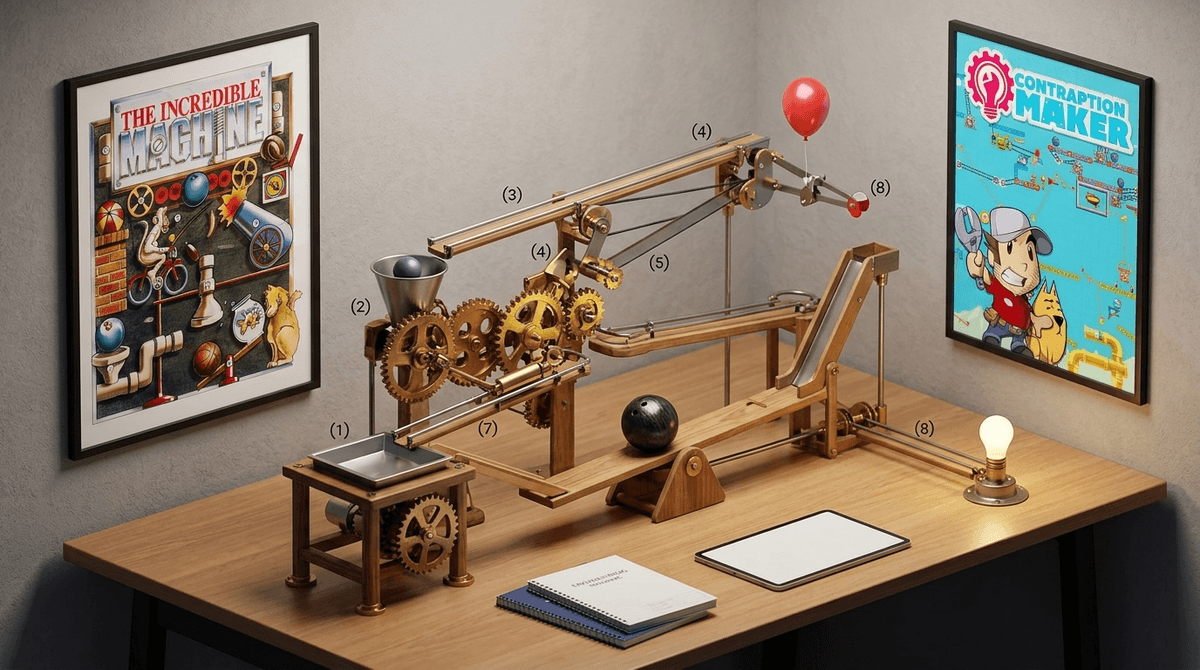
TL;DR: The Incredible Machine is the ultimate "low floor, high ceiling" STEM tool. It’s a series of physics-based puzzle games where kids build Rube Goldberg contraptions to solve simple tasks. No microtransactions, no toxic chat, and no "brain rot"—just pure logic and engineering. If you’re looking for modern versions, check out Contraption Maker or Bad Piggies.
Get more STEM game recommendations
If you grew up in the 90s, you probably remember the distinct sound of a MIDI soundtrack playing while you tried to figure out how to make a cat run on a treadmill to trigger a jack-in-the-box. The Incredible Machine (often called TIM) was the original physics sandbox.
The premise is deceptively simple: you are given a goal (like "turn on the fan" or "feed the fish") and a cluttered toolbox of random items. You might have a few lengths of pipe, a bowling ball, a balloon, a magnifying glass, and a very hungry mouse. Your job is to arrange these parts so that one action triggers another in a giant, ridiculous chain reaction.
It’s essentially a digital Rube Goldberg kit. While the original 1993 version looks "vintage" (read: pixelated) now, the core mechanics are more relevant than ever. It’s about understanding cause and effect, momentum, and gravity—all while feeling like a mad scientist.
We talk a lot about "educational" games, but let’s be real: a lot of them are just math flashcards with a coat of shiny paint. They aren't actually teaching kids how to think; they're teaching them how to recall.
The Incredible Machine is different. It’s a masterclass in the Engineering Design Process:
- Identify the Problem: I need to get this ball into that bucket.
- Brainstorm/Build: What if I use the see-saw and the anvil?
- Test: Hit the "Play" button and watch everything collapse.
- Iterate: Okay, the anvil was too heavy. Let’s try the flashlight and the solar panel instead.
This "trial and error" loop is exactly what we want to see in digital play. It builds frustration tolerance—the ability to fail, laugh at the absurdity of a cat getting hit by a boxing glove, and try again without a meltdown.
While you can still find the original The Incredible Machine on sites like GOG.com, it can be a bit of a hurdle to get running on a modern MacBook or Windows 11 machine. Fortunately, the "physics puzzler" genre is thriving.
Here are the best ways to get that TIM vibe today:
This is the spiritual successor created by the same team that made the original 90s classic. It’s essentially a high-definition version of the original game with thousands of community-created levels. It’s the "Gold Standard" for this type of play. It even includes a "Maker Lab" where kids can build their own puzzles to challenge you.
Created by the Rovio team (of Angry Birds fame), this game flips the script. Instead of knocking things down, you have to build vehicles to get the pigs to the finish line. It uses the same "parts-based" logic as TIM. Just watch out for the typical mobile game ads and prompts to buy "scrap"—the core gameplay is great, but the "freemium" wrapper can be annoying.
If your kid is more into "real world" engineering, this is the one. You have to build bridges to get vehicles across a gap using a limited budget and specific materials (wood, steel, hydraulics). Watching a bridge shatter into a million pieces because you forgot a support beam is both heartbreaking and a fantastic physics lesson.
Ages 12+ This is like the "heavy metal" version of TIM. You build medieval siege engines to destroy windmills and soldiers. It’s much more complex and can be a bit more violent (in a stylized, blocky way), but for an older kid who has outgrown the "cute" animals of TIM, the engineering challenges here are incredibly deep.
Parents often ask if The Incredible Machine is just a 2D version of Minecraft or Roblox. Not exactly.
In Minecraft, the engineering happens mostly through "Redstone," which is more like electrical engineering and logic gates. It’s amazing, but it has a steep learning curve.
Roblox has physics engines, but most kids are playing "Obbys" (obstacle courses) or role-playing games like Adopt Me!, which don't really require much logic.
TIM-style games are pure puzzles. There are no distractions, no skins to buy, and no "prestige" to chase. It’s just your kid’s brain vs. the laws of physics.
- Ages 5-7: They will need your help. At this age, they’ll enjoy watching the "machines" work and placing a few parts, but the logic required to solve the harder puzzles will be frustrating. Look for Pettson's Inventions as a great starter app for this age group.
- Ages 8-11: This is the "Sweet Spot." Kids in 3rd through 5th grade have the spatial reasoning to handle these games independently. They’ll start to see the humor in the puzzles and take pride in finding "unintended" solutions.
- Ages 12+: Challenge them with Kerbal Space Program or the more complex levels in Contraption Maker.
This is the best part for intentional parents: The Incredible Machine and its direct successors are almost entirely "Green Light" games.
- Privacy: Most are single-player. There’s no voice chat, no strangers, and no data harvesting.
- Monetization: If you buy Contraption Maker on Steam or a console, you own it. No "Battle Passes," no "Gems," and no begging for your credit card every five minutes.
- Content: It’s "cartoon violence" at worst. A cat might get bumped by a bowling ball, or a mouse might get scared by a firework. It’s very much in the vein of Tom & Jerry.
If you want to introduce this to your kids, don't call it "educational." That’s the kiss of death. Instead, frame it as a challenge.
"Hey, I found this game where you have to use a laser and a magnifying glass to pop a balloon. I can't figure out level 10—can you see if you can solve it?"
Once they get hooked, you can start asking "Why" questions:
- "Why did the bowling ball fall faster than the balloon?"
- "What happens to the momentum when the ball hits the see-saw?"
- "Is there a simpler way to do that using fewer parts?"
The Incredible Machine and its modern descendants represent the best of what digital play can be. They aren't designed to keep kids "engaged" through dopamine hits and variable rewards; they are designed to engage kids through the genuine satisfaction of solving a hard problem.
In a world of "Ohio" memes and Skibidi-whatever, a little bit of old-school logic is a breath of fresh air.
- Check out Contraption Maker on Steam or your preferred platform. It’s the most accessible way to play this style of game today.
- Try a bridge builder. If your kid likes the building aspect, Poly Bridge is a fantastic next step.
- Go analog. If they love the game, buy a physical marble run or a Snap Circuits kit to bring those "incredible machine" concepts into the real world.