

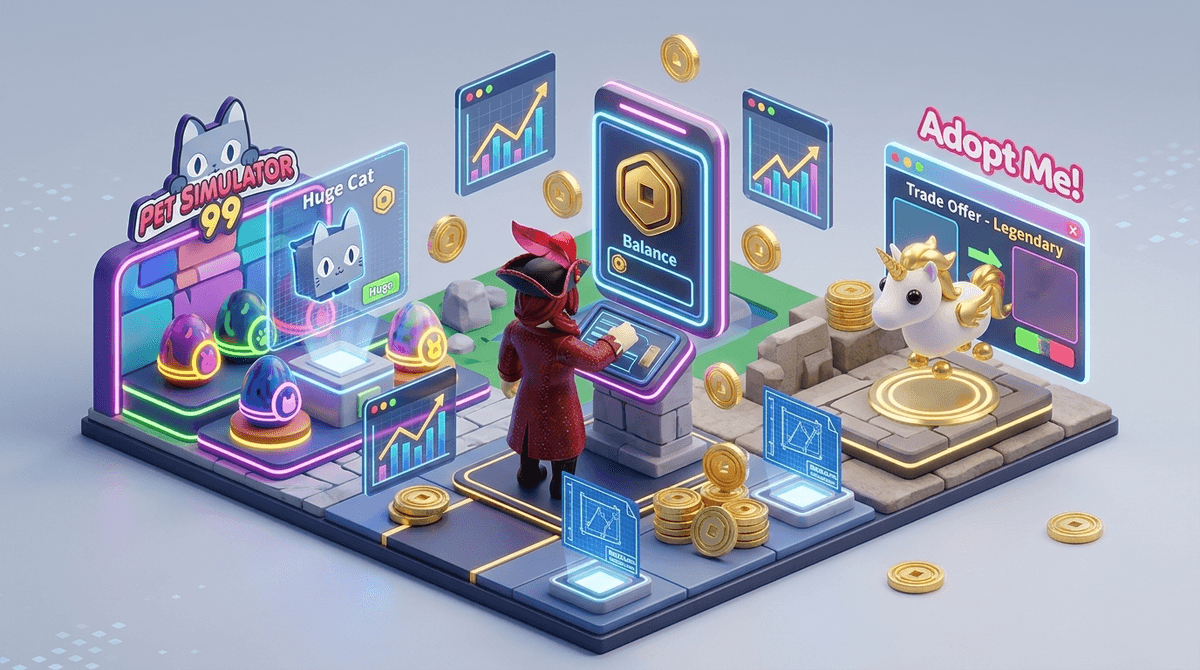
TL;DR: Roblox is less of a "game" and more of a massive digital economy where Robux (the in-game currency) is effectively real money. It offers genuine opportunities for kids to learn coding through Roblox Studio and entrepreneurship, but it’s also riddled with "dark patterns"—design choices meant to keep kids spending and gambling on virtual items. If your kid is obsessed with Pet Simulator 99 or Adopt Me!, they aren't just playing; they’re participating in a high-stakes marketplace.
Quick Links for the Roblox Era:
- The Platform: Roblox
- The Creative Side: Roblox Studio
- Safety First: How to set up Roblox parental controls
- Better Alternatives: Minecraft or Scratch
If you feel like your kitchen has been invaded by sounds of "Skibidi" and requests for "just 400 more Robux," you’re not alone. To understand why your kid is treating a digital neon cat like a blue-chip stock, you have to understand that Roblox is a closed-loop economy.
Robux are purchased with actual dollars (usually via your App Store or Google Play account). Once that money is in the system, it stays there. Kids use it to buy "skins" (outfits), "gamepasses" (special powers within a specific game), or "limiteds" (items that can be traded and fluctuate in value).
The "Ohio" of it all? The "brainrot" content—those bizarre, low-effort games and memes—is often just a delivery vehicle for these transactions. Developers (some of whom are literally teenagers making millions) create games designed to be addictive, social, and, above all, profitable.
Kids love Roblox because it’s their version of the mall. It’s where they hang out, show off their "drip" (cool outfits), and participate in a shared culture.
The Entrepreneurship Angle
There is a legitimate upside here. Unlike watching mindless YouTube shorts, Roblox allows kids to become creators. If a kid learns to use Roblox Studio, they are learning Lua (a real coding language), 3D modeling, and UI design. Some kids start "clothing brands" within the game, designing shirts and selling them for a profit. This is basically a 2026 version of a lemonade stand, but with a global audience.
The Financial Literacy (or Lack Thereof)
On the flip side, the economy is designed to obfuscate how much money is actually being spent. When a kid sees "99 Robux," it doesn't feel like a dollar. It feels like a point in a game. Without a parent intervening, kids can easily blow through a $50 gift card in ten minutes on "eggs" in Pet Simulator 99 that may or may not contain a rare pet.
Learn more about how Robux is in fact real money
We need to talk about the "gacha" mechanics. In games like Adopt Me!, players spend Robux to buy eggs. You don't know what's inside the egg until it hatches. It might be a common dog, or it might be a legendary unicorn.
This is gambling. It triggers the same dopamine loops in a child's brain that a slot machine does in an adult's. When you combine this with the social pressure of seeing a friend with a "Neon Shadow Dragon," you get a recipe for impulsive spending.
Then there’s the "Black Market." Because some items are so rare, there are entire third-party websites where kids try to trade or sell items for "real" cash. These sites are almost exclusively scams. If your kid is talking about "cross-trading" or "getting free Robux" from a website they found on TikTok, red flags should be flying.
Check out our guide on common Roblox scams
Elementary School (Ages 6-10)
At this age, the social pressure is high, but the impulse control is low.
- The Rule: No spending Robux without a "consultation." Treat it like a real purchase.
- The Setting: Turn off "Trade" requests in the settings. This is where most bullying and "sharking" (bad trades) happens.
- Recommendation: Focus on "Obbys" (obstacle courses) or building games like Welcome to Bloxburg which require more creativity and less "gambling."
Middle School (Ages 11-14)
This is when they start wanting to "dev" (develop).
- The Move: Encourage them to download Roblox Studio. If they want Robux, tell them they have to earn them by creating something others want to buy, rather than just asking for your credit card.
- The Discussion: Talk about "sunk cost fallacy." Just because they’ve spent $20 on a game doesn't mean they need to spend $20 more to "keep up."
If you're looking for a way to transition your kid away from the more "brainrot" parts of Roblox, here are some solid alternatives that offer the same creative "high" without the aggressive monetization:
The gold standard. While it has its own marketplace now, the core gameplay is much more focused on survival and creativity than social signaling. It’s the "organic kale" of the gaming world compared to Roblox's "high fructose corn syrup."
If your kid loves the idea of making games, Scratch is a phenomenal (and free) place to start. It’s developed by MIT and has zero "loot boxes."
Nintendo's game-making course for the Switch. Guided lessons teach kids to build their own games with visual programming, and there is nothing to buy once you own it.
Find age-appropriate alternatives to Roblox
Don't lead with "this game is garbage" (even if you think the graphics look like a fever dream from 2004). Instead, try these conversation starters:
- "I noticed you're really trying to get that Huge Cat. What happens to the value of that pet if the developer releases a newer, cooler one next week?"
- "Do you know how much 1,000 Robux actually costs in dollars? Let's look at the math together."
- "I saw a video about how some games use 'flashing lights' and 'spin wheels' to make you want to spend more. Have you noticed that in the games you play?"
Roblox isn't inherently evil, but it is an unregulated "Wild West" of digital capitalism. It can be a brilliant tool for learning game design and basic economics, or it can be a "brainrot" money pit that teaches kids that the only way to have fun is to pay for it.
The difference usually comes down to parental involvement. You don't have to play the game with them (though playing an "Obby" together can be a hilarious bonding experience), but you do need to be the "Central Bank" and the "Regulator" of their digital world.
Next Steps:
- Audit the Spend: Look at your purchase history. Are you surprised by the total?
- Toggle the Settings: Go into the Roblox Parental Controls and set a monthly spending limit (or set it to zero).
- Shift the Focus: If they love the platform, point them toward Roblox Studio and challenge them to make $1 in Robux through their own creativity rather than your wallet.