

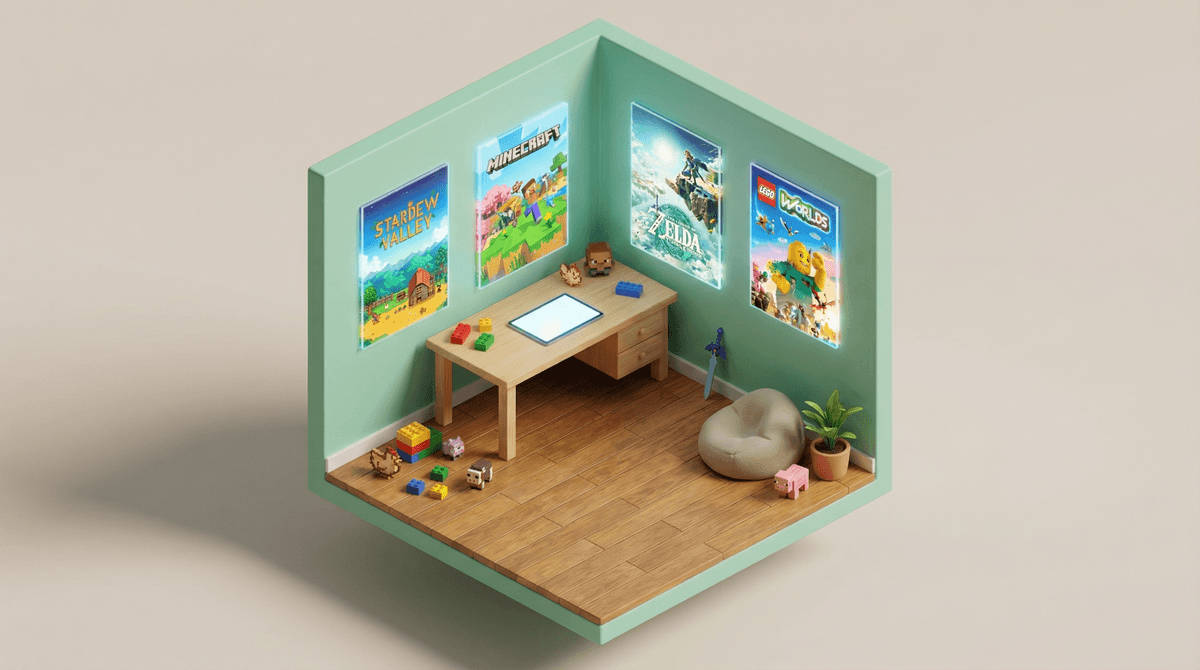
Look, I get it. Minecraft started as "the creative game" that all the parenting blogs said was good for kids. Spatial reasoning! Problem-solving! Digital Legos! And then somehow it became the only thing your kid wants to talk about, play, watch on YouTube, or think about during dinner.
You're not imagining it. Minecraft isn't just popular—it's designed to be endlessly engaging in ways that tap directly into how kids' brains work. The question isn't whether Minecraft is "bad" (it's not), but rather: when does healthy interest tip into compulsion, and what do we do about it?
Minecraft hits different than other games because it combines several psychological hooks into one package:
The infinite canvas effect. Unlike games with endings, Minecraft worlds are essentially limitless. There's always one more thing to build, explore, or optimize. For kids ages 7-12 especially, this taps into their natural drive to create and control their environment.
Social currency. Knowing Minecraft isn't just about playing—it's about belonging. Kids trade building tips at recess, reference YouTubers like DanTDM or Dream, and bond over shared server experiences. Stepping away can feel like social exile.
The dopamine loop. Mine resources → craft better tools → access new areas → find rare materials → repeat. This progression system releases steady hits of dopamine that keep kids coming back. Add in the unpredictability of what you'll find while mining, and you've got a recipe for "just five more minutes" that turns into two hours.
Creative mastery. Unlike school where they're constantly being evaluated, Minecraft lets kids be genuinely competent. That redstone contraption they built? It actually works. That house? Genuinely impressive. This sense of mastery is intoxicating, especially for kids who struggle academically.
Not all intense interest is problematic. Here's what to watch for:
Rigid thinking patterns. When Minecraft becomes the only acceptable activity, that's a red flag. "We could go to the park, play board games, do art..." "No, I just want to play Minecraft."
Emotional dysregulation around access. Big meltdowns when it's time to stop, or when they can't play, that seem disproportionate to the situation. We're talking beyond normal disappointment into genuine distress.
Interference with other areas of life. Rushing through homework to get back to the game. Losing interest in previously loved activities. Sleep disruption because they're thinking about their next building project. Declining real-world friendships.
Sneaking or lying about play time. Finding them on the iPad at 2am, or discovering they've been playing when they said they were doing homework.
Constant YouTube consumption. When they're not playing, they're watching others play for hours. The line between active engagement and passive consumption blurs entirely.
For most kids ages 8-14, about 30-60% are playing Minecraft regularly according to various surveys. But if your kid is in the top 10% of usage (multiple hours daily, every single day), and showing the signs above, it's worth addressing.
The goal isn't to demonize Minecraft or go cold turkey (unless things are truly severe). It's about diversifying their digital diet and reconnecting them with offline experiences.
Start with curiosity, not criticism
"I've noticed Minecraft is pretty much your whole world right now. What is it about the game that feels so important?" Listen without judgment. Understanding their attachment helps you find alternatives that actually appeal.
Match your child's Minecraft habit to healthier alternatives:
If they love building:
- Digital: LEGO Worlds, Dragon Quest Builders 2, Townscaper
- Offline: Real LEGO sets, cardboard creations, woodworking
If they love mining & crafting:
- Digital: Stardew Valley, Slime Rancher, Forager
- Offline: Gardening, geocaching, cooking
If they love exploring:
- Digital: Zelda: Tears of the Kingdom, Journey, A Short Hike
- Offline: Family hikes, scavenger hunts, map-making
If they love redstone/circuits:
- Digital: Game Builder Garage, Human Resource Machine, Baba Is You
- Offline: Robotics kits, Snap Circuits, LEGO Spike
If they love socializing:
- Digital: Overcooked 2, LEGO co-op games, Unravel Two
- Offline: Board game nights, cooperative projects
The transition is easier when you're not asking them to completely shift gears. Try:
-
Terraria (ages 10+): 2D building and exploration with more combat and boss progression. Many kids find it's "Minecraft but with more structure and goals."
-
Stardew Valley (ages 10+): Farming, building, and community relationships. The creative building scratches a similar itch but with more narrative and social elements.
-
Dragon Quest Builders 2 (ages 8+): Combines Minecraft-style building with RPG storytelling. The structured quests help kids who've lost the ability to self-direct.
-
Lego Builder's Journey (ages 6+): Gorgeous, meditative building puzzles. Short sessions by design—a feature, not a bug.
Sometimes you need to break the pattern entirely:
-
Splatoon 3 (ages 8+): Team-based action that's colorful and fun without being violent. Matches are short (3 minutes), making it naturally less consuming.
-
Animal Crossing: New Horizons (ages 6+): Creative and social, but the real-time clock means there's natural stopping points. You can only do so much in one day.
-
Unpacking (ages 8+): A zen puzzle game about organizing belongings. Surprisingly satisfying and completable in a few sittings.
If Minecraft is their social hub, you need to replace that function: learn more about gaming as social connection .
.
- Set up game nights with friends playing different multiplayer games
- Find local gaming clubs or esports leagues that play various games
- Introduce them to board game cafes where the social element is still present
This is the hard part, but it's essential. The competition isn't other games—it's real life being interesting enough to matter.
- Hands-on building. Actual Legos, woodworking, cardboard construction. The tactile feedback hits differently.
- Outdoor exploration. Geocaching, hiking, bike trails. Frame it as "IRL exploration" if that helps.
- Creative projects with stakes. Cooking (you eat the result!), stop-motion animation, building a fort. Things with tangible outcomes.
Set up systems, not just rules
"One hour of Minecraft per day" is a rule that invites negotiation and conflict. Instead, try systems:
- "Earned screen time" through offline activities. 30 minutes of reading = 30 minutes of gaming. This makes offline time the path to online time.
- "Game rotation weeks." Minecraft is available Monday/Wednesday/Friday. Other games Tuesday/Thursday. Weekends are flexible. This normalizes variety.
- "Digital sunset" routines. All screens off 90 minutes before bed, replaced with a predictable routine. The consistency matters more than the specific timing.
Sometimes the compulsion is severe enough that you need a full reset. If you're seeing signs of genuine gaming addiction, a 2-4 week complete break from Minecraft specifically (not all screens) can help.
During the break:
- Expect withdrawal-like symptoms: irritability, boredom, anger
- Fill the time proactively—don't just remove the game and leave a void
- Process their feelings with empathy: "I know this is really hard. Your brain got used to that dopamine pattern."
- After the break, reintroduce with very clear boundaries
This is hard-mode parenting and you might need support from a therapist who specializes in gaming issues if you're going this route.
Minecraft isn't evil, but it is engineered to be maximally engaging in ways that can overwhelm kids' still-developing self-regulation. When it becomes the only thing that matters, you're not being mean by stepping in—you're being a parent.
The goal is diversification and balance, not perfection. Some weeks will be better than others. Some kids will fight you harder than others. That's normal.
This week:
- Track actual Minecraft usage for 3-4 days (you might be surprised by the real numbers)
- Have one curious conversation about what they love about it
- Pick one alternative game to try together—emphasis on together
This month:
- Implement one system (not just a rule) around game variety
- Create at least two compelling offline activities that happen regularly
- Check in with other parents about what's working for them
Remember: you're not alone in this. If you want to dig deeper into your specific situation, Get guidance for a child obsessed with Minecraft about your family's unique dynamics.
And hey—if you need to hear it: you're doing a good job navigating this weird digital parenting landscape. None of us got a manual for this stuff.