

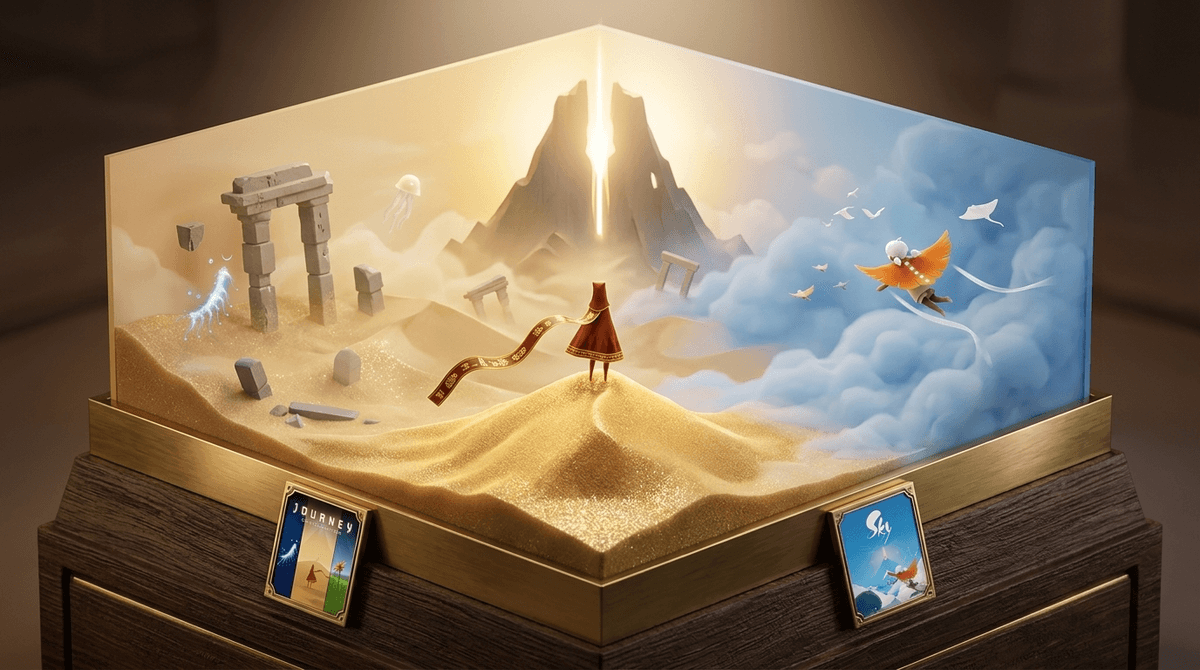
TL;DR: Journey is a breathtaking, short-form adventure game where players travel toward a distant mountain. It is the gold standard for "safe" online play because it features anonymous multiplayer with zero text or voice chat, making it impossible for strangers to be toxic, bully, or share personal info. It’s the perfect "starter" online game for kids ages 7+ who want to feel connected to a wider world without the risks of Roblox or Fortnite.
If your house is anything like mine, the "soundtrack" of gaming is usually a chaotic mix of frantic clicking, someone yelling about a "skibidi" something-or-other, and the constant low-level anxiety of wondering who exactly your kid is talking to in a Discord channel.
Digital parenting in 2026 often feels like being a full-time private investigator. We’re constantly checking privacy settings, monitoring chat logs, and trying to figure out if that "friend" in a Minecraft server is actually a ten-year-old from the next town over or a 40-year-old with bad intentions.
But then there’s Journey.
If Roblox is a loud, sticky indoor trampoline park full of screaming kids and questionable vending machines, Journey is a quiet, sun-drenched museum gallery. It’s the game I recommend to every parent who wants to introduce their kids to the beauty of the internet without the "Ohio" energy of unregulated social spaces.
Released by thatgamecompany, Journey is an indie masterpiece that has won pretty much every "Game of the Year" award in existence. You play as a robed figure in a vast, shimmering desert. Your goal is simple: reach the peak of a glowing mountain on the horizon.
There are no "levels" in the traditional sense, no high scores, and no "game over" screens that send you back to the beginning in a fit of rage. You glide over sand dunes, fly through the air using magical scarves, and solve light puzzles. It takes about two to three hours to finish, making it a perfect Saturday afternoon activity.
But the "secret sauce" is the multiplayer.
As you play, you will naturally encounter other players. You don’t "invite" them; they just appear in your world. They look exactly like you. You can’t see their username. You can’t send them a message. You can’t hear their voice.
The only way to communicate is by pressing a button to let out a musical "chirp."
Most online games are designed around competition or transactional socialising. In Fortnite, a stranger is someone to shoot. In Roblox, a stranger is someone to trade with (or get scammed by).
In Journey, a stranger is a companion.
Because you can't speak, you have to rely on body language and "chirps" to help each other. You might show a new player where a hidden item is located, or you might huddle together in a cold windstorm to keep each other’s scarves charged (which allows you to fly).
It’s a profound lesson for kids: you can be kind to someone, help them, and share an experience with them without knowing a single thing about their real-world identity. It strips away the labels, the bullying, and the "trash talk" and leaves only human connection.

You might think a game with no guns and no chat would be "boring" to a kid raised on MrBeast videos. But Journey taps into a different part of the brain.
- The Visuals: It is arguably one of the most beautiful games ever made. The way the sand ripples and the light hits the ruins is mesmerizing. It’s "brain rot" proof—it’s actually nourishing to look at.
- The Mystery: Kids love the "Who is this?" factor. At the end of the game, during the credits, the game finally reveals the usernames of the people you traveled with. It’s a common "core memory" for young gamers to see those names and realize they just spent two hours bonded with a stranger halfway across the world.
- Low Stakes, High Reward: There is no way to "fail" at Journey. For kids who get stressed by the competitive nature of Brawl Stars, this is a massive relief.
Recommended Age: 7+
While the game is rated E for Everyone, there are a few things to keep in mind:
- The "Scary" Parts: Toward the end of the game, there are large, snake-like stone creatures (Guardians) that can "attack" the player, knocking off pieces of their scarf. It’s not violent or bloody, but it can be tense and a bit frightening for very young children (under 6).
- The Ending: The final climb up the mountain is emotionally heavy. It deals with themes of persistence and, arguably, the cycle of life. It’s beautiful, but it might lead to some big questions from your kids.
- Technical Setup: Journey is available on PlayStation, PC, and iOS. If they play on an iPad, make sure they have a decent pair of headphones—the Grammy-nominated soundtrack is half the experience.
If your kid finishes Journey and wants more "vibey" games that don't involve a battle pass, check these out:
Created by the same team, this is essentially "Journey: The Social Network." It’s free-to-play and much more expansive. It does have more complex social features, so check out our guide to Sky: Children of the Light before letting them dive in.
Think Journey, but underwater. You play as a diver exploring the ocean. There’s no combat, just beautiful sea life and a soaring score. It’s pure relaxation.
A stunning 2D platformer about a girl dealing with sorrow. It looks like a watercolor painting come to life. It’s a bit more "puzzly" than Journey but shares that same silent, emotional DNA.
Another one from thatgamecompany. You play as the wind, collecting flower petals. It sounds like a "napping app," but it’s actually a very engaging and surprisingly intense experience.
The most important thing to know about Journey is that it is uncancelable. In a world where every app seems to be trying to harvest our kids' data or sell them "limited edition" skins, Journey is just a piece of art.
There are no in-app purchases. No "daily login bonuses." No "loot boxes."
How to Talk About It
After they finish, ask them:
- "Did you meet anyone else on the way to the mountain?"
- "How did you know if they were trying to help you?"
- "How did it feel when you were separated from your companion?"
These questions are great "side-door" ways to talk about digital citizenship. You're not lecturing them about "stranger danger"; you're talking about the mechanics of cooperation and the value of a shared experience.
Journey is the antidote to the "brain rot" and toxicity we often fear in digital spaces. It proves that the internet can be a place of quiet beauty and anonymous kindness.
If you’re tired of the "Robux" talk and the Fortnite dances, buy this game, sit on the couch with your kid, and just watch them glide through the dunes. It might be the most peaceful two hours you’ve had as a "digital parent" in years.
Next Steps:
- Download Journey on your console or PC.
- Check your PlayStation parental controls or Steam settings to ensure they can play online (remember, the multiplayer is the point here!).
- Let them play it in one sitting if possible—it’s designed to be experienced like a movie.