

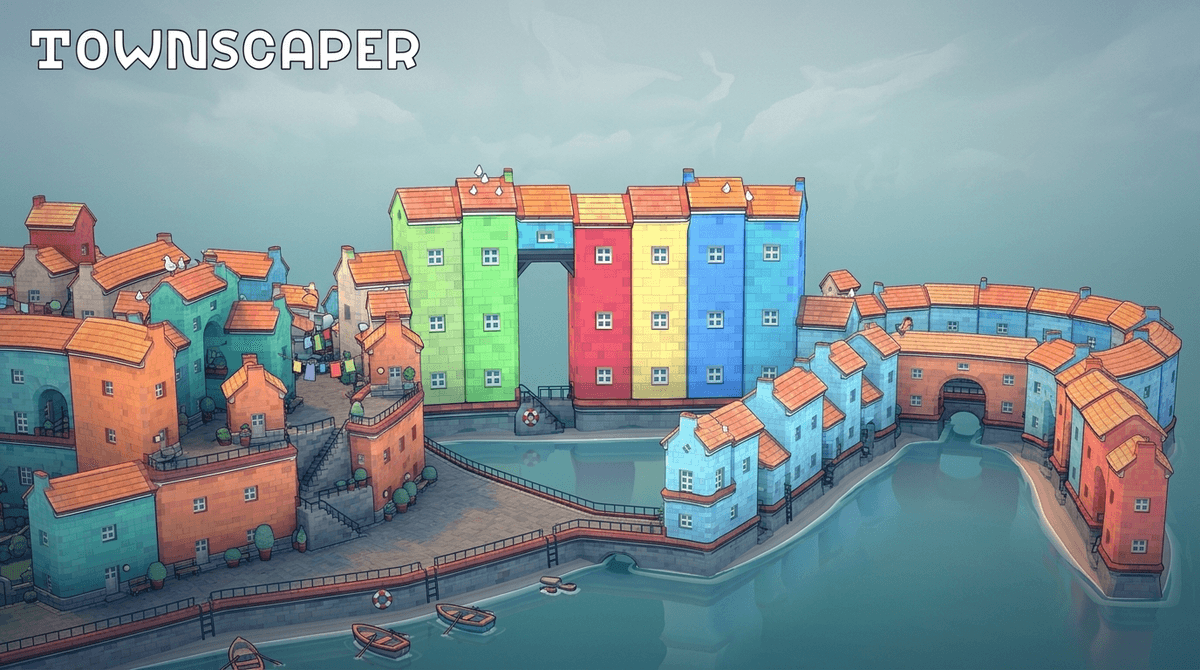
TL;DR: Townscaper is the ultimate "anti-game." There are no enemies, no timers, no scores, and zero ways to lose. It’s a pure creative sandbox that feels like popping digital bubble wrap while building a colorful Mediterranean village. If your kid is burnt out on the high-intensity stress of Fortnite or the social chaos of Roblox, this is the "digital palette cleanser" they need.
Quick Links to Zen Favorites:
Most video games are built on a "loop" of tension and release. You fight a boss, you win, you get a reward. You build a house in Minecraft, but you have to worry about Creepers blowing it up or falling into lava.
Townscaper throws all of that out the window. Created by Oskar Stålberg, it’s less of a "game" and more of a "toy." When you open it, you’re looking at a vast, empty ocean. You click, and plink—a little colored block appears on the water. Click again, and it becomes a house. Stack them, and they become towers. Place them in a circle, and the game’s algorithm automatically generates a courtyard or a garden.
There is no "inventory management." There are no "daily login bonuses." There is just the sound of the ocean, the satisfying pop of buildings appearing, and the ability to change the time of day to see your little town in the golden hour or under the stars.
Check out our guide on why "toy-like" games are better for younger kids
If you’ve spent any time on TikTok or YouTube lately, you’ve probably seen the "brain rot" content—those hyper-stimulating, loud, nonsensical videos (yes, looking at you, Skibidi Toilet) that seem to turn kids' brains into mush. Townscaper is the literal opposite of that.
Kids love it because it offers total agency without the threat of failure. In a world where school, sports, and even other video games are constantly grading them or telling them they aren't fast enough, Townscaper is a space where every choice is the "right" one.
The "plink-plonk" sound design is incredibly satisfying (it’s basically ASMR for kids), and the way the buildings automatically add little details—like clotheslines, seagulls, or ladders—makes the child feel like a master architect without needing to learn complex controls. It’s "Ohio" in the best way possible: weirdly satisfying and totally its own thing.
We often call Minecraft "digital Lego," but let's be honest: Minecraft has become complicated. Between the crafting recipes, the enchantments, and the constant pressure to keep up with what YouTubers are building, it can be a lot.
Townscaper is what happens when you take a bucket of bricks to the rug and just start snapping them together. It encourages:
- Spatial Awareness: Understanding how shapes fit together in a 3D space.
- Color Theory: Experimenting with palettes (you can choose from a simple color wheel).
- Narrative Play: Many kids will start "role-playing" with their towns, deciding which tower the "king" lives in or where the "secret library" is hidden, even though there are no actual characters in the game.
If your family discovers that the low-stress vibe of Townscaper works for your house, you might want to explore the "Cozy Gaming" genre. This is a massive trend right now, and for good reason—it's the antidote to the "sweaty" (overly competitive) gaming culture.
Ages 7+. This is a zen puzzle game where you simply unpack boxes and put items away in a new room. It sounds like a chore, but it’s strangely meditative and tells a beautiful story through objects. It’s great for kids who like organization and "vibes."
Ages 6+. A peaceful building strategy and puzzle game where you create a beautiful, ever-growing village landscape by placing hexagonal tiles. No combat, just matching forests to forests and houses to houses.
Ages 6+. A small, beautiful game about a bird going on a hike. There’s no way to die, and the goal is just to explore, talk to quirky animals, and eventually reach the top of the mountain. It’s the gaming equivalent of a warm hug.
Ages 5+. If your kid is on a tablet, this is a must-have. It’s a series of M.C. Escher-style optical illusion puzzles. It’s quiet, stunningly beautiful, and teaches kids to look at problems from different perspectives—literally.
Recommended Age: 4 to 99
There is genuinely nothing in Townscaper that is inappropriate for a child.
- Violence: None.
- Language: None.
- Social/Online: None. (This is a huge win for parents—no strangers, no chat, no bullying).
- Microtransactions: None. You buy the game once, and you own the whole thing. No "Robux" required.
For younger kids (ages 4-6), they might just enjoy clicking and seeing things pop up. For older kids (ages 8-12), they might challenge themselves to build "floating cities" or massive sprawling metropolises.
1. It’s a "Finite" Experience
Unlike Roblox, which is designed to keep kids hooked for hours on end with gambling-adjacent mechanics, Townscaper is something a kid can play for 20 minutes and feel "done." It doesn't have that "just one more round" hook that leads to bedtime meltdowns.
2. It’s Great for Neurodivergent Kids
If you have a child with ADHD or sensory processing sensitivities, the predictable, calm nature of Townscaper can be a great "regulation tool." Many parents in the Screenwise community use it as a transition activity—something to play for 10 minutes after getting home from a loud, over-stimulating school day to help reset the nervous system.
3. The "Export" Feature
On the PC version, you can actually export your creations as 3D models. If you’re a particularly tech-savvy family (or have a 3D printer), your kid can actually 3D print the town they built. Talk about taking "digital Lego" to the next level.
Learn more about how 3D printing and gaming can intersect for kids
Since there are no "winners" in Townscaper, you have to change how you ask about their play. Instead of "Did you win?" try:
- "Tell me about this neighborhood you built. Who do you imagine lives in that tall blue tower?"
- "I love the way you used the light here. Is this supposed to be sunrise or sunset?"
- "How did you get that little garden to appear in the middle of the houses?"
These questions lean into creative intent rather than achievement, which is a great habit to build in our digital lives.
Townscaper is a rare gem in a sea of noisy, expensive, and often toxic digital media. It’s a $5-$6 investment (depending on the platform) that provides a peaceful, creative outlet.
Is it going to teach them "entrepreneurship" like some people claim Roblox does? No. But it will teach them that tech can be a tool for peace and beauty, rather than just a source of competition and "clout." In 2026, that might be the most valuable lesson we can give them.
- Try it yourself: Download the mobile version for a few bucks and play it for 5 minutes. You’ll see the "zen" immediately.
- Set a "Zen Zone": Designate a specific time of day (like after homework) where only "non-competitive" games like Townscaper or Stardew Valley are allowed.
- Take a Survey: If you're curious how your kid's gaming habits compare to other kids in their grade, take the Screenwise habits survey.