

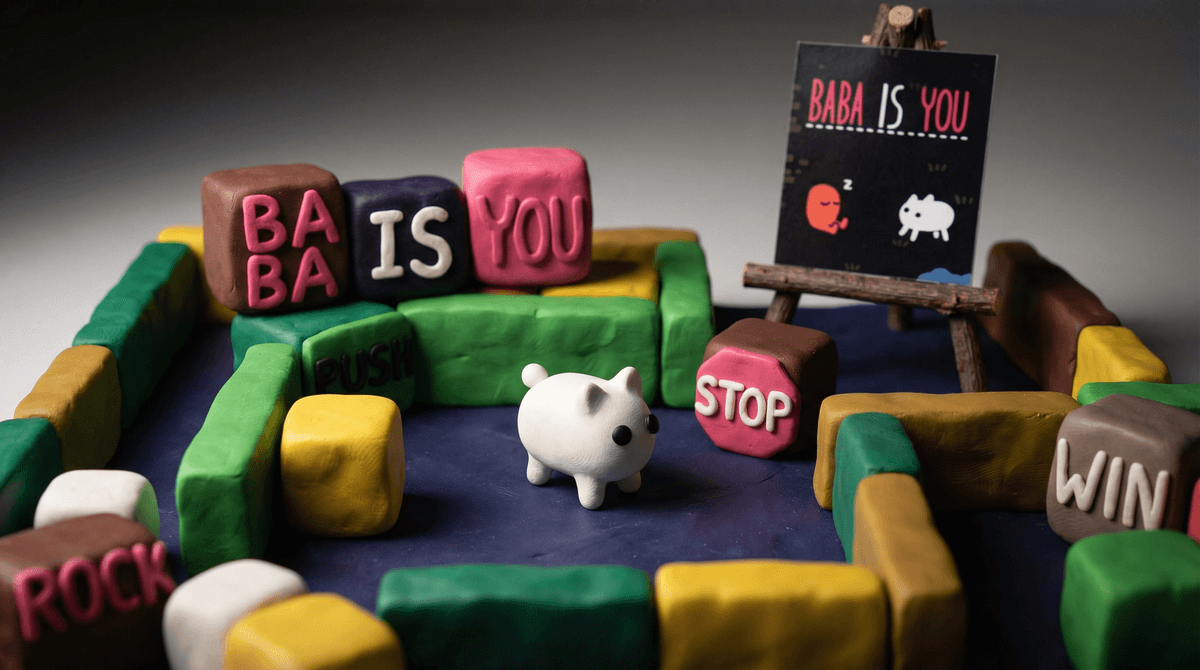
Baba Is You is an award-winning indie puzzle game that looks deceptively simple but will absolutely bend your brain in the best possible way. Created by Finnish developer Arvi Teikari, it won the Excellence in Design award at the Independent Games Festival in 2018, and honestly? It deserved it.
Here's the wild premise: you don't just solve puzzles by moving pieces around. You solve them by rewriting the rules of the game itself.
In each level, you see words scattered around like "BABA," "IS," "YOU," "WALL," "STOP," "WIN," and "FLAG." These words form sentences that dictate how the game works. "BABA IS YOU" means you control the little white creature named Baba. "WALL IS STOP" means walls block your movement. "FLAG IS WIN" means touching the flag completes the level.
But here's where it gets brilliant: you can push those words around to make new rules. Push "YOU" away from "BABA" and attach it to "ROCK," and suddenly you're controlling rocks instead. Change "WALL IS STOP" to "WALL IS WIN" and now touching any wall completes the level. The entire game is about manipulating the fundamental logic of each puzzle to create a path to victory.
It's available on Nintendo Switch, PC, iOS, and Android, typically priced around $15.
This game is genuinely challenging in a way that feels empowering rather than frustrating. Unlike games where you're just executing the same combo moves or grinding for resources, every single puzzle in Baba Is You requires you to think differently.
Kids who love logic puzzles, coding concepts, or games like Portal will find this incredibly satisfying. There's something deeply appealing about the "aha!" moment when you realize you can break what you thought were the fundamental rules of a level.
The aesthetic is charmingly retro—simple pixel art with a lo-fi soundtrack—which means it's not competing with the dopamine-heavy graphics of most modern games. This is actually a feature, not a bug. The game rewards thinking time, not reaction speed. You can sit with a puzzle for days, come back to it, and finally crack it.
And honestly? Adults get just as hooked. This is one of those rare games where parents might find themselves "just checking" what their kid is stuck on and then losing an hour to it themselves.
Ages 8-10: Can definitely start playing, especially if they enjoy puzzle games or have been introduced to basic coding concepts through platforms like Scratch. They'll likely need help with some of the more complex levels, but the early puzzles are accessible and teach the core mechanic well.
Ages 10-13: The sweet spot. Kids this age have the abstract thinking skills to really grasp the meta-puzzle nature of the game. They can work through most levels independently, though some of the later puzzles are genuinely difficult (even for adults).
Ages 13+: Will appreciate the full depth of the game's design and might even start thinking about game design principles themselves.
One thing to note: this game requires reading comprehension. All the rules are word-based, so younger kids who are still developing reading skills might struggle. But for kids who are strong readers, this actually reinforces literacy in a playful context.
The Learning Value Is Real
This isn't just "educational" in that vague way we sometimes say about games to justify screen time. Baba Is You directly teaches:
- Computational thinking: The same kind of logic used in programming
- Creative problem-solving: There are often multiple solutions to puzzles
- Growth mindset: Failure is literally part of the puzzle-solving process
- Abstract reasoning: Understanding that rules are systems that can be manipulated
If your kid is interested in coding, game design, or just loves brain teasers, this is genuinely valuable play time. Learn more about how puzzle games support cognitive development .
.
It Can Be Frustrating (In a Good Way)
Some puzzles are hard. Like, really hard. Your kid might get stuck. They might get frustrated. This is actually part of what makes the game valuable—it teaches persistence and the satisfaction of working through difficulty.
That said, if you have a child who struggles with frustration tolerance, you might want to play alongside them or establish a "if you're stuck for 20 minutes, take a break" rule.
No Social Features, No Microtransactions, No Ads
This is a complete, self-contained game. No in-app purchases, no ads, no chat features, no online multiplayer. It's just... a game. Remember when games were just games? This is that.
For parents worried about the monetization tactics in games like Roblox or the social pressures of Fortnite, Baba Is You is refreshingly straightforward.
Screen Time That Feels Different
Not all screen time is created equal, and this is a great example. Twenty minutes of Baba Is You involves active problem-solving, experimentation, and creative thinking. Compare that to twenty minutes of passively scrolling TikTok or watching random YouTube videos, and you can see why many parents feel differently about different types of digital engagement.
Baba Is You is one of those rare games that's genuinely clever, challenging, and enriching without being preachy about it. It's not trying to "teach coding" or "build STEM skills"—it's just a really well-designed puzzle game that happens to exercise exactly those muscles.
If you're looking for screen time that feels like it's building something—logic skills, creative thinking, persistence—this is a solid choice. It's also a great game to play together, taking turns or talking through puzzles as a team.
Is it going to replace outdoor play or reading time? No, and it shouldn't. But in the landscape of digital entertainment competing for your kid's attention, this is one of the good ones.
- Try it yourself first: The mobile version is a good way to preview before committing to the full game
- Set expectations about difficulty: Let your kid know that getting stuck is part of the game, not a sign they're doing it wrong
- Consider co-playing: Especially for younger kids, working through puzzles together can be a great bonding activity
- Use it as a bridge: If your child is interested in game design or coding, this can be a great conversation starter about how games work
Want to explore more games that build similar skills? Check out our guides on Portal, The Witness, and other puzzle games that actually make you think.