

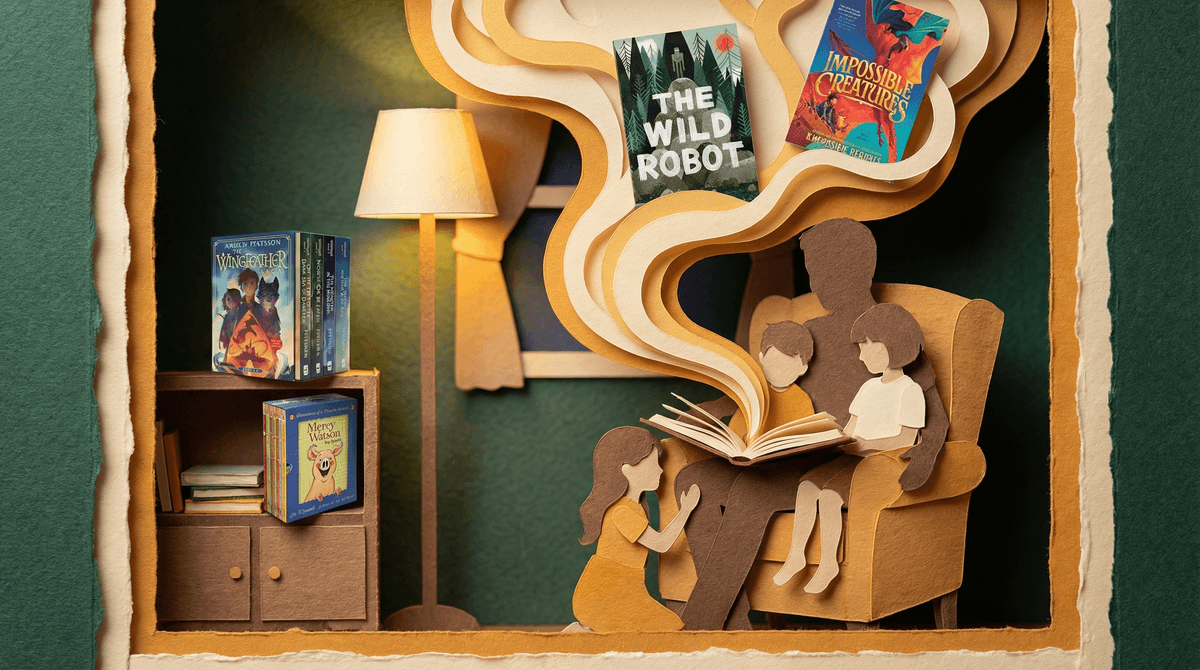
You've discovered the holy grail of parenting: finding a chapter book that can hold the attention of an 8-year-old, a 6-year-old, AND a 3-year-old at the same time. If you've had success with Impossible Creatures, you already know what works—adventure, magical elements, vivid descriptions, and a story that moves.
But here's the thing: a 3-year-old doesn't need to understand every plot point to be engaged. They're there for the rhythm of your voice, the exciting moments, the funny sounds, and the cozy ritual. Meanwhile, your older kids are tracking the actual story arc and character development.
The sweet spot? Books with strong sensory descriptions, clear emotional beats, repetitive elements, and forward momentum. Think: books where even if you miss a chapter, you can still enjoy the next one. Books with pictures help enormously, but aren't required if the language is vivid enough.
Let's be real: a 3-year-old's attention span is approximately 4.7 minutes on a good day. Your 8-year-old wants actual plot complexity. Your 6-year-old is somewhere in between, probably making sound effects.
The good news? Family read-aloud time isn't about perfect comprehension for everyone—it's about shared experience. Your 3-year-old is learning how stories work, building vocabulary, and (crucially) learning that books are where the good stuff happens. She doesn't need to understand the geopolitical implications of the fantasy realm; she needs to hear that the dragon went "ROAAAAR" and the hero was brave.
Some nights your toddler will zone out and play with toys nearby. That's fine. She's still absorbing the language and the ritual. Some nights she'll be completely locked in because there's a talking animal or someone falls in mud. Roll with it.
The Wild Robot series by Peter Brown
Starting with The Wild Robot, this is chef's kiss for mixed ages. A robot learning to survive on an island with animals? Your 3-year-old will love the animal characters and the simple emotional beats (Roz is lonely! Roz makes friends!). Your older kids will appreciate the survival story and deeper themes about belonging. The chapters are short, there are illustrations, and the language is beautiful without being overwrought.
The Mercy Watson series by Kate DiCamillo
These are technically early chapter books, but Mercy Watson is a pig who loves toast and gets into ridiculous situations. They're SHORT (you can finish one in a sitting), heavily illustrated, and genuinely funny for adults too. Your 8-year-old might initially resist because they look "babyish," but the humor works for everyone. Perfect for nights when energy is low.
The Magic Tree House series by Mary Pope Osborne
Yes, they're everywhere. Yes, there are 10 million of them. But Magic Tree House books are engineered for this exact situation—short chapters, clear adventure structure, simple vocabulary but interesting topics (dinosaurs! pirates! ancient Egypt!), and your 3-year-old can track "Jack and Annie go somewhere cool, something exciting happens, they come home."
Charlotte's Web by E.B. White
Charlotte's Web is a masterclass in language that works across ages. A pig and a spider are friends! There's a rat who says funny things! Yes, it deals with death, but in a way that's gentle and meaningful. The chapters are short, the barnyard setting is concrete enough for little ones, and the writing is so good that even your 8-year-old will be moved. Fair warning: you might cry at the end.
Ivy and Bean series by Annie Barrows
Ivy and Bean books are about two second-grade girls getting into low-stakes trouble. They're illustrated, funny, and have that episodic quality where each chapter is almost its own mini-story. Your 3-year-old will get the physical comedy, your 6-year-old will relate to the school dynamics, and your 8-year-old will appreciate the friendship complexity.
The Wingfeather Saga by Andrew Peterson
If Impossible Creatures worked for you, try On the Edge of the Dark Sea of Darkness (yes, that's the real title). This is more advanced than some others on this list, but it has that same magical adventure quality with vivid world-building. There are scary parts, but they're "exciting scary" not "nightmare scary." Your 3-year-old might drift in and out, but the action sequences and creature descriptions will pull her back in. The humor helps too—there are footnotes that are genuinely funny.
Pippi Longstocking by Astrid Lindgren
Pippi Longstocking is pure chaos in the best way. A girl who lives alone, lifts horses, and doesn't follow any rules? The chapters are episodic (Pippi goes to school! Pippi goes to the circus!), the situations are absurd enough to be funny for everyone, and there's something delightful about a character who just... does whatever she wants.
Let your 3-year-old move around. Seriously. She can color, play with quiet toys, or just roll around on the floor. She's still listening. The second you make story time a "sit still and pay attention" requirement, you've lost her.
Do the voices. This is non-negotiable. Your older kids might claim they're "too old" for voices, but they're lying. Everyone loves voices. Your 3-year-old especially needs the vocal variation to stay engaged.
Stop when it's not working. Some nights, it just won't land. That's fine. You're building a long-term habit, not trying to force a perfect moment every single time.
Let your older kids "help" explain things to your toddler. "Remember, Jack and Annie are looking for the medallion?" This keeps your older kids engaged AND helps your little one track the story.
Skip the boring parts. If there's a chapter that's all setup and no action, you're allowed to summarize. "Okay, so basically they walked through the forest for a while and found a cave. Now let's see what's IN the cave..."
Use audiobooks strategically. Sometimes hearing a professional narrator can help everyone track the story better, especially with more complex books. But don't abandon the in-person read-aloud—there's real magic in hearing your voice tell stories.
The perfect book for ages 8, 6, and 3 doesn't exist. But there are plenty of books that are "good enough" for all three, and that's what matters. You're looking for adventure, clear emotional stakes, vivid language, and forward momentum. Your 3-year-old is getting way more out of this than you think, even when she seems distracted.
And honestly? The fact that you're doing this at all—carving out time to read chapter books to three different ages at once—is kind of heroic. Some nights it'll feel like chaos. Some nights everyone will be locked in and you'll think "this is why we do this." Both are fine.
Start with The Wild Robot or Mercy Watson depending on your energy level. Keep Impossible Creatures energy in mind—you want that sense of adventure and wonder. And remember: if your 3-year-old wanders off halfway through chapter 4, she's not rejecting literature. She's just 3.
Want more read-aloud recommendations? Or looking for audiobook versions of these?