

TL;DR
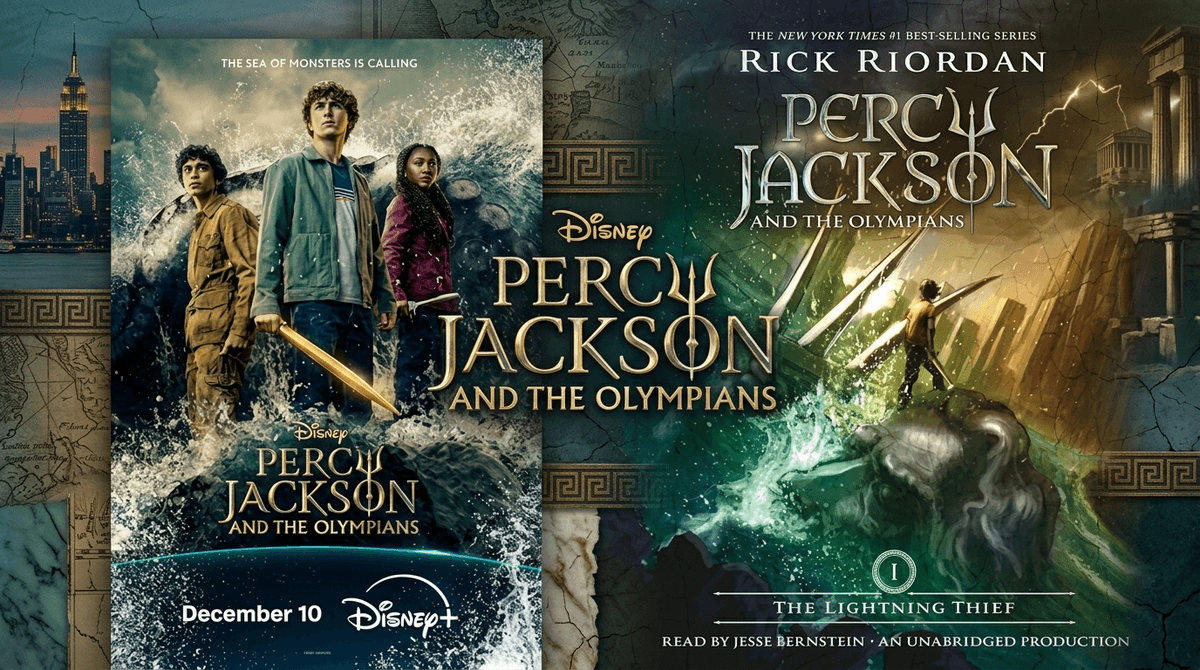
If you have a middle schooler, Percy Jackson and the Olympians on Disney+ is likely already on their radar. Unlike the 2010 movie attempt (which we collectively pretend doesn't exist), this series is a faithful, smart, and emotionally resonant adaptation of the beloved book series. It’s perfect for ages 8-12, blending Greek mythology with modern-day middle school struggles.
Quick Links:
- The Show: Percy Jackson and the Olympians (Disney+)
- The Starting Point: The Lightning Thief by Rick Riordan
- The Deep Dive: Rick Riordan’s Extended Universe Guide
- The "What Next?": Hades (the video game) for older kids who love the lore.
Percy Jackson and the Olympians is the long-awaited "redo" of Rick Riordan's massive book franchise. The story follows Percy, a 12-year-old who discovers he isn't just a kid with ADHD and dyslexia—he’s actually a demigod, the son of the Greek god Poseidon.
Season one follows the plot of The Lightning Thief. Percy is accused of stealing Zeus’s master bolt and has to trek across America with his friends Grover (a satyr) and Annabeth (daughter of Athena) to find it before a war breaks out between the gods.
It’s a "quest" show in the truest sense, but it’s grounded in very real-world feelings of being an outsider.
If your kid is into "Main Character Energy," Percy is the blueprint. But it’s more than just the action.
- The Underdog Factor: Percy starts the series feeling like a "problem kid." Seeing those "problems" (like ADHD) reframed as survival instincts for a warrior is incredibly empowering for kids who feel like they don't fit the standard school mold.
- The Lore: Kids love a complex world they can master. Once they learn the difference between Ares and Hephaestus, they feel like experts. It’s the same "collection" impulse that drives Pokémon or Minecraft obsession.
- The Humor: The show maintains the books’ "no-BS" snark. It doesn't talk down to kids; it talks with them.
See why Greek mythology is trending with Gen Alpha
If your family is diving into the world of Camp Half-Blood, here is how to navigate the media landscape surrounding it.
Ages 8+ The book that started it all. Even if your kid has seen the show, the book is worth the read. The internal monologue of Percy is hilarious and provides a lot of context that the show (rightfully) has to trim. It’s a great choice for reluctant readers because the pacing is relentless.
Ages 7+ If your kids finished Percy Jackson and want more "found family on a quest with elemental powers," this is the gold standard. It deals with similar themes of destiny and parental expectations but in a different mythological setting. Read our guide on why Avatar is the perfect family watch
Ages 12+ For the older kids (and honestly, the parents), this is one of the best games of the last decade. It’s a "roguelike" where you play as Zagreus, son of Hades, trying to escape the Underworld. The writing is top-tier, and the mythological accuracy is impressive. It’s a bit violent, but it’s stylized and educational in its own way.
Ages 9+ Another fantastic Netflix show that hits the same "epic fantasy quest" notes. It’s great for the 9-12 age range and features a diverse cast and complex villains that aren't just "evil for the sake of it."
The show is rated TV-PG, and for the most part, it stays in that lane. However, there are a few things to keep in mind if you have a sensitive 8-year-old.
The Scare Factor
There are monsters. Medusa is a standout episode—it’s atmospheric and a bit creepy, focusing on the psychological horror of her garden of statues. The Chimera and the Procrustes (the "Crusty" bed guy) scenes can be intense for younger viewers. It’s not "horror movie" scary, but it’s "jump scare" scary.
The "Absent Parent" Theme
This is the heavy hitter. The Greek gods are, frankly, terrible parents. They are distant, demanding, and often use their children as pawns. If your child is sensitive to themes of abandonment or parental conflict, some of the conversations Percy has about his father, Poseidon, might need a post-show debrief.
Neurodiversity as a Superpower
One of the best parts of the Percy Jackson universe is that ADHD and Dyslexia are explained as "demigod traits."
- ADHD is actually "battlefield reflexes."
- Dyslexia is because the brain is hard-wired for Ancient Greek, not English.
This is a fantastic conversation starter if your child has a learning difference. It moves the needle from "disability" to "different ability."
Check out our guide on media that celebrates neurodiversity
Let’s be real: the show isn't perfect. While it’s miles better than the movies, the pacing in the middle episodes can feel a bit rushed, and sometimes the kids solve puzzles a little too quickly because they’ve read the myths.
However, the casting is excellent. Walker Scobell (Percy), Leah Sava Jeffries (Annabeth), and Aryan Simhadri (Grover) have great chemistry. There was some unfortunate "internet noise" about the casting of Annabeth (who is white in the books but played by a Black actress in the show), but frankly, Leah Sava Jeffries nails the "scary smart" vibe of the character perfectly. If your kids bring up the casting, it’s a good moment to talk about how characters are about spirit, not just a sketch on a page.
If you want to move beyond "Did you like it?", try these prompts:
- "The gods seem kind of selfish. Do you think Percy owes his dad anything just because he's a god?" (This gets into the show's core theme: loyalty vs. duty).
- "Which Greek god do you think would be the hardest to have as a parent?" (A fun way to test their mythology knowledge).
- "If you were at Camp Half-Blood, what would your 'specialty' be?" (Great for self-esteem building).
Percy Jackson and the Olympians is a win for intentional parents. It’s high-quality storytelling that encourages kids to pick up a book, learn about history/mythology, and feel better about their own "glitches."
It’s not brain rot. It’s a gateway to a much larger world of literature and history.
Next Steps:
- If they loved the show: Get them The Sea of Monsters (Book 2) so they can get ahead of Season 2.
- If they love the mythology: Check out Mythology by Edith Hamilton for the "real" (and much darker) versions of these stories.
- If you want to set boundaries: Talk about a "one episode per day" rule to avoid the Disney+ binge-crash.