

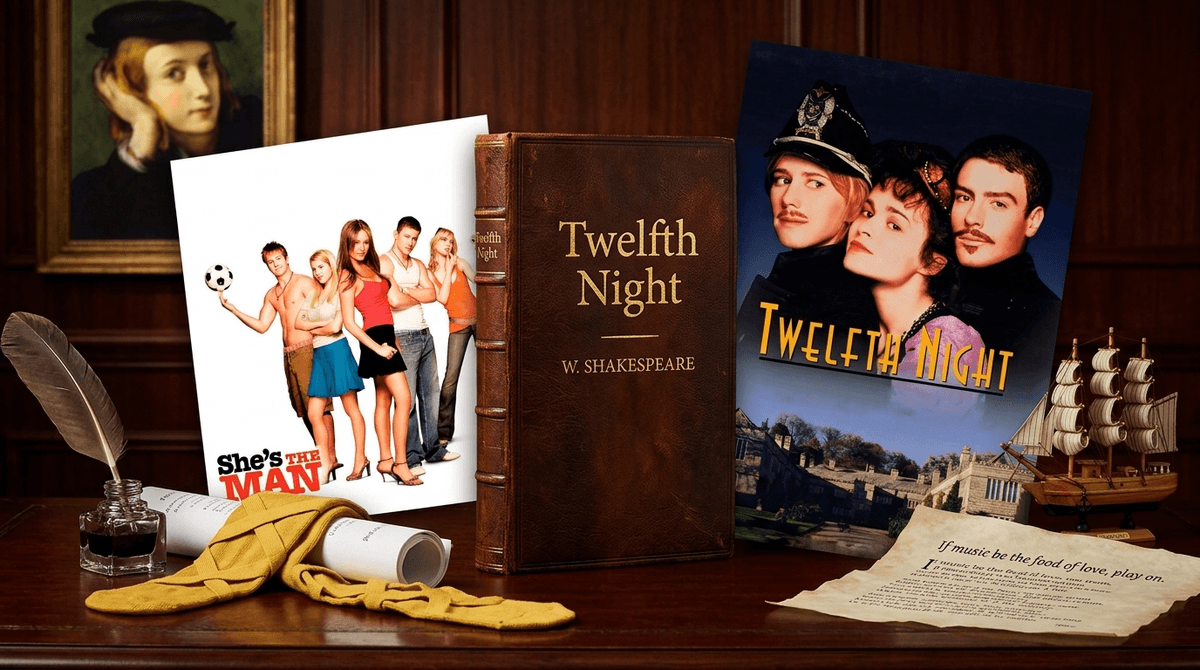
Shakespeare’s Twelfth Night is the original "She’s the Man"—literally—but with more sword fights, way more drinking, and a subplot that is surprisingly cruel for a "comedy." It’s a story about shipwrecked twins, mistaken identity, and a love triangle that only gets resolved because a second identical person happens to wander into town at the last minute. If you’re looking for a gateway drug to get a kid into the Bard, this is arguably a better bet than the tragedy-heavy Romeo and Juliet or the dense political maneuvering of Julius Caesar.
TL;DR
Twelfth Night is a high-energy rom-com featuring gender-bending disguises and slapstick humor that lands well for ages 10 and up. While the main romance is lighthearted, the "prank" played on the steward Malvolio is legitimately mean-spirited and offers a great opening to talk about the line between a joke and bullying. For a modern entry point, check out She's the Man or the 1996 film adaptation for a version that keeps the pace moving.
Most Shakespeare plays feel like "homework," but Twelfth Night feels like a sitcom pilot. You have Viola, who survives a shipwreck, thinks her brother is dead, and decides the best way to survive in a strange land is to put on pants and pretend to be a guy named Cesario. She ends up working for Duke Orsino, who is hopelessly in love with a woman named Olivia. Orsino sends "Cesario" to woo Olivia for him, Olivia falls for "Cesario" instead, and Viola falls for Orsino.
It’s messy, it’s fast, and it’s genuinely funny. For a kid raised on Disney Channel tropes or modern rom-coms, the "disguise" plot is a familiar language. It’s also one of the best ways to show kids that Shakespeare wasn't just some guy writing "thee" and "thou" in a vacuum—he was writing for an audience that wanted to be entertained.
The core of the play is Viola’s disguise. In 2026, the idea of gender fluidity and identity is a standard part of the cultural conversation, but back in 1601, this was revolutionary (even if it was partly born out of the fact that women weren't allowed on stage, so you had a boy playing a girl playing a boy).
If your kid is into stories about "fitting in" or the performance of identity, this is the gold standard. It’s a great way to discuss how we act differently depending on who we’re with or what "costume" we’re wearing. It doesn't need to be a heavy "lesson"—the play handles it with a wink and a nudge, especially when Olivia starts getting aggressive in her pursuit of the very confused Viola.
Here is where the "comedy" label gets a bit strained. While the nobles are busy falling in love, the "upstairs/downstairs" staff—Sir Toby Belch, Maria, and Sir Andrew Aguecheek—decide to take down Malvolio, Olivia’s stiff-necked steward.
They forge a letter making him believe Olivia is in love with him and wants him to dress in yellow, cross-gartered stockings and smile constantly (which he never does). It starts as a funny prank, but it ends with Malvolio being locked in a dark room and treated like a literal madman.
The takeaway for parents: This is the part that usually surprises people who haven't read the play since high school. It’s mean. According to the New York Theatre Guide, the play is often described as "bittersweet" because the humor comes at a real cost. It’s a perfect "is this actually funny?" moment to have with a middle schooler who might be navigating their own "prank" culture at school.
Don't just hand them the Folger edition and wish them luck. Shakespeare was meant to be seen, not read under a desk lamp.
Yes, it’s a mid-2000s teen movie starring Amanda Bynes and Channing Tatum, but it is a remarkably faithful adaptation of the spirit of the play. It moves the setting to a prep school soccer team. If you want to prime a 10-year-old for the actual play, watch this first. They’ll recognize the plot beats instantly when they see the stage version.
Directed by Trevor Nunn, this version is lush, easy to follow, and features a killer cast (Helena Bonham Carter, Ben Kingsley). It leans into the Victorian aesthetic and manages to make the dialogue feel natural rather than declamatory. It’s the "prestige" pick that won't put your kids to sleep.
If you can find the recording of the Stephen Fry/Mark Rylance version, grab it. It uses an all-male cast to replicate the original Elizabethan experience. It’s hilarious, high-energy, and shows just how much physical comedy is baked into the script.
If your kid is engaging with Twelfth Night for school or a local theater production, don't worry about the "thee/thou" stuff. Focus on the human messiness.
- The "Prank" Line: Ask them: "At what point did the joke on Malvolio stop being funny?" It’s a great way to talk about empathy without being preachy.
- The Disguise: "Why do you think Viola felt safer as a man?" This opens up conversations about historical gender roles and how things have (or haven't) changed.
- The Ending: The ending is "happy" because everyone gets married, but Malvolio leaves swearing revenge. Ask them if they think the ending is actually a happy one for everyone involved.
The biggest "friction point" in Twelfth Night isn't the language—it's the drinking. Sir Toby Belch is essentially a functioning (or non-functioning) alcoholic. The play treats his drunken antics as comic relief, but in a modern context, he’s a bit of a mess. Also, be prepared for some bawdy double entendres. Shakespeare loved a dirty joke, though most of them fly right over the heads of anyone without a PhD in Elizabethan slang.
Q: Is Twelfth Night appropriate for a 10-year-old? Absolutely. The plot is basically a Disney Channel movie with better writing. The "romance" is mostly pining and confused glances, and the violence is limited to a few comedic sword-fighting blunders.
Q: What are the content warnings for Twelfth Night? Expect heavy themes of deception, significant depictions of alcohol use (Sir Toby), and the psychological bullying of Malvolio. There’s no graphic violence or explicit content, just 17th-century "messiness."
Q: Which version of Twelfth Night is best for beginners? Start with She's the Man to get the plot down, then move to the 1996 Trevor Nunn film. If you’re seeing it live, look for a production that emphasizes the "comedy" and "romp" aspects.
Q: Why is it called Twelfth Night? It refers to the twelfth night of Christmas, a festival characterized by "misrule" and social roles being flipped upside down. It’s basically the "Purge" but with more lutes and less murder.
Twelfth Night is the most accessible of Shakespeare's comedies because its central themes—wanting to be someone else, falling for the wrong person, and dealing with annoying bosses—are universal. It’s a masterclass in plot construction that rewards kids who are willing to look past the old-fashioned language to the chaotic rom-com underneath.
- Check out our best movies for kids list for more literary adaptations.
- If your kid loves the "disguise" trope, look at our digital guide for middle school for shows with similar themes.
- Find more "gateway" Shakespeare plays for teens
