

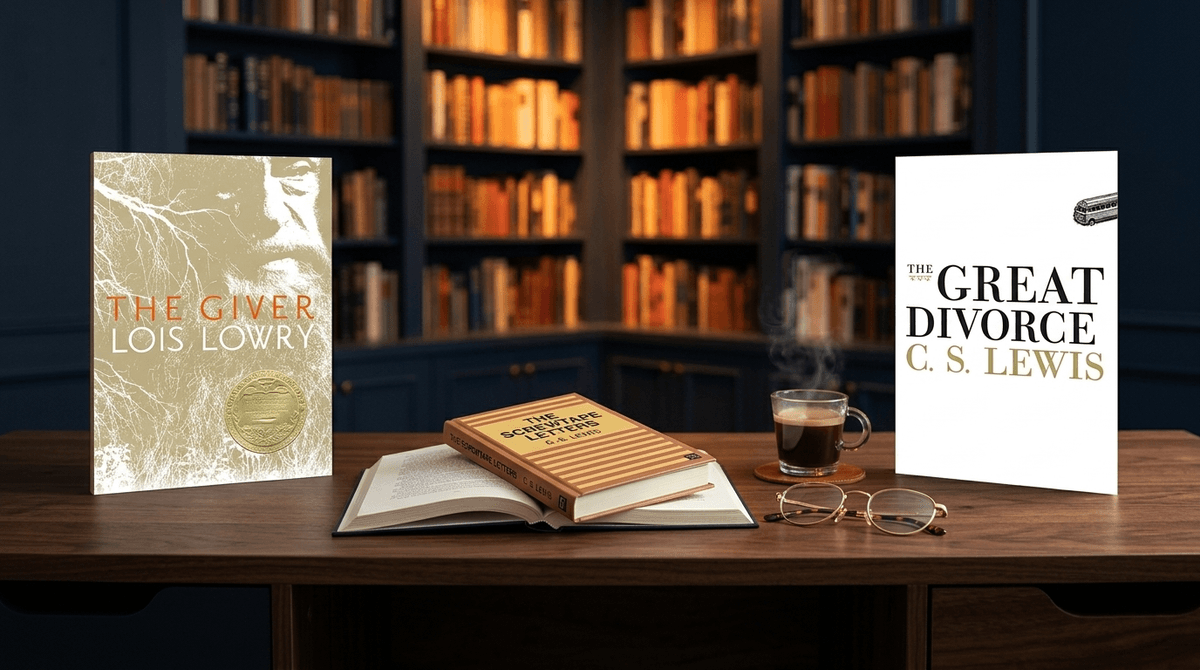
The Screwtape Letters is a masterclass in psychological warfare, but it’s written in 1940s British academic-ese—which means your teen might need a translator or a more modern entry point to appreciate the brilliance of its "everything is the opposite" gimmick. C.S. Lewis isn't being a buzzkill here; he’s writing a manual on how to be a bad person from the perspective of a demon who thinks he’s the hero, and that reverse-psychology is exactly what makes it stick for kids who are tired of being lectured.
If you want the deep moral psychology of The Screwtape Letters without the mid-century vocabulary hurdles, start with The Great Divorce for a more visual narrative or The Giver for a modern look at how small choices shape a soul. These books tackle the "invisible battle" of the human heart without making your kid feel like they're doing extra credit for a theology degree.
The genius of Screwtape is the "backward logic." God is "the Enemy." Satan is "Our Father Below." Virtue is "the poison." For a middle or high schooler, this flip is usually the thing that gets them through the door. It turns a book about morality into a spy thriller where the protagonist is actually the villain.
Screenwise community data shows that about 70% of middle-schoolers aren't picking up Lewis independently—it’s usually a parent-led or school-assigned read. But for the 30% who do dive in on their own, the psychological "hacks" are what keep them turning pages. Lewis is the original "it’s not a bug, it’s a feature" guy, showing how tiny, mundane annoyances (like how your mom chews her food) are more effective at ruining your character than big, dramatic sins.
If the demons are too much or the prose is too dense, Lewis has other ways into these same themes that feel more like stories and less like a stack of mail.
Think of this as the 3D version of Screwtape’s concepts. It’s a dream-trip on a bus from Hell to Heaven, but Hell is just a rainy, grey city where everyone is grumpy, and Heaven is so "real" that the grass hurts your feet. It’s much more visual and hits those same notes about how we choose our own misery through small, stubborn habits.
Specifically The Last Battle. While the whole series is the obvious baseline, the final book handles the "internal monologue" and the struggle to see the truth through deception in a way that maps directly to Screwtape’s advice. If your kid is younger (ages 8-11), this is the move before hitting the heavier stuff.
If you want the "Screwtape vibe"—deep psychological insight, moral stakes, or the feeling of an invisible world—but want it written in the last twenty years, try these.
It’s a different genre (dystopian), but the core question is the same: what happens to a soul when you remove the ability to choose between good and evil? It’s a great companion piece because it shows the "grey world" that Screwtape is trying to create—a place where nothing hurts, but nothing matters either.
If your teen likes the "letter" format, this is a real-world version. It’s a series of actual letters between a son (a theologian) and his father (a skeptic). It’s modern, handles the "big questions" directly, and lacks the 1942 British slang. It’s the "non-fiction but feels like a story" alternative.
This sounds like a curveball, but Lemony Snicket’s narrative voice—dry, cynical, and constantly breaking the fourth wall to explain how miserable things are—is the closest modern equivalent to Screwtape’s tone. It’s "Screwtape Lite" for the middle-grade crowd who likes a narrator with a dark sense of humor.
If you’re going for the original, don't just hand them a mass-market paperback and walk away.
- Get the Annotated Version: There are editions that explain the 1940s references (like what a "gas-mask" or "the Blitz" meant to the original readers).
- Audio is the Move: Hearing the letters read with a posh, slightly annoyed British accent makes the satire much more obvious. It turns a "religious book" into a performance. Listening builds the language comprehension strands of literacy, which is vital for a text this dense.
- Focus on the "Slow Fade": The most relevant part for a 2026 teen isn't the theology; it's the chapters on "the inner ring" (wanting to be in the cool group) and "the glib" (being cynical to sound smart).
Screwtape’s goal isn't to make people "evil" in a movie-villain way; it's to make them "lukewarm." Ask your kid: "Which of Screwtape’s 'distractions' do you see most often in your feed?" Usually, it’s not the big temptations, but the "infinite scroll" of nothingness that Screwtape would love. It’s a way to talk about the algorithm as a spiritual tool.
The biggest friction point is the "Enemy" / "Father Below" naming convention. For the first three chapters, your kid will probably be confused about who is who. Remind them once: Screwtape is a demon, so if he hates it, it’s probably good. If he loves it, watch out.
Q: What age is The Screwtape Letters appropriate for? It’s best for ages 13 and up. While there’s nothing "inappropriate" in terms of content, the vocabulary and the satirical "backward" logic are usually too much for younger kids to track without getting frustrated.
Q: Is The Screwtape Letters scary? Not at all. It’s a psychological drama, not a horror story. The demons are portrayed more like middle-managers in a failing corporation than monsters in a basement.
Q: Is there a movie version? There isn't a definitive feature film, but there are several excellent stage plays and "dramatic readings" on YouTube and Audible. For a teen, the audio drama version is often more engaging than the physical book.
The Screwtape Letters is the ultimate "think for yourself" book because it forces the reader to argue against the narrator. If the prose is a wall, use a modern bridge like The Giver or Lewis’s more narrative The Great Divorce.
- Check out our best books for middle school for more deep-thinker picks.
- Explore the best podcasts for kids if your teen prefers the "audio drama" route.
- Get help picking a next book series
