

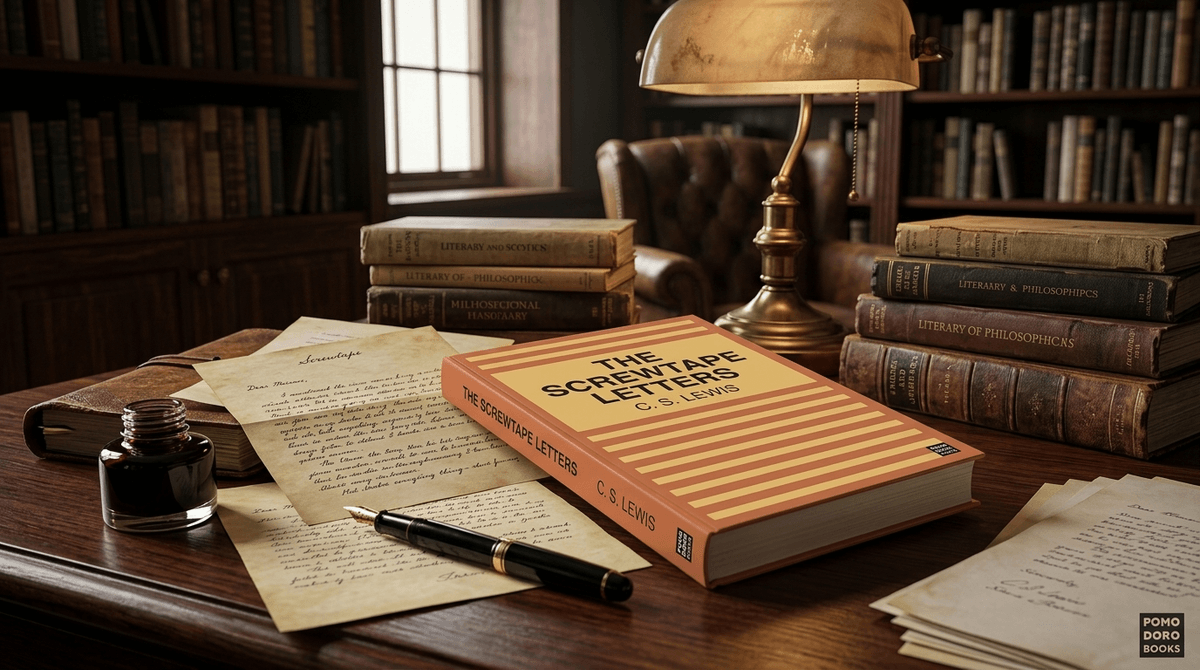
The Screwtape Letters is a brilliant, dry, and deeply psychological piece of satire that is perfectly safe for teens—provided they have the reading stamina to hack through 1940s British prose. There’s no "content" to worry about in the traditional sense (no gore, no sex, no swearing), but the entire book is written from the perspective of a demon, which requires a kid who can handle irony without getting turned around.
TL;DR: The Screwtape Letters is a masterclass in self-awareness disguised as a series of letters from a senior demon to his nephew. It’s a "brain workout" book that’s best for high schoolers (14+) who are ready to talk about why humans do the dumb things they do. If they can handle the vocabulary, it’s one of the most useful books they’ll ever read. For more high-level picks, check out our best books for kids list.
C.S. Lewis didn’t write a horror story; he wrote a corporate satire. The premise is simple: Screwtape is a seasoned "Under Secretary" in the hierarchy of Hell, and he’s mentoring his nephew, Wormwood, on how to successfully damn a specific British man (referred to as "the patient").
The genius—and the challenge—is that everything is inverted. Screwtape refers to God as "the Enemy" and Satan as "Our Father Below." Gluttony isn’t just about overeating; it’s about being "fussy" with tea. Greed isn’t just about money; it’s about the feeling that your time is your own property. It’s subtle, it’s witty, and it’s remarkably observant about human nature.
Let’s be real: the biggest barrier to entry for a modern 15-year-old isn't the theology—it's the sentence structure. Lewis was an Oxford don writing in 1942. He uses words like "asphyxiating," "extirpate," and "philological."
If your kid is a reluctant reader, this book will feel like a brick wall. However, if they’re into Percy Jackson or The Hunger Games and looking to level up to something more "adult," this is a great bridge. It’s short (usually under 200 pages), and because it’s a series of letters, it has natural breaking points.
Teens are in a developmental stage where they are hyper-aware of hypocrisy—both in others and, eventually, in themselves. The Screwtape Letters hits that sweet spot because it’s essentially a book about the "inner monologue."
It’s not about grand villains or epic battles. It’s about the tiny, petty thoughts that lead to being a jerk to your mom or ignoring a friend. It gives teens a vocabulary for self-reflection that isn't preachy. When a demon is the one explaining why "being annoyed at the way someone chews" is a great way to destroy a relationship, it lands differently than a parent saying it.
The only real "friction point" is the satirical flip. Because Screwtape calls good things "bad" and bad things "good," a younger or less literal-minded kid might get confused. They need to be able to hold the idea that "The author believes the opposite of what the character is saying."
If your kid is already familiar with Lewis through The Chronicles of Narnia, this is the "grown-up" version. It’s less about the magic and more about the mechanics of the soul.
If the text is too dense, the audiobook narrated by John Cleese (or Andy Serkis) is a game-changer. Hearing the "Screwtape" voice—haughty, impatient, and slightly disgusted—makes the satire much more obvious and the humor more accessible.
Conversations to Start:
- The "Patient's" Mom: There’s a famous chapter about how the demons try to make the patient and his mother annoy each other through "tones of voice." Ask your teen if they’ve ever noticed how a "neutral" sentence can be a weapon.
- The "Quiet Desperation": Screwtape argues that the safest road to Hell is the gradual one—the "soft underfoot, without sudden turnings." Ask them what they think that means for everyday life.
- The Definition of Love: Screwtape is baffled by the idea that "the Enemy" (God) actually loves humans. He thinks it’s a lie. It’s a great way to talk about what real love looks like versus transactional relationships.
Q: Is The Screwtape Letters too scary for a 13-year-old? Not at all. There are no jump scares, no demons jumping out of closets, and no graphic descriptions of hell. The "horror" is entirely psychological and moral. If they can handle a dry British comedy, they can handle this.
Q: Is this only for Christian families? While Lewis was a famous Christian apologist, the book’s insights into human psychology, ego, and habit are pretty universal. Even if you aren't religious, it’s a fascinating look at how small choices shape character.
Q: What age is The Screwtape Letters appropriate for? The "sweet spot" is 14 and up. Younger kids (11-12) can read the words, but they often miss the satirical layer, which makes the book feel like a confusing lecture rather than a sharp critique.
Q: Is there a movie version? There have been various stage plays and audio dramas, but no major feature film (though rumors always fly). It’s better as a book anyway—the "action" is all inside the characters' heads.
The Screwtape Letters is a high-reward read. It treats the reader like an adult, offering a sophisticated look at morality without the "after-school special" vibes. If your teen is ready for a challenge, hand them this and then ask them which of Screwtape’s tactics they’ve seen in the wild.
- For more challenging but rewarding reads, see our digital guide for high schoolers.
- If they loved the dry wit, try The Hitchhiker's Guide to the Galaxy.
- Get help picking a next book series
