

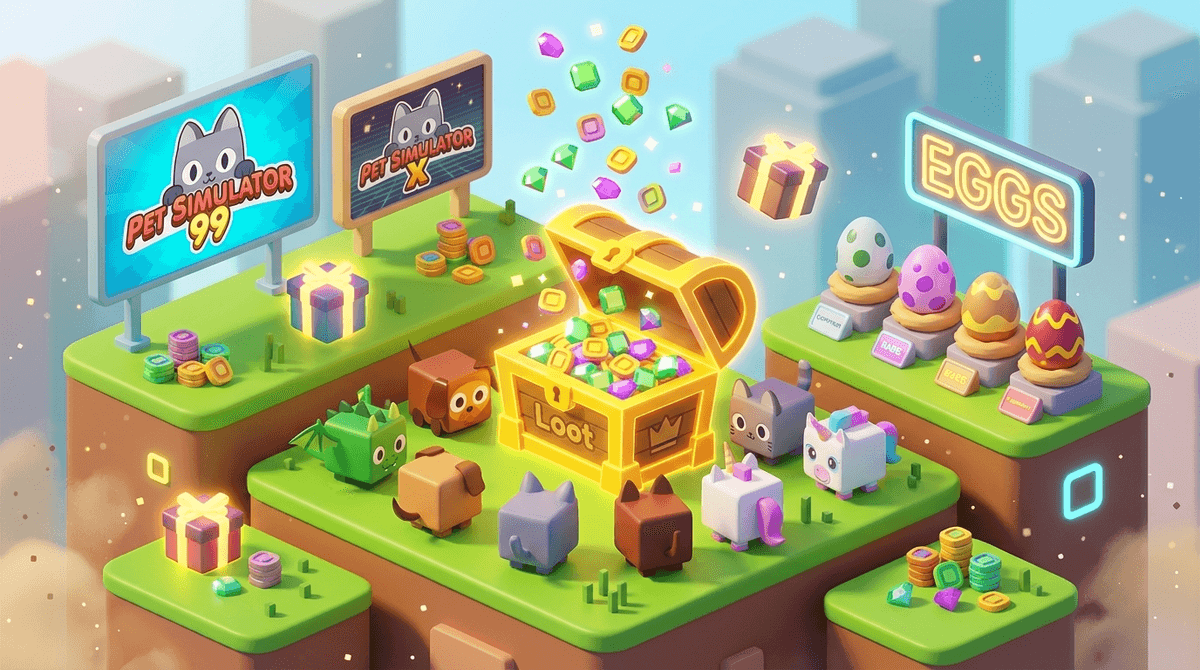
Pet Simulator 99 is essentially a high-gloss, neon-soaked digital casino designed for the elementary school set. It’s the successor to the massive Pet Simulator X on Roblox, and it takes every psychological trick in the book—scarcity, "gacha" mechanics, and tiered rewards—and turns them up to eleven. It’s not "dangerous" in a graphic sense, but it is the most efficient machine ever built for separating a kid from their (or your) Robux.
Pet Simulator 99 is an "incremental" collection game where players use pets to break objects and earn currency to buy better pets. It uses aggressive monetization tactics like the Forever Pack and high-stakes Trading Plazas to keep kids engaged. If your kid is playing, focus on setting hard spending limits and discussing how "rarity" is manufactured to drive demand. For lower-stress alternatives, check out Bee Swarm Simulator or our best games for kids list.
At its heart, Pet Simulator 99 is a "clicker" or "idle" game. Your pets hit a large chest; the chest drops coins; you use coins to buy an egg; the egg hatches a slightly better pet; that pet hits a bigger chest. Rinse and repeat across dozens of colorful "zones."
It sounds boring to an adult, but for a kid, it’s a masterclass in dopamine delivery. Every few seconds, something sparkles, a number goes up, or a "rank up" notification fills the screen. The game is designed to be played for hours, often left running in the background (called "AFK farming") so the player can accumulate enough wealth to reach the next area. It’s the ultimate "just one more" experience.
If you’ve heard your kid asking for "just 50 Robux" for a pack, they’re likely looking at the Forever Pack. This is one of the most clever—and predatory—pieces of game design in the Roblox ecosystem.
Here’s how it works: The first item in the pack is often free or very cheap (e.g., 50 Robux). Once you claim it, the next item is revealed. It might be a super-rare "Huge" pet. But to get it, you have to pay more. Then the next item is revealed, and the price jumps again. It exploits the "sunk cost fallacy"—the feeling that because you’ve already started the chain, you might as well finish it to get the big prize at the end. It is a bottomless pit, and it’s remarkably effective at draining a digital wallet.
Once a kid gets a few decent pets, they’ll want to head to the Trading Plaza. This is a separate server where players can set up booths to sell their pets or trade with others.
This is where Pet Simulator 99 turns into a lesson in high-frequency trading and, unfortunately, social engineering. The "value" of pets is determined by the community, often tracked on external "Value List" websites. Because some pets (like "Titanic" pets) can be worth the equivalent of hundreds of real-world dollars, the Plaza is a magnet for scammers.
Common tactics include "switch-and-bait" trades or "trust trades" where a player promises to give a rare pet back after "borrowing" it. For an 8-year-old, the emotional fallout of losing a "Huge" pet they spent months earning is real. If your kid is in the Plaza, they aren't just playing a game; they’re participating in an unregulated commodities market.
The biggest thing to understand is that progress is intentionally slowed to encourage spending. You can play for free, but the game will constantly remind you that a "VIP pass" or a "Luck Gamepass" would make everything faster.
The game also relies heavily on "gambling-lite" mechanics. Hatching eggs is a lottery. You have a 0.0001% chance of getting the pet you actually want. That "near-miss" feeling—where the spinner almost lands on the rare item—is designed to trigger the same brain response as a slot machine.
Instead of just banning the game (which usually backfires), use it as a laboratory for digital literacy.
- Talk about Manufactured Rarity: Ask them, "Why is that square cat worth more than the other square cat?" Help them see that the developers decide what is rare just to make people want it more.
- The "AFK" Conversation: If they are leaving their device on all night to "farm" coins, talk about the trade-off. Is a digital pet worth the electricity and the wear on the hardware?
- Scam Awareness: Treat the Trading Plaza like a crowded city square. "If a deal looks too good to be true, it’s a scam." Teach them never to give anything away for free with the promise of a future reward.
If the "money pit" aspect of Pet Sim is wearing you out, there are games that offer similar collection thrills without the aggressive psychological prodding:
Also on Roblox, this is widely considered the "prestige" version of the genre. It’s deep, complex, and while it has microtransactions, it’s much more focused on questing and discovery than just "buying the best thing."
If they love the "loop" of working to get money to buy better tools to get more money, Stardew Valley is the gold standard. It’s a one-time purchase with zero microtransactions and a much more wholesome soul. Read our full guide to Stardew Valley here.
The original "collect-them-all" franchise. It hits the same "rarity" and "trading" itches but within a structured, safe environment where you can't accidentally spend $500 on a single digital lizard.
Q: Is Pet Simulator 99 appropriate for a 7-year-old? Technically, yes—the content is cartoonish and bloodless. However, the complexity of the economy and the predatory nature of the "Forever Pack" often exceed a 7-year-old's impulse control. If they play, keep them out of the Trading Plaza.
Q: How do I stop my kid from spending Robux in Pet Simulator 99? The best way is through Roblox account settings. You can set a monthly spending limit or require a PIN for any purchase. Don't rely on the game to be "fair"—it’s designed to be tempting. Check out our guide to Roblox parental controls.
Q: What is a "Huge" pet and why does my kid want one so badly? "Huge" pets are larger versions of standard pets that do significantly more damage. They are status symbols. In the world of Pet Simulator 99, having a "Huge" is the equivalent of driving a Ferrari to elementary school.
Q: Is Pet Simulator 99 better than Pet Simulator X? It’s more polished and has more "quality of life" features, but it’s also more aggressive with its monetization. It’s the same engine, just tuned to be more addictive.
Pet Simulator 99 isn't "evil," but it is "extractive." It’s a game built around the joy of acquisition rather than the joy of play. If your kid loves it, they’re likely enjoying the sense of progression and the social status of rare pets. Just make sure you’re the one holding the keys to the wallet.
- Explore our best games for kids list for titles that value your kid's time (and your money).
- Check out our digital guide for elementary school to see how Roblox fits into a healthy media diet.
- Find Roblox alternatives
