

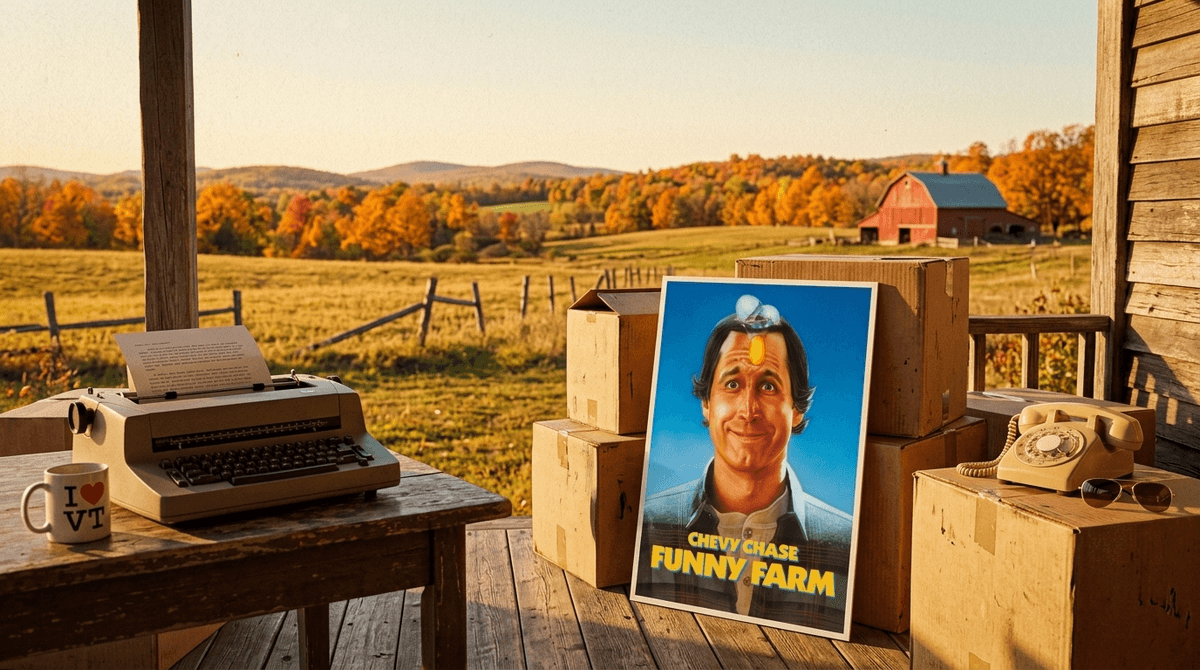
Funny Farm is the ultimate "nostalgia trap" for parents who grew up on a steady diet of Chevy Chase—it’s way more cynical, foul-mouthed, and dark than your childhood memory probably suggests. While it carried a PG rating in 1988, modern streaming services have correctly bumped it to TV-14 because it features a steady stream of "soft" profanity and a brand of marital friction that feels a lot more real than your average family comedy.
Funny Farm is a classic fish-out-of-water comedy that hits best for the 12+ crowd who can appreciate Chevy Chase’s signature descent from smug writer to manic ruralite. It’s a great pick for families who want a break from polished modern animation, but be ready for a barrage of 80s-era swearing and some gross-out humor involving "lamb fries." If you're looking for more era-specific hits, check out our best movies for kids list.
If you haven't seen Funny Farm since it was on a loop on basic cable in the 90s, you might remember it as a whimsical tale of a city couple moving to Vermont. In reality, it’s a masterclass in the "Chevy Chase slow-burn"—that specific brand of 80s smugness that eventually curdles into a very funny, very relatable nervous breakdown.
The reason it carries a TV-14 tag today isn't because of one specific "bad" scene, but because of the cumulative grit. The 1980s PG rating was a wild west where you could get away with a surprising amount of "shit," "asshole," and "son of a bitch" as long as nobody took their clothes off or started a chainsaw. Funny Farm lives in that gap. It’s not a "kids' movie" in the modern sense; it’s an adult comedy that happened to be accessible to kids.
Let’s talk about the language, because that’s usually the first thing that catches intentional parents off guard. Andy Farmer (Chase) and the local townspeople aren't exactly speaking in Sunday school terms. You’re going to hear:
- Multiple uses of "shit" and "son of a bitch."
- Frequent "goddamns" and "hells."
- A colorful variety of insults directed at the "idiot" locals and the "bastard" dog.
If your household is strictly "G-rated language only," this is going to feel like a lot. However, if your kids are already in the Marvel or Stranger Things ecosystem, the language here won't even register as a blip. It’s used for comedic emphasis—usually when a bridge is collapsing or a deer is mocking Andy from the lawn—rather than being mean-spirited.
Beyond the words, there’s the content that makes the movie actually interesting (and a little weird).
The "Lamb Fries" Scene: This is the movie's most famous bit of gross-out humor. Andy realizes he’s just eaten a record-breaking amount of sheep testicles. It’s played for maximum gag-factor. It’s a great moment to talk about cultural food norms and the "gross-out" comedy tropes of the era, but sensitive eaters might find it a bit much.
The Garden Corpse: Early in the film, the Farmers find a human skeleton in their garden. It’s handled with a very dry, dark humor. The sheriff is unbothered, the locals are cryptic, and the skeleton eventually ends up in the back of a truck. It’s not "scary" in a horror sense, but it establishes the movie’s cynical tone early on.
The Drunk Mailman: The town’s mailman is perpetually intoxicated, weaving his Jeep across the road and screaming. In 1988, this was a standard "funny character" trope. Today, it stands out as a bit darker. It’s a perfect example of how 80s comedies often used substance abuse as a punchline.
Despite the saltiness, Funny Farm is a fantastic piece of satire. It’s the antidote to the "everything is better in a small town" trope. It shows the reality of moving to a new place with unrealistic expectations: the plumbing breaks, the neighbors aren't friendly, and your "dream project" (Andy’s novel) might actually be terrible.
For an intentional parent, the real value here is the depiction of the Farmers' marriage. Andy and Elizabeth (played by Madolyn Smith) actually have to navigate real stress. They fight, they disagree about their future, and they eventually have to decide if they’re staying together because they want to or because they’re stuck. It’s a much more "adult" look at relationships than kids usually see in media, and it’s handled with enough humor that it doesn't feel heavy.
If your kids enjoy the "city person fails at country life" or the "everything goes wrong on vacation" energy of Funny Farm, here are a few other picks that hit the same notes:
The gold standard of "everything goes wrong." It’s R-rated (mostly for one specific, legendary F-bomb-filled rant), but the heart and the comedy are unparalleled. If you can handle the language, it’s a better movie than Funny Farm.
Another 80s/90s staple that feels a bit more "family-friendly" while still maintaining that John Hughes edge. It deals with family dynamics and "messy" adults in a way that resonates with middle-schoolers.
For a modern take on the "stuck in the wilderness/rural life" theme, this Taika Waititi film is a masterpiece. It’s funny, weird, and has a lot more emotional depth than the 80s classics, without losing the "grit."
If you want to stay in the 80s lane, this Dan Aykroyd and John Candy team-up is the spiritual sibling to Funny Farm. It’s got the bears, the bad food, and the family tension, with a slightly more slapstick feel.
- The "Perfect" Life: Andy moves to Vermont because he has a postcard-perfect image of what it will be like. Ask your kids: "Why was Andy so disappointed? Was it the town’s fault, or his own expectations?"
- 80s vs. Now: Point out the mailman or the sheriff. Ask: "How would these characters be portrayed in a movie made today? Why do you think people found them funny in the 80s?"
- The Novel: Andy struggles with his writing throughout the movie. It's a great opening to talk about the "messy middle" of any creative project—how things rarely turn out perfect on the first try.
The "Yellow Dog" subplot is the one that might actually upset younger or more sensitive kids. Andy gets a dog that immediately runs away and refuses to come back to him, eventually becoming a sort of local legend that everyone else can find except Andy. It’s played for laughs, but for a kid who is very attached to their pets, Andy’s mounting frustration with the dog (and his eventual apathy toward it) might feel a bit mean.
Q: Is Funny Farm okay for a 10-year-old? It depends on your kid's exposure to "adult" humor. A 10-year-old will likely find the slapstick (Andy falling off the bridge, the lawn mower chase) hilarious, but they might be bored by the marital subplots and confused by some of the 80s-specific references. The language is the main hurdle.
Q: Why is Funny Farm rated TV-14 on streaming? Because of the frequent profanity ("shit," "asshole," "son of a bitch") and themes like public intoxication and dark humor involving a corpse. While it was PG in 1988, those elements push it into the TV-14 category by modern standards.
Q: Are there any "scary" parts in Funny Farm? Not really. There is a human skeleton found in a garden, but it’s treated as a joke rather than a horror element. There’s also a scene with a very large, aggressive deer, but again, it’s played for comedy.
Q: Does Funny Farm have any "adult" scenes? There is no nudity or graphic sexual content. The "adult" elements are strictly limited to language, some gross-out food humor, and the realistic portrayal of a marriage under stress.
Funny Farm is a solid "bridge" movie—something to watch when your kids are aging out of pure animation but aren't quite ready for R-rated comedies. It’s funny, cynical, and a great reminder that Chevy Chase was the king of the "frustrated everyman" for a reason. Just don't expect a clean-scrubbed Hallmark version of Vermont.
- For more middle-school-appropriate hits, check out our digital guide for middle school.
- Planning a retro night? See our full best family movies list.
- Get more "fish out of water" movie recs
