

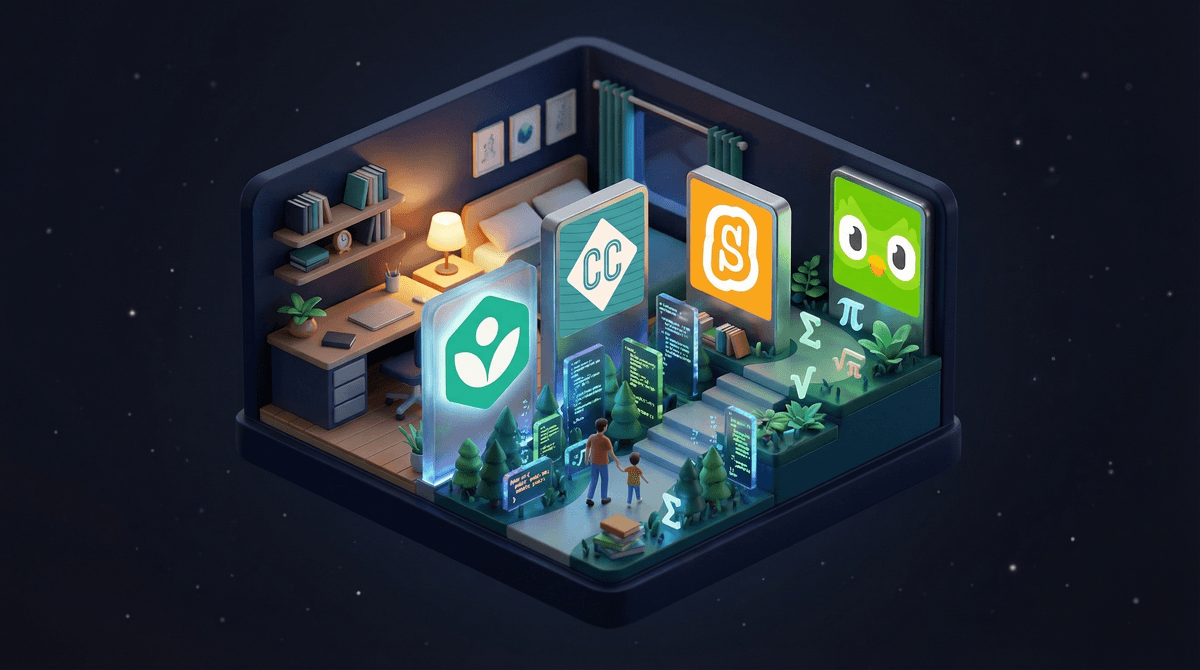
Online learning is basically any educational content delivered through screens — from your kid's district-issued Chromebook running Google Classroom to Khan Academy math practice to that Duolingo owl guilt-tripping them about Spanish. It includes live Zoom classes, asynchronous video lessons, educational apps, virtual tutoring, and everything in between.
The pandemic made online learning ubiquitous overnight, but now that we're past emergency remote schooling, it's worth asking: when is screen time actually educational, and when is it just... screen time with a worksheet attached?
Here's the thing: not all educational screen time is created equal. A kid passively watching a Khan Academy video while also scrolling TikTok is having a very different experience than one doing an interactive coding lesson on Scratch or video-chatting with a tutor about fractions.
The research on online learning is genuinely mixed. Some studies show it can be incredibly effective for certain learners and subjects. Others show it's a disaster for engagement and retention. The truth is maddeningly situational — it depends on the kid, the content, the implementation, and honestly, the day of the week.
Flexibility and accessibility. Online learning can be a game-changer for kids who need to learn at their own pace, revisit concepts, or access specialized content not available locally. Got a kid obsessed with marine biology in landlocked Kansas? Online courses can scratch that itch.
Personalization that actually works. Adaptive learning platforms like IXL or Prodigy Math can meet kids exactly where they are, unlike a classroom teacher juggling 28 different ability levels. When done well, this is genuinely powerful.
Building digital literacy. Like it or not, our kids will need to navigate digital workspaces, manage online collaboration, and learn through screens for the rest of their lives. There's real value in developing these skills early — learning to manage Google Docs, participate in video discussions, and organize digital assignments.
Access to incredible content. The internet has genuinely amazing educational resources. Crash Course on YouTube, interactive science simulations, virtual museum tours, live coding tutorials — stuff that simply didn't exist when we were kids.
Attention fragmentation is real. Even with the best intentions, having education happen on the same device as YouTube, Discord, and TikTok is like trying to study in a casino. The pull of that notification, that other tab, that quick check of messages — it's not a willpower issue, it's a design issue. These platforms are engineered to be distracting.
Loss of embodied learning. Younger kids especially learn through physical manipulation, social interaction, and movement. You can't replicate the experience of building with blocks, doing a science experiment, or reading a physical book together through a screen. Some learning genuinely needs to be analog.
The "productivity theater" trap. Just because a kid is staring at an educational app doesn't mean learning is happening. ABCmouse might keep your preschooler busy, but is it actually better than playing outside or doing a puzzle together? Sometimes "educational screen time" is just screen time with better marketing.
Zoom fatigue is real for kids too. Adults discovered this during the pandemic, but kids experience it too. Staring at a grid of faces or a static screen while trying to learn is cognitively exhausting in ways that in-person learning isn't.
Widening gaps. Online learning often works best for kids who already have strong executive function, self-regulation, and parental support. For kids who struggle with organization, motivation, or who don't have stable home environments, it can actually increase educational inequality.
Elementary (K-5): Online learning should be minimal and highly interactive. Live video with an actual teacher beats pre-recorded content. Short bursts (15-20 minutes max) work better than marathon sessions. Prioritize apps and programs that require active participation, not passive watching. And honestly? For this age, a good audiobook like Magic Tree House or hands-on activity beats most "educational" screen time.
Middle School (6-8): This is where online learning can start to work better. Kids have more self-regulation and can handle asynchronous content. But they also need the most social interaction for development, so be cautious about replacing in-person connection with screen-based learning. Hybrid approaches work well — using Duolingo for language practice but also having conversation partners, for example.
High School (9-12): Online learning can be genuinely effective here. AP courses through providers like FLVS, college-level MOOCs, specialized skill-building on platforms like Coursera — teens can handle the self-direction required. Just watch for the kid who's "doing homework" but actually has six tabs open and is retaining nothing.
Not all platforms are created equal. Some educational apps are genuinely well-designed with solid pedagogy. Others are just gamified worksheets with coins and badges slapped on. Check out specific reviews before committing.
Screen time for school still counts as screen time. If your kid just spent 6 hours on Zoom for school, they probably don't need another hour of "educational" apps. Their brain needs a break, even if the content was worthwhile.
The best online learning is often synchronous and social. A live video session where kids can interact, ask questions, and see each other beats a pre-recorded video lecture almost every time. Humans learn from humans.
Watch for the homework-that's-actually-busywork trap. Just because an assignment is submitted through Canvas doesn't make it valuable. If your kid is spending hours on low-value digital busywork, that's worth a conversation with the teacher .
.
Online learning is a tool, not a magic solution or an automatic disaster. Used thoughtfully — for specific skills, as a supplement to hands-on learning, with clear boundaries and good content — it can be genuinely valuable. Used as a default or a babysitter, it's just more screen time with a educational veneer.
The best approach? Be skeptical but not dogmatic. Question whether each online learning activity is actually the best way to learn that particular thing. Sometimes it is! Sometimes a YouTube tutorial is genuinely the best way to learn to code or understand photosynthesis. Sometimes it absolutely isn't, and your kid would be better off with a book, a conversation, or just messing around outside.
Audit what's actually educational. Spend a week tracking what "educational screen time" your kids are actually doing. Is it engaging? Are they learning? Or are they just clicking through to get it done?
Set up the environment for success. If online learning is happening, make it happen in a common space, with a dedicated time, and with other tabs and apps closed. Make it as focused as possible.
Balance with analog. For every hour of online learning, try to match it with hands-on, physical, or social learning. Read physical books. Do experiments. Have conversations. Build things.
Stay involved. The kids who succeed with online learning almost always have parents who are checking in, asking questions, and staying connected to what's being learned. You don't need to hover, but you do need to know what's going on.
And remember: just because something is on a screen doesn't make it educational, and just because something isn't on a screen doesn't make it old-fashioned. Trust your instincts about what's actually working for your kid.