

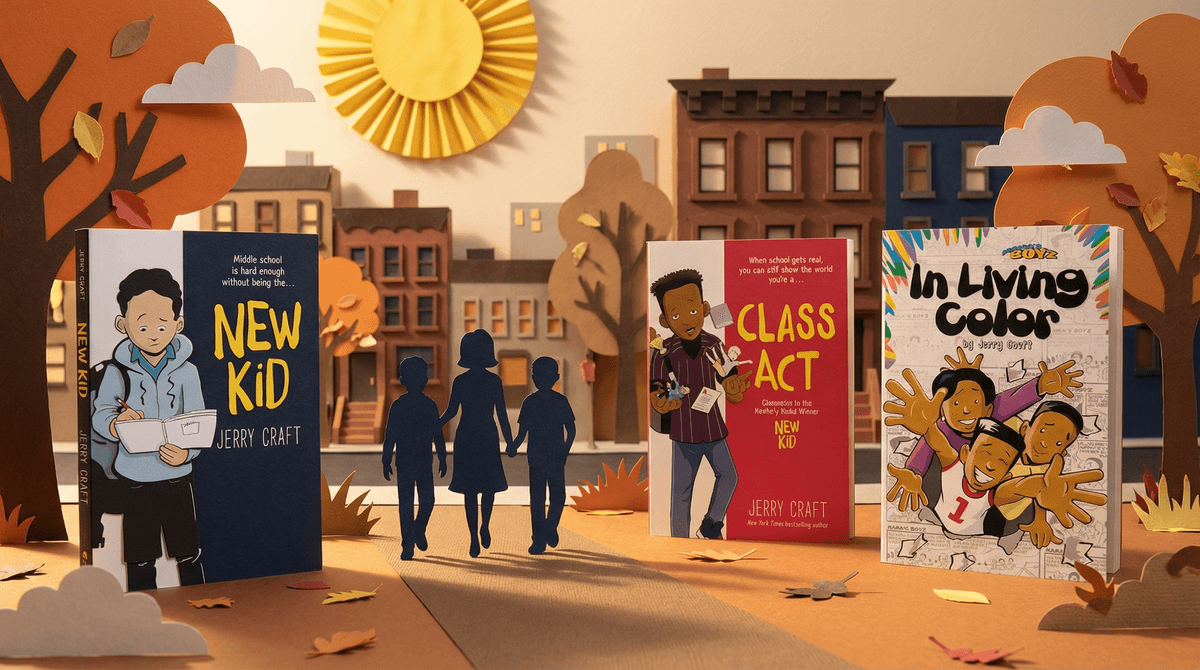
Mama's Boyz by Jerry Craft is a comic strip that ran in syndication from 1995 to 2013, following the lives of Yolanda Porter and her two teenage sons, Tyrell and Yusuf. Created by Jerry Craft (who later won a Newbery Medal for his graphic novel New Kid), the strip tackled everything from pop culture to family dynamics to identity with warmth and humor.
While the original strip ended its newspaper run, it lives on through collected books and online archives. More importantly, it paved the way for Craft's later work—including New Kid and Class Act—which are now staples in middle school libraries and classrooms everywhere.
If your kid has brought home one of Jerry Craft's graphic novels from school (and honestly, there's a good chance they have), understanding Mama's Boyz gives you context for why his work resonates so deeply with young readers.
Here's the thing: Mama's Boyz might feel like a throwback, but the themes are incredibly relevant to what kids are navigating right now—especially in our hyper-connected, social media-saturated world.
The strip centered a Black family dealing with everyday life, which was (and sadly still is) relatively rare in mainstream comics. Yolanda is a single mom running a bookstore, raising two sons with different personalities and interests. Tyrell is the cool, athletic one; Yusuf is the nerdy, artistic one. Sound familiar? These archetypes show up constantly in the content kids consume today, from The Proud Family to Spider-Man: Across the Spider-Verse.
The core themes include:
- Identity and representation - Seeing yourself reflected in media matters, whether that's in a 1990s comic strip or a TikTok video
- Family expectations vs. personal interests - The eternal struggle of "what my parents want for me" vs. "who I actually am"
- Code-switching and cultural navigation - How kids present themselves in different spaces (school, home, online)
- Economic realities - Money stress, entrepreneurship, and making ends meet
If your child's teacher has assigned New Kid or Class Act, it's because Craft has a gift for making complex topics accessible through humor and relatable characters. The graphic novel format makes it approachable for reluctant readers while still delivering sophisticated storytelling.
Ages 8-12 are the sweet spot for Craft's graphic novels. Kids this age are:
- Starting to think more critically about representation in media
- Navigating social hierarchies and friendship drama
- Developing their own identities separate from their parents
- Becoming more aware of economic and social differences
The visual format also helps kids who are used to consuming content on YouTube, Instagram, and TikTok—they're trained to process information in quick, visual bursts. Graphic novels meet them where they are.
This is the good stuff. If you're worried about what your kid is reading (or more likely, what they're watching on YouTube Shorts when they should be reading), Jerry Craft's work is genuinely enriching content that sparks important conversations.
Some topics that come up in Mama's Boyz and Craft's later work:
- Microaggressions and subtle racism - The strip didn't shy away from showing how Black families navigate predominantly white spaces
- Economic pressure - Yolanda's bookstore struggles reflect real challenges small business owners face
- Educational expectations - The pressure to succeed academically while maintaining cultural identity
- Media representation - Characters frequently discuss how Black people are portrayed in media
These aren't abstract concepts—they're things kids are experiencing in real-time, whether through their own lives or through the endless stream of content they're consuming online. Learn more about how media representation affects kids' self-image .
.
If your kid is reading Jerry Craft's work (either the original Mama's Boyz collections or the newer graphic novels), here are some conversation starters:
"What do you relate to most about the characters?" - This opens the door to talking about their own identity formation without making it feel like an interrogation.
"Have you ever felt like you had to act differently in different places?" - This gets at code-switching and authenticity, which are huge issues for kids navigating both physical and digital spaces.
"What do you think about how [character] handled [situation]?" - Let them practice moral reasoning in a low-stakes way.
"Are there characters like this in the stuff you watch on YouTube or TikTok?" - Bridge the gap between what they're reading and what they're consuming digitally.
Mama's Boyz might be "old" by internet standards, but Jerry Craft's work has only become more relevant. If your kid is reading his graphic novels, celebrate it—this is exactly the kind of thoughtful, character-driven content that can serve as a counterbalance to the rapid-fire, low-context stuff they're getting from social media.
And honestly? You might want to read them too. They're quick, they're funny, and they'll give you genuine insight into what kids are processing about identity, belonging, and family in 2024.
- Check out New Kid and Class Act if you haven't already—they're the natural evolution of what Craft started with Mama's Boyz
- Ask your child's teacher or librarian for similar graphic novels that tackle identity and family dynamics
- Use this as a springboard to talk about representation in the digital content your kid consumes—learn more about having conversations about media literacy
- Set up a family reading time where everyone reads their own thing for 20 minutes—graphic novels absolutely count, and it models that reading comes in many forms