

TL;DR
Nate the Great is the ultimate "gateway drug" to reading independence for kids aged 6-9. It’s a low-stimulation, high-logic detective series that bridges the gap between picture books and more complex chapter books. If your kid is currently vibrating from too much Skibidi Toilet or Roblox, Nate is the perfect "slow-burn" alternative.
Quick Links:
- The OG: Nate the Great
- The Spooky One: Nate the Great and the Halloween Hunt
- The Next Level: Encyclopedia Brown
- The Modern Rival: The Bad Guys
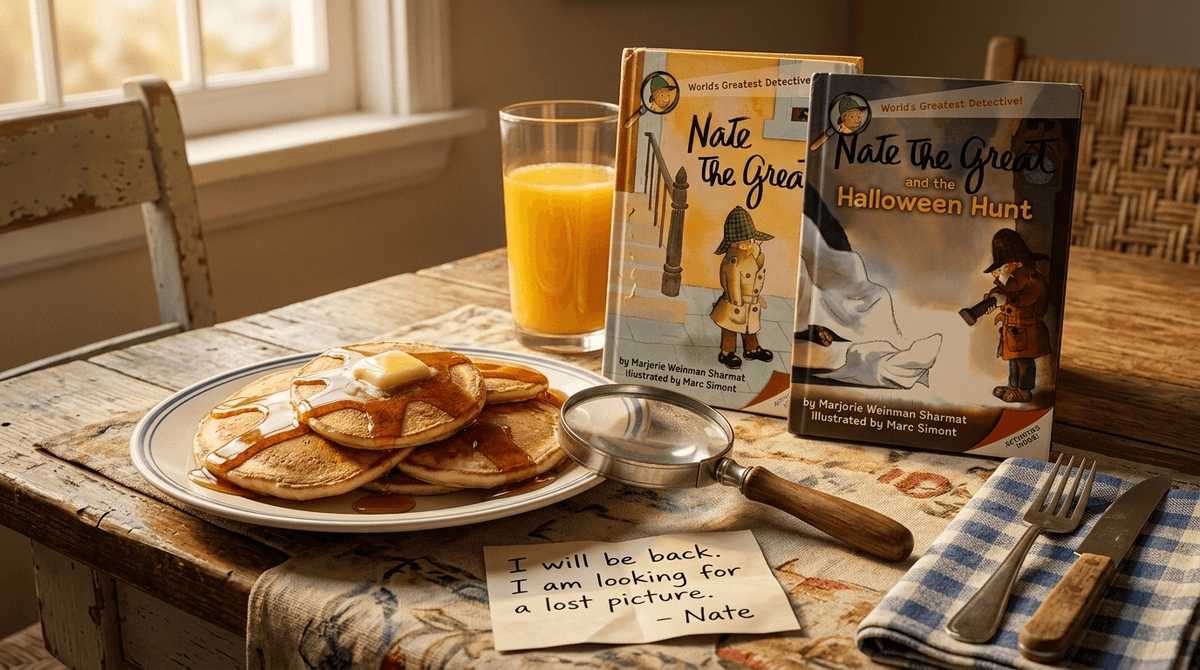
If you haven't revisited these since you were a kid, here’s the refresher: Nate the Great is a pint-sized detective who wears a Sherlock-style trench coat, loves pancakes (specifically his own secret recipe), and solves neighborhood mysteries with his dog, Sludge.
The books, written by Marjorie Weinman Sharmat, use short, punchy sentences and a first-person "noir" narrative style. Nate is serious, methodical, and surprisingly independent. He leaves notes for his mom (like "I will be back. I am looking for a lost picture. I am not looking for a lost dinosaur."), grabs his magnifying glass, and gets to work. No magic, no high-tech gadgets, just deductive reasoning and a lot of breakfast food.
We spend a lot of time talking about "brain rot"—that specific type of high-velocity, low-substance content found on YouTube or TikTok. These platforms thrive on 1.5-second cuts and loud noises that keep a kid's dopamine levels spiked.
Nate the Great is the antithesis of that. It requires sustained attention. To solve the mystery along with Nate, a kid has to remember what happened on page 4 while they’re on page 20. It’s a workout for the working memory.
More importantly, it models independence. In an era where we can track our kids' every move via GPS, there’s something deeply satisfying for a 7-year-old to read about a kid who just... goes out and solves problems on his own. It builds a sense of agency that digital "hand-holding" apps often strip away.
Learn more about how mystery books build critical thinking skills
With nearly 30 books in the series, you don't need to read them in order, but some are definitely better than others. Here are the standouts for your home library:
The one that started it all. Nate has to find a missing painting for his friend Annie. It introduces the core cast, including the eccentric Rosamond (who has four cats) and the dog, Sludge. It’s the perfect baseline for the series.
This is a fan favorite because it leans into the "spooky" (but not actually scary) vibes. Rosamond’s cat goes missing on Halloween. It’s a great seasonal read that keeps the logic front and center even when things get "weird."
This one is actually a great teaching tool. Nate has to figure out if a neighborhood kid is using "fake" money. It introduces basic concepts of commerce and observation in a way that feels like a high-stakes thriller to a second grader.
If your kid is prone to losing their own stuff (aren't they all?), this one hits home. It’s a classic "closed-room" mystery style adapted for kids, focusing on retracing steps and logical elimination.
Target Age: 6 to 9 years old (Grades K-3)
- For the 6-year-old: This is likely a "read-to-me" or "read-together" book. The sentences are short, which helps them track the words without getting overwhelmed by long clauses.
- For the 7-8-year-old: This is the "sweet spot." They can read these solo, which gives them a massive confidence boost. "I just read a whole chapter book!" is a big milestone.
- For the 9-year-old: If they are struggling readers, Nate is a non-embarrassing way to build fluency. If they are advanced readers, they might find Nate a bit too simple and should probably move on to Encyclopedia Brown or The Mysterious Benedict Society.
It’s easy to look at a book from 1972 and think it can’t compete with Minecraft or Bluey. But Nate has a secret weapon: The Cliffhanger.
Sharmat was a master of the "end of chapter" hook. Even though the books are short (usually around 48-60 pages), they are structured to keep a kid saying "just one more chapter."
If your kid is obsessed with:
- Among Us: They will like Nate because it’s all about finding the "imposter" or the lie in the story.
- Pokémon: They will appreciate the "collection" aspect of the series and the distinct "stats" and personalities of the recurring neighborhood kids.
- Scooby-Doo: This is the natural literary progression. Less running away from monsters, more actual clue-finding.
Check out our guide on moving from graphic novels to chapter books
The Gender Dynamics
Nate is a "boy detective," but the series is remarkably balanced. His best friend/frequent client is Annie, and the "antagonist" (if you can call her that) is often Rosamond. It doesn't feel like a "boys only" club, which is why it has stayed relevant for over 50 years.
The "Stodgy" Factor
Nate is a bit of a stiff. He’s very serious. Some kids might find him "cringe" if they are used to the high-energy chaos of Dog Man or The Bad Guys. If your kid needs more humor, you might want to pair Nate with something like InvestiGators.
The Logic Lessons
The "extra" sections at the back of many modern editions (the "Nate the Great's Notes" sections) include actual riddles, pancake recipes, and facts about dogs or detective work. It’s a great way to extend the "screen-free" time.
If you’re reading these with your kid, don't just blast through the pages. Use the "detective" framing to build their digital literacy and critical thinking:
- "What’s the Red Herring?" Explain that a "red herring" is a clue that’s meant to distract you. This is a massive skill for the internet age—learning to ignore the "clickbait" to find the real information.
- "Is Nate's Mom worried?" Talk about the notes Nate leaves. It’s a great way to discuss trust and boundaries. "Nate tells his mom where he's going so he can be independent. How can we do that in our house?"
- "Solve it before the end." Pause the book three chapters before the end and ask your kid to make a prediction based only on the clues Nate has found so far.
Get questions to ask your kid about the books they are reading
Nate the Great is a classic for a reason. It isn't flashy, it doesn't have an app tie-in (usually), and it doesn't involve a battle pass. But it does something better: it teaches a kid how to think.
In a world where algorithms are designed to do the thinking for us, giving your kid a book about a boy who stops, eats a pancake, and actually observes his world is one of the best digital wellness moves you can make.
Next Steps
- Grab the first book: Nate the Great at your local library.
- If they love it: Look into Cam Jansen (The girl with the photographic memory).
- If they need more visuals: Try the Nate the Great TV Shorts if you can find them on legacy platforms, but honestly, the books are where the magic is.
- Create a "Mystery Bin": Put a magnifying glass, a notebook, and a box of pancake mix in a bin. It’s the ultimate low-tech "Nate" starter kit.