

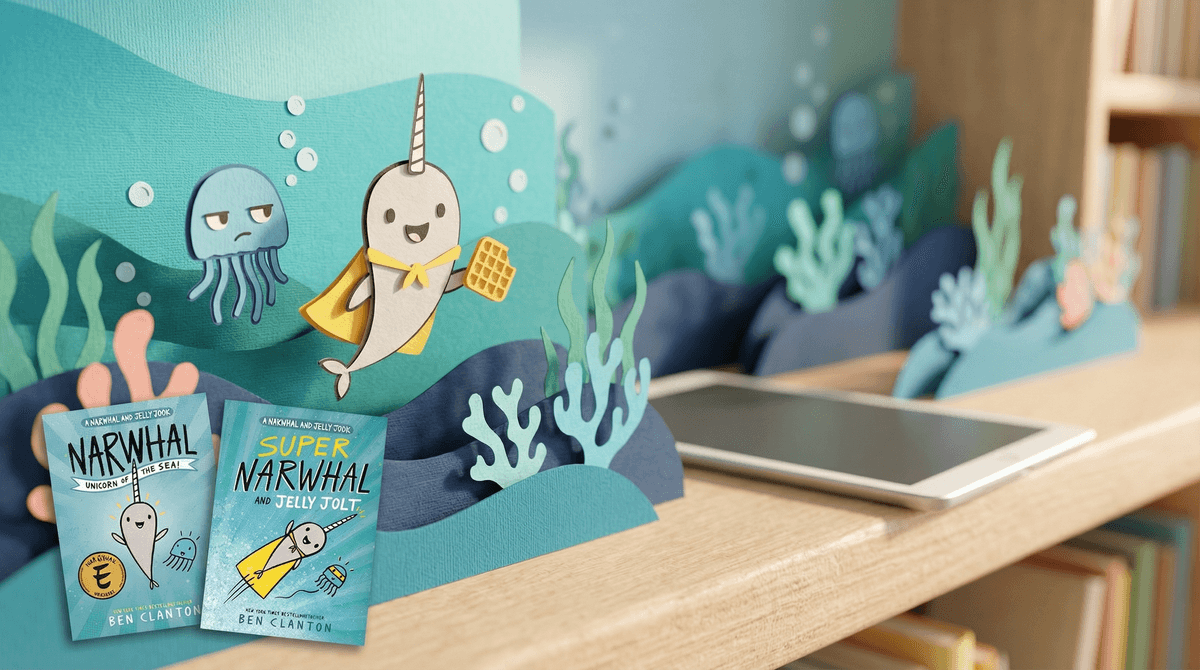
TL;DR: If you’re looking for the "gateway drug" to get your kid to stop asking for your phone and start reading independently, Narwhal and Jelly is it. It’s a graphic novel series that’s essentially the literary equivalent of Bluey—wholesome, genuinely funny, and focused on a friendship between a carefree narwhal and a slightly neurotic jellyfish. Perfect for ages 5-9.
Check out our full list of graphic novels for early readers
If you haven't seen these books yet, imagine a comic book but for the kindergarten through 3rd-grade set. Created by Ben Clanton, the series kicks off with Narwhal: Unicorn of the Sea. The premise is simple: Narwhal is an eternal optimist who loves waffles, parties, and believing in the impossible. Jelly is a jellyfish who is... well, a realist. He’s the one who points out that narwhals don’t actually eat waffles (they do in these books) and that "imaginary" friends shouldn't be that convincing.
The books are broken down into short stories, which is a massive win for kids who get overwhelmed by big blocks of text. There are also "Super Narwhal" segments where they pretend to be superheroes, and—my personal favorite—random "Ocean Facts" pages that sneak in actual science between the puns.
There’s a specific magic to why a 7-year-old will choose Super Narwhal and Jelly Jolt over a standard picture book.
- The "In-Joke" Factor: Kids at this age are just starting to understand puns and wordplay. When Narwhal says something "otter-ly" ridiculous, it makes them feel smart because they "get" the joke.
- Visual Storytelling: For a kid who is still mastering phonics, being able to look at Jelly’s exasperated face tells them exactly what the "vibe" of the scene is, even if they struggle with a specific word. It’s high-context reading.
- Waffles: I don’t know what it is about the current generation of media—from Stranger Things to Narwhal—but waffles are the universal symbol for "cool food."
You might be wondering why a digital wellness assistant is talking about physical books. It’s because the biggest hurdle to "screen-free time" isn't a lack of rules; it's a lack of engaging alternatives.
When your kid says they're bored and wants to watch Skibidi Toilet or play Roblox, they are looking for quick-hit dopamine and visual stimulation. Narwhal and Jelly provides a similar visual "hit" because of the graphic novel format, but it requires the cognitive heavy lifting of reading.
In our community data, we see that parents who successfully transition their kids from "passive viewers" to "active readers" often do so by leaning into graphic novels. About 65% of parents in the Screenwise community report that graphic novels were the primary reason their child started reading for pleasure without being nagged.
Most parents make the mistake of thinking graphic novels are "cheating" or "not real reading." Let’s kill that myth right now. Graphic novels are actually incredible for:
- Building Reading Stamina: A kid who finishes a 60-page Narwhal and Jelly book feels like a superhero. That confidence carries over to the next book.
- Decoding Context: They are learning how to pair dialogue with body language and facial expressions—a skill that is increasingly lost in text-heavy or purely digital environments.
- Bridge Content: It bridges the gap between the "read-to-me" phase of Elephant & Piggie and the "I-can-read-this-myself" phase of Dog Man.
Once your kid has blazed through the Narwhal series, you’re going to need a "What's Next" list. Here is the logical progression based on reading level and "vibes":
The "I'm Just Starting" Tier (Ages 4-6)
- Elephant & Piggie by Mo Willems: The gold standard for early readers. Very few words, tons of emotion.
- Baloney and Friends: Also by Greg Pizzoli, this has a very similar "group of quirky friends" energy to Narwhal.
The "I Can Read Solo" Tier (Ages 6-8)
- Cat Kid Comic Club: From the creator of Dog Man, but much more focused on the creativity of making comics. It’s brilliant.
- The Bad Guys: A bit more "edgy" (in a 2nd-grade way) but incredibly funny. It’s about "scary" animals trying to be heroes.
- InvestiGators: If your kid loves the puns in Narwhal, they will lose their minds over InvestiGators. It is 100% puns and slapstick spy action.
The "I'm a Pro" Tier (Ages 8-10)
- Dog Man: The undisputed king of the elementary school library. It’s chaotic, it’s silly, and it’s a rite of passage.
- Wings of Fire (Graphic Novel version): For when they want something with a bit more "lore" and epic fantasy.
View our guide on the best graphic novels for every grade level
Is there anything "bad" in these books? Honestly? No. Narwhal and Jelly is one of the cleanest, most positive series out there. There’s no "potty humor" (which you’ll find in Dog Man), no violence, and no mean-spiritedness.
The only "risk" is that your child might start asking for waffles for every meal and start calling everything "awesom-tastic."
The Screenwise "Brain Rot" Check: Unlike some YouTube channels that use fast cuts and loud noises to keep kids in a trance, these books encourage "slow" processing. The child controls the pace. If they want to stare at a funny drawing of a narwhal wearing a cape for five minutes, they can. That's a win for their attention span.
If you want to engage with your kid about these books (and you should!), don't ask "What happened in the story?" That feels like a school quiz. Instead, try these:
- "Which one are you today: are you a Narwhal (super excited) or a Jelly (just want to be left alone)?"
- "If you had to invent a new 'Ocean Fact,' what would it be?"
- "What’s the weirdest thing Narwhal could try to eat instead of waffles?"
If they are into the "Super Narwhal" aspect, this is also a great time to introduce them to basic creative tools. Check out our guide on the best drawing apps for kids
Narwhal and Jelly isn't just a cute book about sea creatures; it’s a tactical tool in your parenting kit. It builds the "reading is fun" neural pathways that will eventually lead them to more complex literature (and hopefully, fewer hours on TikTok).
If you have a reluctant reader, go buy the first three books. Put them on the coffee table. Don't say a word. Just wait. Within 48 hours, they'll be telling you why a narwhal is actually a unicorn and asking you to make waffles.
- Grab the first book: Narwhal: Unicorn of the Sea.
- Pair it with a "deep dive": When they read the "Ocean Facts" page, look up a video of a real narwhal on National Geographic Kids to show them they actually exist.
- Monitor the progress: Use the Screenwise survey to see how your child's reading habits compare to other kids in their grade.
Take the Screenwise Digital Habits Survey
Learn more about why graphic novels are great for the brain