

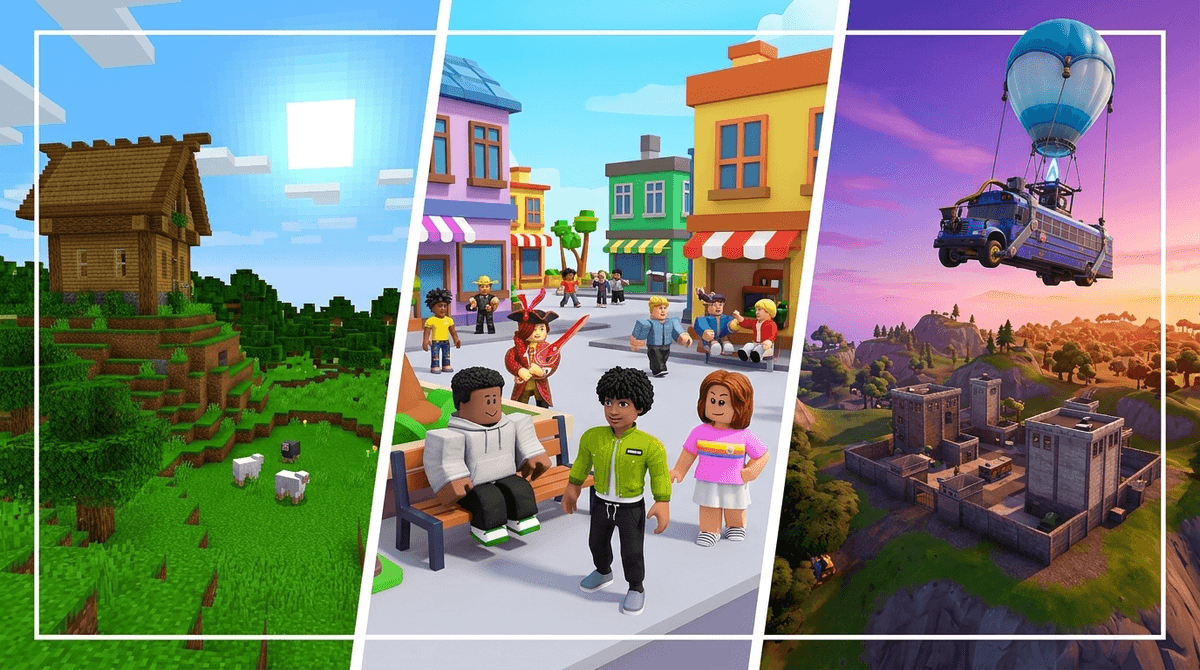
Minecraft vs Roblox vs Fortnite: Which Game is Right for Your Kid?
TL;DR: These three games dominate kid culture but serve completely different purposes. Minecraft is digital LEGOs with genuine creative value. Roblox is a social platform disguised as a game with real money concerns. Fortnite is a competitive shooter that's surprisingly less problematic than you'd think. Here's how to decide what fits your family.
You're going to hear about all three of these games. A lot. They're the holy trinity of kid gaming right now, and according to our Screenwise community data, only 25% of families have managed to avoid Roblox entirely, while 70% have held the line on Fortnite. Minecraft sits somewhere in the middle with 40% saying no thanks.
But here's what most parents don't realize: comparing these three games is like comparing a basketball, a mall, and a paintball arena. They're fundamentally different experiences that happen to all involve screens.
Minecraft: The Digital LEGO Set
Minecraft is a sandbox building game where kids mine resources and construct literally anything they can imagine. Think of it as infinite LEGOs that don't hurt when you step on them. The graphics look intentionally blocky (yes, that's the aesthetic, not a budget issue), and there's no set objective beyond "create stuff and survive."
The real deal: About 35% of kids in our community play Minecraft offline in creative mode, treating it purely as a building tool. Another 25% play on servers with other people, which introduces a whole different dynamic we'll get to.
Cost structure: $26.95 one-time purchase for most platforms. That's it. No battle passes, no constant nagging for V-bucks or Robux. You buy it once and you're done. This alone makes it the most parent-friendly option financially.
Roblox: The Social Media Platform Pretending to Be a Game
Roblox isn't actually a game—it's a platform where users create and play thousands of different games. Think of it as YouTube meets a game engine, with all the content moderation challenges that implies.
The real deal: A whopping 60% of kids in our community who use Roblox are playing on servers with other people. Only 15% stick to offline mode. This is fundamentally a social experience, which means it comes with all the social dynamics (and drama) you'd expect from any online social space.
Cost structure: Free to download, but here's where it gets messy. The in-game currency (Robux) is how kids buy cosmetics, game passes, and access to certain experiences. And unlike Minecraft's one-and-done purchase, Roblox is designed to make your kid ask for Robux. Constantly. Learn more about how Robux is actually real money with real consequences .
.
Fortnite: The Competitive Shooter Everyone Worries About
Fortnite is a battle royale game where 100 players drop onto an island and fight until one person (or team) remains standing. Yes, there's shooting. No, it's not realistic violence—the art style is cartoonish and players who get eliminated just disappear in a flash of light.
The real deal: Only 30% of families in our community allow Fortnite at all, and when they do, 12% let their kids play with friends only, while 8% allow them to play with everyone online. This is the most restrictive of the three games in terms of parent comfort levels.
Cost structure: Free to play, but the battle pass ($7.99 per season, roughly every 10 weeks) is basically mandatory for the full experience. Kids will absolutely feel left out without the current season's cosmetics. Budget around $40-50/year if you go this route.
Minecraft genuinely teaches:
- Spatial reasoning and planning
- Resource management and delayed gratification
- Basic engineering concepts (redstone circuits are literally programming)
- Creativity and design thinking
When your kid spends three hours building an elaborate castle, they're engaging the same skills as architecture and design work. The creative mode is legitimately educational. Survival mode adds problem-solving and strategic thinking.
Roblox teaches:
- Social navigation (for better or worse)
- Basic economics if they're into trading
- Actual game development if they use Roblox Studio (some kids genuinely learn coding this way)
But let's be real: most kids aren't using Roblox Studio. They're playing "Adopt Me" or "Brookhaven" which are basically social hangout spaces with minimal educational value. The social dynamics of Roblox deserve their own guide.
Fortnite teaches:
- Hand-eye coordination and reaction time
- Strategic thinking and spatial awareness
- Team communication and cooperation (in squad modes)
- How to lose gracefully, because you're going to lose a lot
The competitive nature actually builds resilience. But unlike Minecraft's open-ended creativity or Roblox's social sandbox, Fortnite is pure gameplay. It's fun, it's engaging, but it's not particularly enriching beyond the skills of playing competitive games.
Minecraft: Safest of the three if you keep it offline or on private servers with known friends. The game itself has no chat, no strangers, no problems. But public servers? That's where you get exposed to unmoderated chat and potentially inappropriate content built by other players. The 25% of families who let their kids on public servers need to understand this isn't the same game as solo creative mode.
Roblox: The wild west. The platform has 40 million+ user-generated games with wildly inconsistent moderation. Your kid can stumble into inappropriate content, encounter predatory behavior, or get scammed out of Robux. The company has made improvements, but this is fundamentally a user-generated content platform with all the risks that entails. Understanding Roblox safety settings is non-negotiable if you're allowing this game.
Fortnite: Surprisingly decent moderation for voice chat, and you can disable it entirely. The main concerns are:
- The intensity and potential for gaming addiction (the "just one more game" factor is strong)
- Exposure to older players and potentially toxic behavior
- The pressure to spend money on cosmetics
The violence itself? Honestly not the main concern. It's cartoonish and there's no blood or gore. The PEGI rating is 12+, which feels about right.
Minecraft:
- Ages 6-8: Creative mode only, offline. This is basically digital art class.
- Ages 9-11: Can handle survival mode, private servers with friends you know IRL.
- Ages 12+: Public servers become more reasonable with established online safety conversations.
Roblox:
- Ages 6-8: Honestly, I'd wait. The social elements are too complex for this age.
- Ages 9-11: Heavily supervised with strict privacy settings and friend-only servers.
- Ages 12+: More independence, but you should still spot-check their activity and know which games they're playing.
Fortnite:
- Ages 6-10: Generally too intense. The competitive pressure and shooter mechanics aren't developmentally appropriate.
- Ages 11-13: The sweet spot, especially if they're playing with IRL friends in squads.
- Ages 14+: Minimal concerns beyond time management and spending.
If your kid gravitates toward Minecraft, they probably enjoy:
- Building and creating
- Problem-solving and figuring things out
- Working on long-term projects
- Playing independently or cooperatively without competition
These kids often also like LEGO, art projects, and building games like Terraria.
If your kid gravitates toward Roblox, they probably enjoy:
- Social interaction and hanging out with friends
- Variety and trying new experiences
- Role-playing and imaginative play
- Being part of trends and cultural moments
These kids often also like Among Us, social media (or will soon), and group activities.
If your kid gravitates toward Fortnite, they probably enjoy:
- Competition and measurable improvement
- Fast-paced action and excitement
- Team-based challenges
- Being part of a competitive community
These kids often also like sports, competitive games like Rocket League, and challenges with clear win/lose conditions.
Minecraft: Have the conversation once. "We're buying this game for $27. That's the budget. There are no additional purchases." Done.
Roblox: This requires ongoing financial literacy conversations. Consider:
- A monthly Robux allowance they manage themselves
- Teaching them about premium currency vs. real money
- Discussing why cosmetics don't change gameplay
- Explaining how free-to-play games make money
Understanding the Roblox economy is genuinely useful financial education, but only if you're actively teaching it.
Fortnite: The battle pass model is actually pretty reasonable if you set expectations:
- One battle pass per season
- No additional V-bucks for cosmetics in the item shop
- Explain that cosmetics are optional and don't affect gameplay
The kids who struggle with Fortnite spending are usually the ones whose parents gave them access to payment methods without clear boundaries.
Of course you can. But understand what you're opting out of: these aren't just games, they're cultural touchstones. The 25% of families who've avoided Roblox entirely and the 70% who've held the line on Fortnite are making a valid choice, but their kids are having different social experiences as a result.
This isn't about peer pressure—it's about recognizing that digital play spaces are where kids socialize now. Saying no to all three is like saying no to the playground in 1995. You can do it, but you should do it intentionally and with awareness of the tradeoffs.
If you're looking for alternatives to these big three games, there are plenty of options that split the difference.
Choose Minecraft if: You want genuine creative value, minimal ongoing costs, and the safest option. This is the "yes, and" game—it's easy to feel good about.
Choose Roblox if: Your kid is socially motivated, you're willing to actively manage the platform, and you can handle the financial conversations. This requires the most parental involvement but can be fine with proper boundaries.
Choose Fortnite if: Your kid is competitive, can handle losing without melting down, and you're comfortable with shooter mechanics. This is the most intense option but also the most time-limited (matches are 20 minutes max).
Choose multiple if: Your kid is old enough to understand different contexts for different games. A 12-year-old can absolutely play creative Minecraft, social Roblox, and competitive Fortnite and get different things from each.
The real answer? There's no single right choice. It depends on your kid's age, interests, maturity level, and your family's values around screen time and spending.
-
Try before you commit: Minecraft has a free trial. Roblox and Fortnite are free to download. Let your kid explore in supervised sessions before making decisions.
-
Set up parental controls immediately: Don't wait until there's a problem. Minecraft parental controls, Roblox parental controls, and Fortnite parental controls should be configured from day one.
-
Establish spending rules before they start asking: Whatever your budget is, communicate it clearly upfront.
-
Check in regularly: Play with them occasionally, ask about what they're building/playing/doing, and stay connected to their digital life.
The goal isn't to pick the "best" game—it's to pick the right game for your specific kid at this specific time. And that might change, which is fine too.