

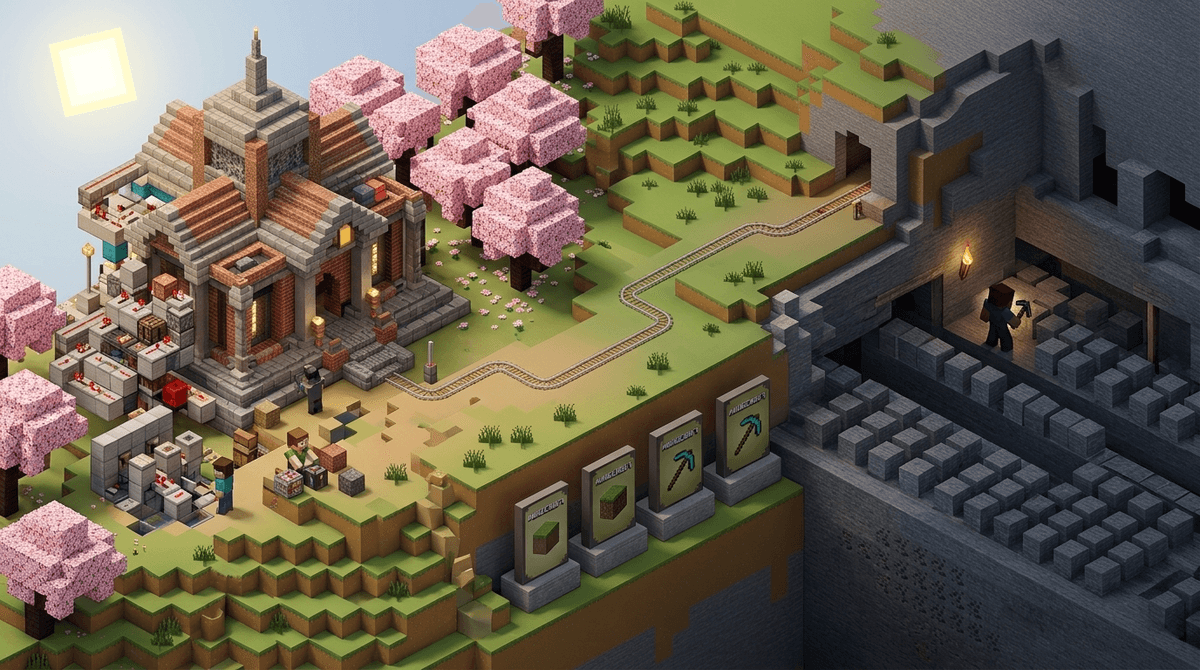
TL;DR: Minecraft is the rare "evergreen" game that can actually teach your kid logic, architecture, and collaboration—but the 2025 shift toward frequent "Game Drops" and the lure of high-intensity servers can turn it into a mindless, infinite grind. If they’re building Redstone circuits, it’s a tool. If they’re just grinding for "mending books" for ten hours straight, it’s a time sink.
Quick Links for the Minecraft-Adjacent Parent:
- The "Better" Version: Minecraft: Java Edition (Best for mods and creativity)
- The "Social" Version: Minecraft: Bedrock Edition (Cross-platform, but watch the Marketplace)
- The Logic Step-Up: Scratch (For when they outgrow Redstone)
- The "Cozy" Alternative: Terraria
- The Creative Competitor: Roblox (Specifically "Build a Boat for Treasure")
We’ve all been there at school pickup. One parent is bragging about how their 8-year-old built a functioning calculator in Minecraft, and you’re sitting there thinking, "My kid just spent three hours digging a hole and watching a YouTube video of a guy screaming about 'Skibidi' Creepers."
It’s the great Minecraft paradox. Is it the digital LEGO of our generation, or is it just another way for Microsoft to keep our kids’ eyeballs glued to a screen while they chase the next dopamine hit?
In 2026, the answer is: It’s both. But the "Game Drop" era has changed the math. Here is how to tell if your kid is actually "learning to code" or just getting lost in the pixelated sauce.
When people call Minecraft "educational," they aren't just making excuses for screen time. There are legitimate, high-level skills happening here if your kid is playing in the right way.
If you see your kid playing with red dust and torches, pay attention. Redstone is essentially a simplified version of electrical engineering and Boolean logic (AND/OR/NOT gates). Kids who master Redstone are learning the fundamental building blocks of computer science. If they are building automated farms or secret doors, they are problem-solving.
Find games that teach coding logic
Architectural Design and "Creative Mode"
In Creative Mode, the "game" part of Minecraft basically disappears. There are no monsters, no hunger, and no dying. It’s just a blank canvas. I’ve seen kids recreate their own schools, build intricate Japanese gardens, or design "smart homes." This is spatial reasoning and aesthetic planning at its best.
Collaborative Problem Solving
If your kid is on a private server with three friends from school and they are trying to build a city together, they are learning project management. They have to negotiate who builds the bridge, who gathers the materials, and how to handle it when someone accidentally burns the library down with lava. (It happens. It’s a tragedy. We move on.)
Now for the "no-BS" part. Since late 2024 and into 2025, Mojang (the creators) shifted away from one big annual update to frequent "Game Drops."
While this sounds cool, it’s designed to keep the game "sticky." It creates a constant FOMO (Fear Of Missing Out). Your kid feels like they have to log in every week to see the new "biomes" or "mobs," or they’ll be "Ohio" (weird/outdated) compared to their friends.
The Survival Grind
In "Survival Mode," the game can become a massive time-waster. To get the "best" gear, kids often spend hours doing repetitive tasks like:
- Mining: Just clicking on gray blocks for hours to find diamonds.
- Villager Trading: Standing in a room for three hours cycling through trades to get a specific "Enchanted Book."
- The "Grind" Culture: This is where the logic stops and the "brain rot" begins. If they are just doing chores in a video game, they aren't being creative; they're being conditioned.
If your kid says they are playing Minecraft, but they are actually on Hypixel (a massive public server), they aren't building. They are playing "BedWars" or "SkyBlock." These are high-intensity, competitive games that use Minecraft’s skin but feel more like a frantic arcade. They are fun, but they are 100% a time sink and often lead to "gamer rage."
Kids love Minecraft because it’s one of the few places in their lives where they have total agency. In the real world, we tell them when to eat, what to wear, and when to do math. In Minecraft, they are the gods of their own universe.
That sense of power is intoxicating. It’s why they’ll watch a 20-minute YouTube tutorial on how to build a "Tinkerer’s Workshop" but complain about a 5-minute math worksheet. The trick is bridging that gap.
- Ages 6-8: Stick to Creative Mode or a private "Realms" server with only family. The "Survival" monsters (Creepers, Endermen) can actually be pretty stressful/scary for younger kids.
- Ages 9-12: This is the sweet spot for Redstone. Encourage them to try "Modpacks" if they are on the Java Edition.
- Ages 13+: They’ll likely want to join big public servers. This is where you need to talk about "griefing" (people destroying your stuff for fun) and online safety.
Read our full guide on setting up Minecraft parental controls
Minecraft is generally "safer" than Roblox because it doesn't have the same level of predatory user-generated "scam" games, but it’s not perfect.
- The Chat: On public servers, the chat can be toxic. Use the "Social Interactions" screen to mute players.
- The Marketplace (Bedrock Edition): If your kid is playing on a tablet, console, or Minecraft: Bedrock Edition, there is an in-game store. It’s very easy for them to accidentally spend $20 on a "Skin Pack" that looks like a toilet.
- YouTube Integration: Most kids don't just play Minecraft; they watch it. Be wary of "Minecraft YouTubers" who use clickbait or loud, aggressive energy to keep kids hooked.
If you want to move your kid from "Time Sink" to "Creative Tool," you have to engage with the Mode.
- The "Show Me" Rule: Ask your kid to give you a tour. If they show you a giant castle they designed, that’s a win. If they show you a chest full of 10,000 cobblestones they spent all day mining... it might be time for a break.
- Set a Project: Instead of "you have an hour of screen time," try "your goal today is to build a bridge between those two mountains." It shifts the brain from "grinding" to "designing."
Check out our guide on how to talk to your kids about their digital creations
Minecraft is still the best game ever made for kids, full stop. It is infinitely better than the "brain rot" of endless scrolling on TikTok or the gambling-adjacent mechanics of Brawl Stars.
But in 2026, it requires an intentional parent to make sure it stays a tool. Left to their own devices, kids will almost always default to the "infinite grind" because it's easier than the hard work of being creative.
Next Steps:
- Check if your kid is playing Java or Bedrock. (Java is better for creativity/modding).
- Ask them: "What’s the hardest thing you’ve ever built with Redstone?"
- If they are spending too much money in the Marketplace, consider moving them to a subscription-free alternative.
Learn more about the differences between Java and Bedrock editions