

TL;DR
If your kid treats math homework like a personal affront to their dignity, Mathigon might be the peace treaty you've been looking for. It’s a free, highly interactive "textbook of the future" that swaps boring drills for colorful, virtual manipulatives and narrative-driven puzzles. It’s less "memorize this formula" and more "play with these shapes until the formula makes sense."
Top Recommendations for Math-Averse Kids:
- Polypad by Mathigon – The ultimate digital sandbox for geometry and numbers.
- The Timeline of Mathematics – A gorgeous, interactive history of math.
- Khan Academy – The gold standard for structured video lessons.
- Brilliant – For the high schooler who wants to dive deep into logic and CS.
Let’s be real: most "digital math" tools are just worksheets with a fresh coat of paint. You know the ones—the screen shows a problem, the kid types an answer, and if they get it right, a cartoon penguin does a dance. It’s basically digital broccoli covered in cheap sprinkles.
Mathigon is different. It’s an interactive learning platform designed primarily for middle and high school students, though younger kids can get a lot out of its sandbox tools. Instead of passive videos or repetitive quizzes, Mathigon uses "explorables." The text stops and waits for the student to interact with a diagram, move a slider, or solve a puzzle before it continues.
It feels more like a high-quality indie game or a digital museum exhibit than a classroom lecture. It’s part of a growing movement of "active learning" tools that actually respect a kid’s intelligence rather than just trying to gamify their attention span.

In a world of "brain rot" content and 15-second TikTok loops, getting a kid to focus on trigonometry is a tall order. But Mathigon works because it taps into the same "sandbox" energy kids love in Minecraft.
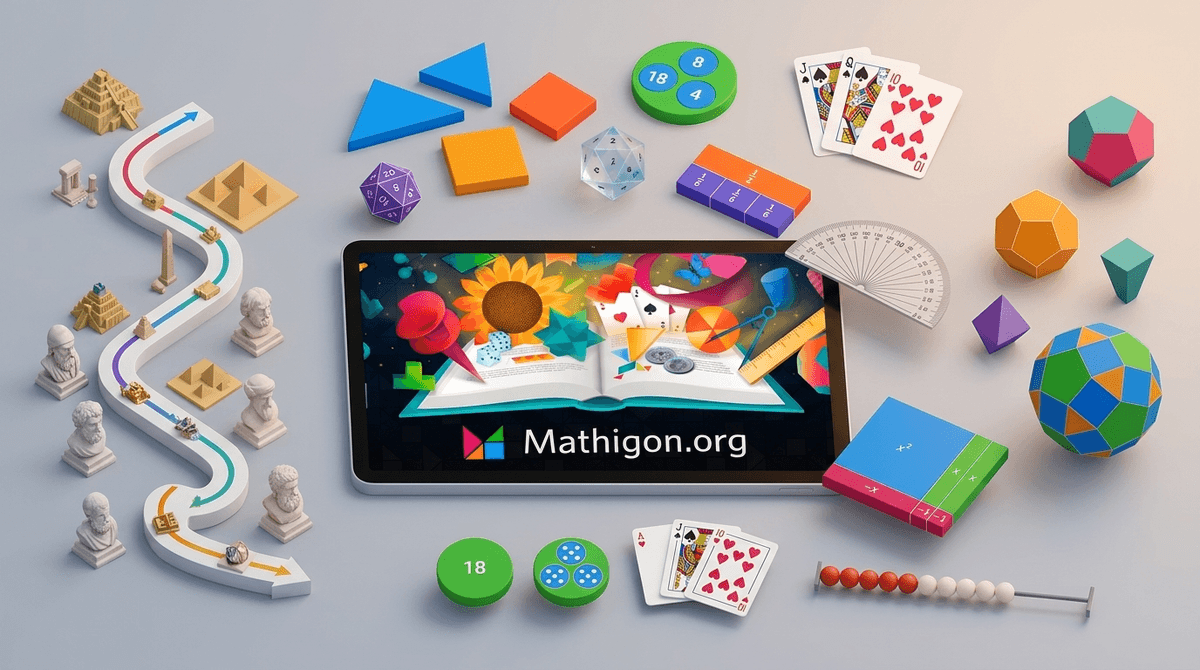
This is the crown jewel of the site. Polypad is a virtual canvas where kids can drag and drop "tiles"—everything from prime factor circles and fraction bars to tangrams and logic gates.
If your kid is a visual learner, this is "W" (that's "win" for those of us still catching up on the slang). They can see how a square is made of two triangles or how 1/4 and 1/4 make 1/2 without you having to sacrifice every orange in the kitchen to a "fractions demonstration." It’s tactile, colorful, and—most importantly—it gives them a sense of agency. They aren't just being told math; they are building it.
The Narrative Approach
Mathigon doesn't just throw numbers at you. It frames math through history, art, and music. The Timeline of Mathematics lets them explore math through the lens of ancient civilizations and famous scientists. It turns math from a "dead subject" into a living, breathing part of human history. For the kid who asks, "When am I ever going to use this?", Mathigon actually has an answer that isn't just "to pass the SATs."
We talk a lot about "screen time," but we all know that an hour on Scratch coding a game isn't the same as an hour scrolling through "Skibidi Toilet" memes.
Mathigon falls firmly into the High-Value Digital Time category. It’s one of the few tools that actually uses the medium of the internet to do something a physical book can't. It encourages:
- Iterative Thinking: Making a mistake isn't "wrong"; it's just a data point to adjust the slider.
- Spatial Reasoning: Especially through the geometry and 3D folding tools.
- Self-Paced Discovery: There’s no timer, no leaderboard, and no "lives" to lose. It’s the anti-anxiety math tool.
Learn more about the benefits of sandbox-style educational tools
While Mathigon markets itself as the "textbook of the future" for ages 11-18, the reality is a bit more flexible:
- Elementary (Ages 6-10): They won't follow the courses (which get into heavy algebra and calculus pretty fast), but they will love Polypad. Let them play with the "Geometry" and "Numbers" tiles. It’s like digital LEGOs for math.
- Middle School (Ages 11-13): This is the sweet spot. The courses on "Symmetry," "Prime Numbers," and "Probability" are perfect for this age. It matches their curriculum but makes it feel like an adventure.
- High School (Ages 14-18): Great for visual learners who are struggling with abstract concepts in Algebra II or Calculus. Seeing a derivative visualized in real-time can be the "aha!" moment they need.
If you're worried about your kid's data being sold or them chatting with strangers in "Ohio" (or anywhere else), you can breathe easy.
- Social Interaction: There is virtually none. Mathigon is a solo experience. There are no chat rooms, no friend requests, and no public profiles.
- Data Privacy: They are very transparent and COPPA compliant. You can create a parent account to track progress, or kids can use it without an account at all (though their progress won't save).
- Monetization: It is free. No "Pro" version, no "buy more gems" to unlock the next level, and no annoying ads for Roblox clones. It’s supported by grants and partnerships, which is a massive win for parents tired of being nickel-and-dimed by educational apps.
Check out our guide on the safest educational websites for kids
Mathigon is brilliant, but it’s not a magic wand. If your kid is truly struggling with the foundational "how-to" of a math problem, they might still need the structured video explanations of Khan Academy.
Think of it this way:
- Khan Academy is the teacher explaining the concept at the whiteboard.
- Mathigon is the laboratory where the kid gets to blow things up (mathematically) to see how they work.
Also, the "AI Tutor" feature in Mathigon is helpful but limited. It’s not ChatGPT; it’s a scripted bot that offers hints if a kid gets stuck on a puzzle. It’s great for keeping them from throwing the laptop across the room, but it’s not going to write their essay on the Pythagorean theorem for them.
Don't pitch this as "extra schoolwork." That’s a one-way ticket to an eye-roll. Instead, try one of these:
- For the gamer: "Hey, check out this Polypad thing. It’s like a physics engine for shapes. See if you can build a tessellation that looks like a glitch."
- For the artist: "Look at the 'Symmetry' course on Mathigon. It explains how patterns in nature and art actually work."
- For the 'I'm bored' kid: "I found this interactive timeline. It’s like a rabbit hole of weird math history and puzzles."
Mathigon is a rare gem in the digital wellness world. It’s high-quality, free, and genuinely respects the learner. It’s not "brain rot," it’s not a data-harvesting machine, and it might actually help your kid stop hating their math homework.
If you're trying to move your family toward a more intentional "digital diet," swapping 20 minutes of YouTube for 20 minutes of exploring Polypad is a massive upgrade.
Next Steps
- Explore Polypad together. Spend 5 minutes dragging shapes around to see what they do.
- Check the curriculum. See if your kid’s current math topic (like fractions or probability) has a corresponding course on Mathigon.
- Compare it. If your kid is currently using Prodigy, ask them which one they find more "fun" vs. which one actually helps them "get" the math.