

The Complete Guide to Kids' Digital Well-Being
Look, I'm not going to open this with some doom-and-gloom stat about how screens are rotting our kids' brains. You already know the struggle. You've seen your 7-year-old turn into a tiny rage monster when you dare suggest that maybe, just maybe, it's time to put down the iPad. You've watched your tween's eyes glaze over during a family dinner while they mentally compose their next Roblox message. You get it.
The truth is, digital well-being isn't about whether screens are "good" or "bad" — that ship has sailed, crashed into an iceberg, and sunk to the bottom of the ocean. Screens are here. The question is: how do we help our kids develop a healthy relationship with technology that doesn't involve us becoming the screen police 24/7?
Digital well-being is about balance, boundaries, and building awareness around how technology makes us feel and behave. It's not about eliminating screens (impossible and honestly, kind of pointless in 2026). It's about helping kids develop the internal compass to know when gaming is fun vs. when it's become a compulsion. When social media is connecting them vs. making them feel like garbage about themselves.
Think of it like teaching kids about food. We don't ban sugar entirely (well, most of us don't). We teach them that vegetables are important, that eating an entire sleeve of Oreos will make them feel sick, and that sometimes a cookie is just nice. Same deal with screens.
Here's what we know from research: excessive, poorly-managed screen time is linked to sleep problems, attention difficulties, increased anxiety and depression, and decreased physical activity. But — and this is important — it's not just about the quantity of screen time. It's about the quality and context.
A kid spending two hours building an elaborate world in Minecraft with friends? That's creative play, problem-solving, and social connection. A kid spending two hours doomscrolling TikTok at 11 PM? Different story entirely.
The other thing that matters: kids are developing their relationship with technology during crucial developmental windows. The habits and patterns they build now — the ability to self-regulate, to recognize when they're feeling crappy from too much screen time, to choose enriching content over brain rot — these are skills that will serve them for life.
The tech is designed to be addictive. These apps and games employ teams of behavioral psychologists whose literal job is to keep users engaged. Your 9-year-old is up against some serious manipulation tactics. It's not a fair fight.
Every kid's friend has unlimited access. You can set all the boundaries you want, but then your kid goes to a playdate where the other family has zero rules, and suddenly you're the villain.
We're tired. Sometimes handing over the iPad is the only way you're going to get 20 minutes to make dinner without someone asking you where their other sock is for the 47th time.
We're not always modeling great behavior ourselves. Hard to lecture about screen time when we're scrolling Instagram while "watching" their soccer game.
All of this is real and valid. Digital well-being isn't about being perfect. It's about being intentional.
Set Clear, Consistent Boundaries
Kids need structure, even when they fight it. This means:
- Screen-free zones: Bedrooms, dinner table, car rides under 30 minutes
- Screen-free times: First hour after waking up, last hour before bed, during family meals
- Clear time limits: And actually enforcing them (this is the hard part)
The key is consistency. If screen time rules change based on your mood or energy level, kids will constantly negotiate and push. Pick boundaries you can actually maintain.
Prioritize Sleep (This Is Non-Negotiable)
The research on screens and sleep is absolutely clear: blue light exposure before bed disrupts melatonin production and makes it harder to fall asleep. Phones and tablets in bedrooms at night are associated with significantly worse sleep quality and quantity.
Practical rule: All devices charge in a central location overnight. No phones in bedrooms. Yes, even for teens. Yes, really .
.
Curate Content (Not All Screen Time Is Equal)
There's a massive difference between:
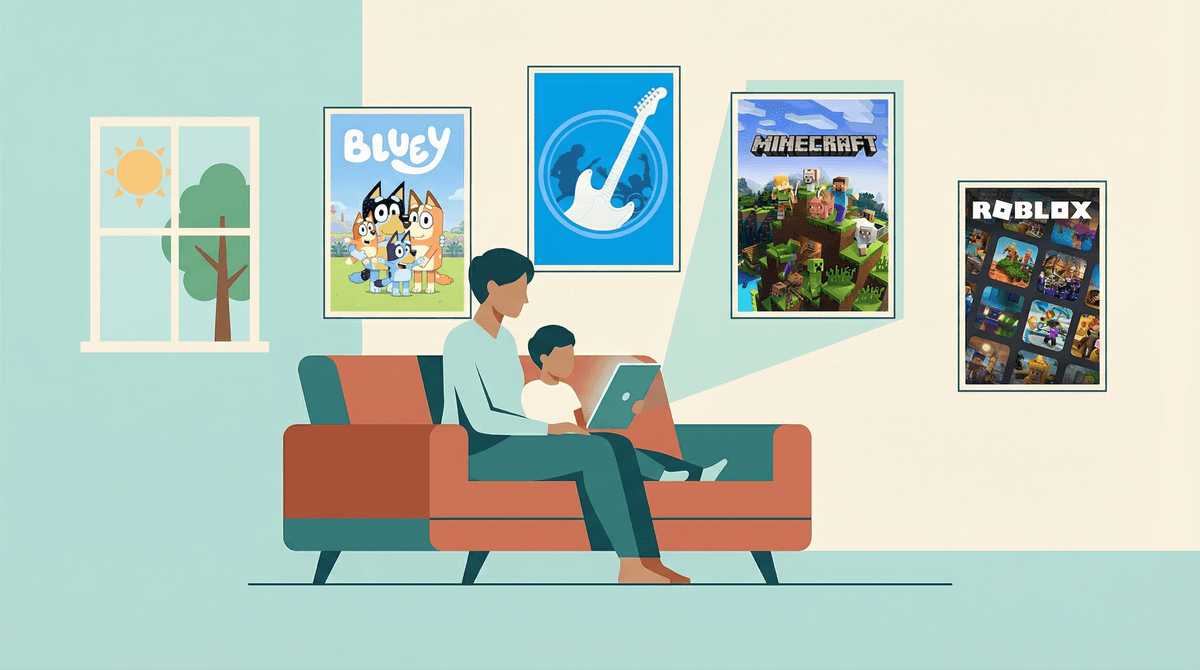
- Educational content like Bluey or Brains On! podcast
- Creative tools like Minecraft or GarageBand
- Passive consumption like YouTube shorts or TikTok
- Social media with all its comparison and validation-seeking
Help your kids understand these distinctions. Talk about how different types of content make them feel. A 10-year-old can absolutely grasp that watching YouTube for 3 hours leaves them feeling blah in a way that building something in Roblox with friends doesn't.
Teach Digital Literacy and Critical Thinking
Kids need to understand:
- How algorithms work and why they're seeing what they're seeing
- That influencers are often paid to promote products
- That people's online lives are heavily curated and not real
- How to identify misinformation and clickbait
- The basics of online privacy and safety
This isn't one conversation. It's ongoing dialogue as they encounter new platforms and situations.
Model Healthy Tech Use
Our kids are watching us. If we're constantly on our phones, they're learning that's normal and acceptable. Some ideas:
- Put your phone away during family time
- Announce when you're going to check your phone and why ("I need to respond to this work email, then I'm putting it away")
- Talk about your own struggles with screen time ("I spent too much time scrolling last night and I feel tired today")
- Have your own boundaries (no phones at dinner, devices charge outside the bedroom)
Build In Alternatives
Kids often default to screens because they're bored or don't know what else to do. Make sure there are appealing alternatives readily available:
- Board games that are actually fun (Catan, Exploding Kittens, Codenames)
- Art supplies that are accessible, not buried in a closet
- Books at their reading level that match their interests
- Outdoor equipment (balls, bikes, chalk)
- Scheduled activities and social time with friends
The "I'm bored" problem often isn't actually about screens — it's about kids not having developed the skill of self-directed play. Screens are just the easy default.
Ages 2-5: The AAP recommends limiting screen time to 1 hour per day of high-quality programming. Co-view when possible. No screens during meals or before bed. At this age, they need physical play, face-to-face interaction, and hands-on exploration way more than they need Daniel Tiger (though Daniel Tiger is pretty solid).
Ages 6-12: This is when it gets complicated. They're old enough to use devices independently but not old enough to self-regulate effectively. Focus on:
- Clear time limits (1-2 hours on school days, more flexibility on weekends)
- Knowing what they're doing online (not spying, but staying involved)
- Teaching them to recognize when screen time is making them feel bad
- Encouraging a mix of passive and creative screen time
Ages 13+: Teens need more autonomy, but they still need boundaries. The goal is gradually increasing independence while maintaining connection. Focus on:
- Collaborative rule-setting (they have input, but you have final say)
- No phones in bedrooms at night (this is the hill to die on)
- Open conversations about what they're seeing and experiencing online
- Helping them develop self-awareness about their digital habits
Digital well-being isn't about being anti-technology. It's about raising kids who can use technology as a tool rather than being used by it. Kids who can recognize when they've been scrolling too long and actually put the phone down. Kids who understand that their worth isn't determined by likes and followers. Kids who can be bored without immediately reaching for a screen.
This is hard work. It requires consistency, patience, and a lot of uncomfortable conversations. You will be the bad guy sometimes. Your kids will tell you that everyone else's parents are cooler than you. You'll question whether you're being too strict or not strict enough.
But here's the thing: you're not trying to be their friend. You're trying to raise a human who can function in a world that's increasingly designed to hijack their attention and manipulate their behavior. That's worth being the bad guy for.
Start small. Pick one boundary that matters to your family and implement it consistently for a month. Maybe it's no devices at dinner. Maybe it's all phones charge in the kitchen overnight. Maybe it's limiting weekend screen time to 3 hours.
Talk to your kids about why you're making these changes. Get their input. Help them understand that these rules aren't punishment — they're guardrails to help them build a healthy relationship with technology.
And give yourself some grace. You're navigating something that no previous generation of parents has had to deal with. You're going to make mistakes. You're going to give in when you're tired. You're going to have days where your kids get way more screen time than you'd planned. That's okay. What matters is the overall pattern, not any single day.
Want to dive deeper? Screenwise can help you understand your family's specific digital habits in context with your community, get personalized recommendations, and access detailed guides for specific apps, games, and platforms. Because every family is different, and cookie-cutter advice only goes so far.