

TL;DR
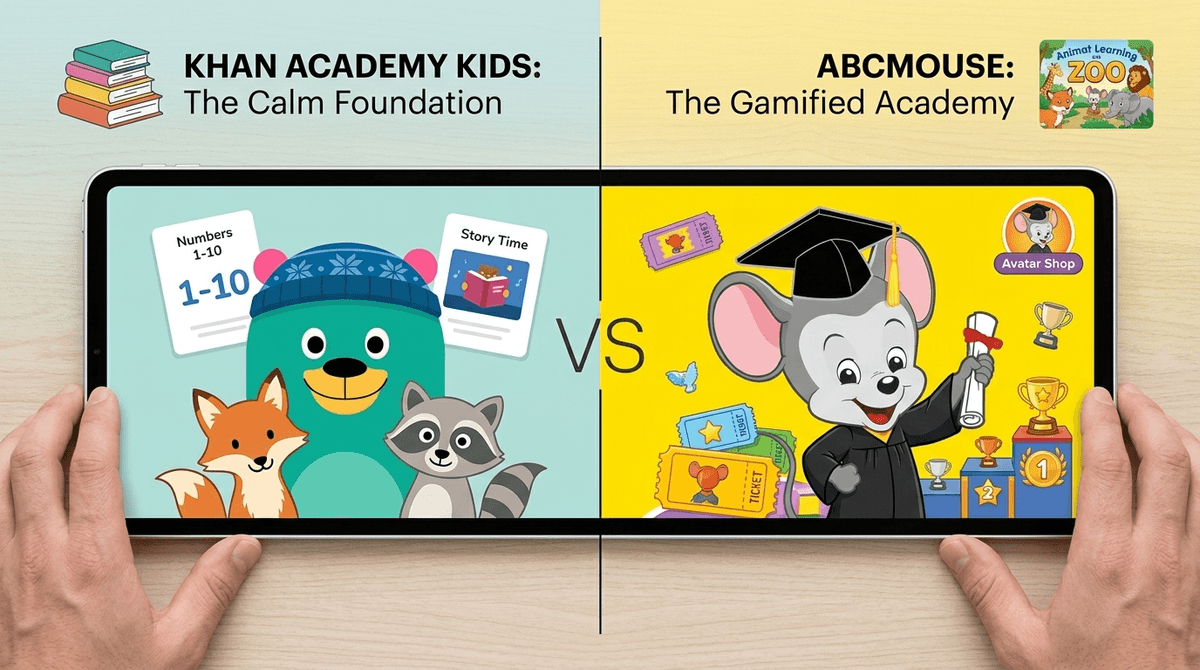
If you want the short version: Khan Academy Kids is the undisputed heavyweight champion of early learning. It’s 100% free, has zero ads, and doesn't try to trick your kid into a dopamine loop for "tickets." ABCmouse is a massive, content-heavy "learning zoo" that kids often love, but the $13+/month subscription and the constant push for digital rewards can feel a lot like "baby’s first casino."
Our pick: Start with Khan Academy Kids. If your child hits a wall or needs a massive variety of "edutainment" and you don't mind the subscription, then look at ABCmouse.
Get a learning plan based on your kid's age
Let’s be real for a second. There is this weird, low-grade panic that starts the moment a kid turns three. You see other parents at the park talking about phonics apps and coding for toddlers, and suddenly you feel like if your kid isn't doing supplemental curriculum by 4:00 PM, they’re going to end up "living in Ohio" (which, in Gen Alpha speak, is the ultimate "weird/bad" fate).
The two names that always come up are Khan Academy Kids and ABCmouse. One is a non-profit darling and the other is a marketing juggernaut. We dug into the fine print to see if that monthly subscription actually buys you a better-prepared student, or if you're just paying for fancy digital stickers.
Ages 2-8 | Cost: Free | Platform: App
Khan Academy Kids is basically the "organic, locally-sourced" option of the app world. It was developed in collaboration with experts at the Stanford Graduate School of Education, and it shows.
The app features a cast of characters—like Kodi the Bear and Ollo the Elephant—who guide your child through a "Path" of activities. It covers reading, writing, math, and social-emotional skills (which is a huge plus).
Why it wins:
- Zero Cost, Zero BS: There are no "pro" versions, no locked levels, and no ads. You get the whole thing for free. This is rare in 2026.
- The Library: Beyond the "Path," there’s a massive library of actual books (including some from National Geographic) that kids can read or have read to them.
- Intentional Design: It doesn't feel like a slot machine. The animations are calm, the colors are bright but not "neon-headache" level, and the focus is actually on the learning.
The downside:
- It can feel a little too academic for some kids. If your child is used to the high-stimulus chaos of YouTube Kids, they might find Kodi the Bear a little slow.
Ages 2-8 | Cost: ~$13/month (often has "deals") | Platform: App & Website
If Khan Academy Kids is a quiet library, ABCmouse is a theme park. It is owned by Age of Learning, Inc., and it is designed to be addictive. That’s not necessarily a dig—sometimes "addictive" is what you need to get a kid to practice their short vowels—but it’s something to be aware of.
Why it wins:
- The Volume: There are over 10,000 activities. It is virtually impossible for a child to "finish" this app.
- The "Tickets": Kids earn tickets for everything they do. They can spend these tickets to buy virtual clothes for their avatar or items for their virtual classroom/hamster cage. For some kids, this is the ultimate motivator.
- The Learning Path: It’s very structured. You don’t have to guess what they should do next; the app just funnels them to the next lesson.
The downside:
- The "Gimme" Factor: The ticket system can backfire. You’ll often find kids rushing through a math game just to get the tickets so they can go buy a digital hat for their avatar. Is that learning? Or is that just work-for-hire?
- The Subscription Trap: Canceling ABCmouse has historically been a bit of a nightmare. They love a "30 days for free" offer that turns into a recurring charge you forgot about.
- Visual Clutter: The interface looks a bit dated. It’s very "early 2010s internet," which can be overstimulating for younger toddlers.
Learn how to navigate the ABCmouse ticket system without losing your mind
1. The "Brain Rot" Test
We talk a lot about "brain rot" (low-quality, high-stimulus content) at Screenwise.
- Khan Academy Kids is the antidote to brain rot. It’s high-quality, thoughtful, and respects the child’s attention span.
- ABCmouse skirts the edge. While the content is educational, the delivery system uses the same psychological tricks as Roblox to keep kids clicking.
2. Curriculum Depth
Both apps cover the basics (ABC, 123). However, ABCmouse goes a bit deeper into science and social studies. If you have a 2nd grader who is struggling with specific concepts, ABCmouse might have more targeted "drills." But for a preschooler or kindergartner? Khan Academy Kids is more than enough.
3. Safety and Privacy
- Khan Academy Kids: Excellent. No ads, no third-party tracking, non-profit status.
- ABCmouse: Generally safe, but it is a commercial product. They are collecting data to sell you more stuff (like their older-kid app, Adventure Academy).
If neither of these feels right, or if you want to mix it up, here are a few other "Screenwise Approved" options:
- If you just want to focus on reading, this is the best app on the market. It uses the same "gamified" approach as the main Duolingo app but for phonics. It’s also free.
- The PBS Kids Games app is phenomenal. It's free, and it features characters kids actually know, like Daniel Tiger.
- It looks like it was designed in 1998, but teachers love Starfall. It is incredibly effective for teaching kids how to read.
Check out our guide on the best reading apps for kids who hate reading
Ages 2-3
Keep it simple. At this age, screen time should be co-viewing. Sit with them while they use Khan Academy Kids. Talk about the animals. Don't worry about the "curriculum" yet. Honestly, they’ll learn more from a cardboard box, but if you need 15 minutes to make dinner, KA Kids is the safest bet.
Ages 4-5 (The Kindergarten Prep Years)
This is where the ABCmouse vs. Khan Academy Kids debate matters most. If your kid is motivated by rewards, ABCmouse will get them to do more "work." If your kid is naturally curious, KA Kids will keep them engaged without the "gimme" attitude.
Ages 6-8
By this point, kids might start finding these "babyish." This is when you might transition to something like Prodigy for math or Epic! for reading.
Before you put your credit card into ABCmouse, know this: You probably don't need it.
The marketing for paid learning apps is designed to make you feel like you're failing if you don't subscribe. You aren't. Between Khan Academy Kids, PBS Kids, and your local library's access to Libby, you can give your child a world-class early education for $0.
Go with Khan Academy Kids if: You want a clean, high-quality, ad-free experience that focuses on the whole child (including emotional intelligence) and you don't want to pay a dime.
Go with ABCmouse if: Your child is extremely "reward-motivated," you want a massive variety of activities, and you don't mind a monthly bill and a slightly more "commercial" feel.
Our advice? Download Khan Academy Kids first. Give it two weeks. If your kid loves it, you’ve just saved yourself $150 a year. If they’re bored, then try the ABCmouse free trial—just remember to set a calendar alert to cancel it!
- Audit your apps: Look at your kid's tablet. Is it full of "junk" games? Delete three and replace them with Khan Academy Kids.
- Set a "Learning First" rule: No Roblox or YouTube until they’ve done 15 minutes of their "learning app."
- Talk about it: Ask your kid, "What did Kodi the Bear teach you today?" It turns solo screen time into a shared conversation.