

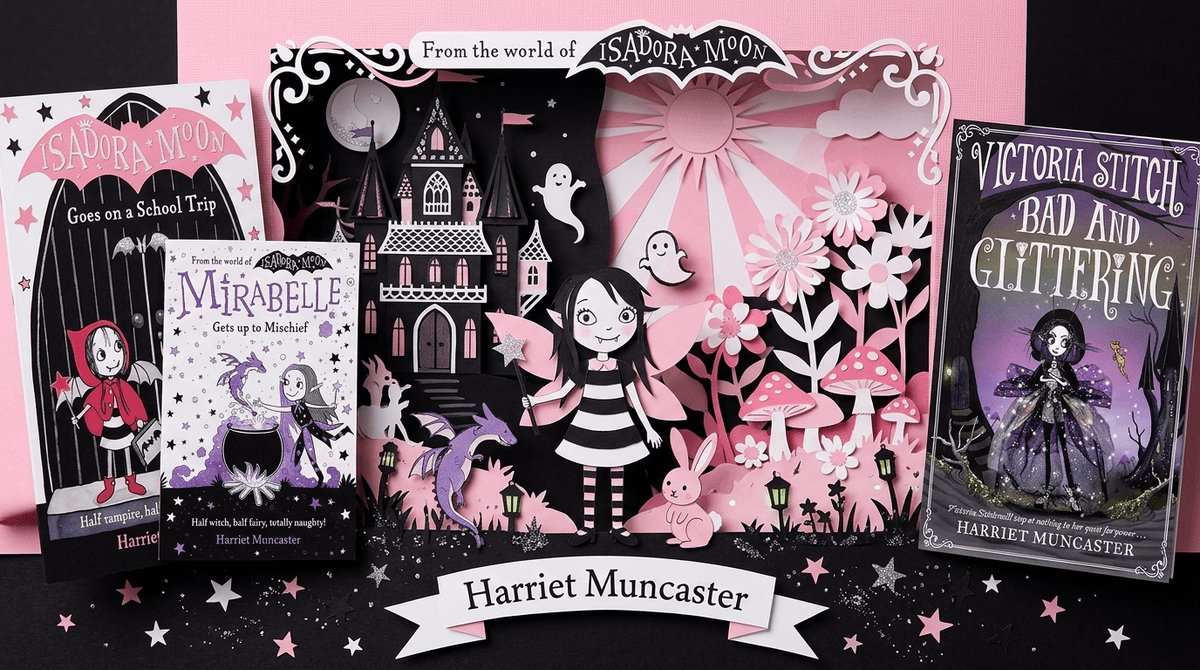
TL;DR: Isadora Moon is the "it" series for the 5-to-9-year-old set right now. It’s about a girl who is half-fairy, half-vampire, and 100% relatable to any kid who feels like they don’t quite fit into one specific box. It’s visually stunning (if you like pink and black), low-stress, and a perfect "bridge" for kids moving from picture books to independent reading.
Quick Links:
If you haven’t seen the glittery, pink-and-black covers dominating the front tables at Barnes & Noble or the Scholastic Book Fair, let me introduce you to the powerhouse that is Harriet Muncaster’s world.
Isadora Moon is a "half-and-half." Her mom is a fairy (loves nature, sunshine, and magic wands) and her dad is a vampire (loves the night, bats, and "red" juice). Isadora herself has tiny vampire fangs and beautiful fairy wings. She lives in a house that is half-spooky castle and half-cottage core dream.
The books are short, highly illustrated chapter books. They aren't "graphic novels" in the traditional sense, but they use the illustrations to carry a lot of the narrative weight, which is why they are such a hit with kids who are still a little intimidated by a wall of text.
There’s a specific magic in the "half-half" identity. While we as parents might see it as a metaphor for biracial identity, neurodivergence, or even just having parents with wildly different interests, kids just see a girl who gets to have a pet Pink Rabbit (brought to life by magic) and also fly around at night.
The Aesthetic
Let’s be real: the branding is top-tier. In a world where kids' media often feels like a neon explosion of "brain rot" (looking at you, Skibidi Toilet), Isadora Moon feels intentional. It’s strictly pink, black, and white. It’s "Goth Lite" meets "Glitter Bomb." It appeals to that age where kids are starting to define their "vibe."
The Low Stakes
The conflicts in these books are very "small world." Isadora goes to a birthday party and worries about her magic. Isadora goes on a school trip. Isadora goes to the ballet. There are no world-ending threats or traumatizing villains. For kids who deal with a lot of performance anxiety at school, these books are a safe, cozy place to land.
You might be wondering why a book series is on a digital wellness platform. It’s because the "Isadora Moon to Screen Pipeline" is real.
Once a kid falls in love with the books, they’re going to find the Isadora Moon TV show on streaming platforms. They’re going to want the apps, the YouTube tutorials on how to draw the characters, and the inevitable Roblox roleplay rooms.
Because Isadora Moon is a "gateway" brand, it’s a great time to talk about media literacy. When your kid wants the Isadora Moon doll they saw in a YouTube unboxing video, that’s your opening to talk about how advertising works.
Learn more about how to handle "I want that" syndrome from YouTube unboxing
If your kid has burned through all 15+ Isadora Moon books, don't panic. Harriet Muncaster has built a bit of a "Muncaster Cinematic Universe" that grows with the reader.
Mirabelle is Isadora’s cousin. She’s half-fairy, half-witch. While Isadora is the "good" girl trying to find her way, Mirabelle is a bit of a troublemaker. These books are slightly more mischievous and are great for kids who find Isadora a little too "sweet."
This is for the older siblings (Ages 9-12). It’s darker, more complex, and deals with themes of power and sibling rivalry. If Isadora is Bluey, Victoria Stitch is the "teen drama" version.
The newest addition to the family—Emerald is a mermaid who doesn't feel like a "typical" mermaid. It follows the same formula as Isadora: identity, cute animals, and a very specific color palette (green and gold this time).
Recommended Ages: 5–9
- Reading Level: If your child is in 1st or 2nd grade, they can likely read these with you. By 3rd grade, they’ll be flying through them solo in twenty minutes.
- Scare Factor: Zero. Despite the "vampire" tag, there is no blood-drinking, no killing, and the bats are basically just winged hamsters.
- Social Themes: Excellent. It covers jealousy, being "different," and navigating family traditions. It’s a very "light" way to introduce the idea that you don't have to be just one thing.
Here’s the no-BS take: The books are a bit formulaic. If you’re looking for the literary depth of The Wild Robot by Peter Brown, you won’t find it here. The prose is simple, and the plots are predictable.
But—and this is a big "but"—they get kids reading.
In an era where we are fighting for our kids' attention against the dopamine hits of TikTok or Minecraft, a book that a child wants to pick up because the cover is sparkly is a win. We don't need every book to be a Newbery Medal winner. Sometimes we just need a book to be fun.
Check out our guide on finding "sticky" book series for reluctant readers
If your child is obsessed with Isadora, use it as a bridge to talk about their own "half-and-half" qualities.
- "Isadora feels like she has to choose between fairy school and vampire school. Do you ever feel like you're two different people at school versus at home?"
- "Dad is a vampire and Mom is a fairy, but they make it work. How do we handle it in our house when we like different things?"
It’s also a great way to pivot into other media. If they love the "spooky but cute" vibe, you might eventually introduce them to The Addams Family (the animated one) or Hotel Transylvania.
Isadora Moon is high-quality, "safe" content. It’s commercial, yes, but it’s wholesome. It encourages individuality and celebrates the "weird" kids.
If your kid asks for these at the book fair, say yes. It’s a much better investment than 1,000 Robux and it might just turn them into a lifelong reader.
Next Steps:
- Grab the first book, Isadora Moon Goes to School.
- If they like the "aesthetic," check out the Isadora Moon Website for free coloring pages—a great non-screen activity.
- Keep an eye on the "Mirabelle" series if they start complaining that Isadora is "too nice."
See if Isadora Moon is appropriate for your specific child's age