

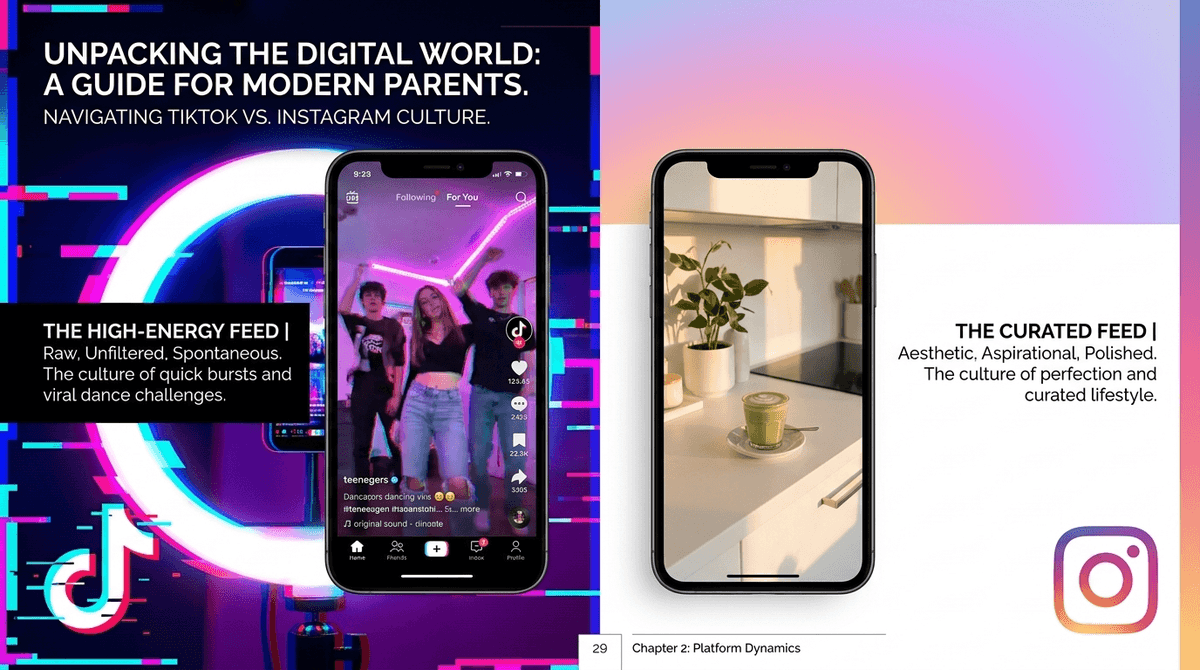
TL;DR: TikTok is where trends are born (the raw, chaotic "Wild West"), while Instagram Reels is where they go to be polished, monetized, and eventually "die" in the eyes of teens. If your kid says a video is "cringe" or "from Ohio," they probably saw it on TikTok three weeks ago. TikTok’s algorithm is more addictive and discovery-based, whereas Instagram is still heavily tied to who you follow and maintaining a certain "aesthetic."
Quick Links for Digital Wellness:
At first glance, TikTok and Instagram Reels look identical. They both feature vertical, short-form videos you swipe through until your thumb gets tired. But for a teenager, the vibe shift between the two is massive.
Think of TikTok as the school cafeteria during a food fight—it’s loud, unpredictable, deeply creative, and everyone is participating in the same inside jokes. Instagram, on the other hand, is like the school’s high-end theater production. It’s curated, filtered, and usually trying to sell you something or prove how perfect someone’s life is.
The biggest technical difference is the Algorithm. TikTok’s "For You Page" (FYP) is scarily good at figuring out exactly what your kid likes within minutes. It doesn't care who they follow; it cares what they watch. Instagram Reels is catching up, but it still prioritizes content from friends and "influencers" your child already follows, making it feel more like a closed loop than a discovery engine.
If you’ve ever sent your kid a Reel and gotten a "Mom, this is so old" or a "Cringe" in response, here is why: The Culture Lag.
TikTok is the source code for modern teen culture. Whether it’s a new dance, a slang term like "Gyatt" or "Rizz," or a weird obsession with Skibidi Toilet, it starts on TikTok. By the time that trend migrates over to Instagram Reels, it has been seen by millions, copied by brands, and "sanitized" for a broader audience.
To a 14-year-old, watching a trend on Reels is like hearing your grandma use the word "lit"—the moment it reaches that level of mainstream saturation, it’s officially dead.
It’s all about the dopamine loop. Both apps use "variable reward" systems—the same mechanism used in slot machines. You swipe, you might see something boring, you swipe again, and boom—a video that makes you laugh hysterically.
- TikTok: It feels like a community. The "Duet" and "Stitch" features allow kids to interact with other creators' videos, making them feel like they are part of a global conversation.
- Instagram Reels: It’s about the "Aesthetic." It’s where kids go to see what their friends are doing, or to follow high-production creators who make "lifestyle" content.
Learn more about how short-form video affects the teenage brain
Ages 13+ TikTok is the undisputed king of attention. While the app is technically for 13+, the "For You Page" can quickly spiral into content that isn't age-appropriate if the algorithm isn't "trained" well.
The Good: Incredible creativity, educational "Learn on TikTok" content, and a place where niche hobbies (like Minecraft modding or book reviews/BookTok) thrive. The Bad: The "infinite scroll" is real. It is very easy for a kid to lose three hours to "brain rot" videos—content that is visually stimulating but intellectually empty.
Ages 13+ Instagram isn't just Reels; it's also Stories, DMs, and Posts. This makes it a more complex social ecosystem than TikTok.
The Good: Better for keeping up with actual friends and family. The "Close Friends" feature allows for a bit more privacy. The Bad: The pressure for perfection. While TikTok celebrates being "messy" and "authentic," Instagram still leans heavily into the "perfect life" narrative, which can be tough on a teen's self-esteem.
When we talk about safety, we’re looking at two different types of risk:
1. Data and Privacy
TikTok is constantly in the news regarding its parent company, ByteDance, and data privacy. If your family is sensitive to international data concerns, this is the big one. Instagram (owned by Meta) also collects massive amounts of data, but it’s a domestic company subject to U.S. laws.
2. Mental Health and Body Image
Research suggests Instagram can be more detrimental to body image because of its focus on curated, filtered photos. TikTok can be more detrimental to attention spans and sleep hygiene because its algorithm is significantly more "sticky."
3. Parental Controls
Both apps have improved their game here:
- TikTok has "Family Pairing," which lets you link your account to your teen’s to set screen time limits and filter keywords.
- Instagram has "Parental Supervision," which allows you to see who they follow and how much time they spend on the app.
Regardless of which app your kid prefers, there are a few "No-BS" things to watch out for:
- The "Search" Bar: Both apps are being used by kids as search engines (replacing Google). This means they might find health advice, news, or "hacks" that are completely unverified or dangerous.
- The Rabbit Hole: If your kid starts seeing "Alpha Male" content, extreme dieting tips, or polarizing political content, the algorithm will feed them more of it. It creates an echo chamber very quickly.
- The "Live" Feature: Both apps allow creators to go "Live." This is where the most unmoderated and potentially inappropriate content happens.
Get advice on talking to your teen about social media echo chambers
If your kids are on these platforms, you can help them "train" their algorithm by following creators who actually provide value.
- For Science: Hank Green (on both platforms) is the gold standard for making science cool and understandable.
- For Creativity: Zach King creates mind-bending "digital magic" that is clean and genuinely impressive.
- For Nature: Bindi Irwin or similar conservationist accounts offer a great break from the noise.
- For Life Skills: Look for "Adulting" creators who teach things like cooking, basic finance, or car maintenance.
Instead of asking "What are you doing on your phone?" (which will get you a "nothing" or a shrug), try these:
- "Show me the funniest thing on your FYP today."
- "Have you noticed the algorithm trying to sell you stuff lately? I keep getting ads for Stanley Tumblers."
- "I heard TikTok trends are way ahead of Reels. Is that actually true or am I just old?"
There is no "winner" here. TikTok is better for entertainment and trend-watching; Instagram is better for social connection.
The goal isn't necessarily to ban one or the other, but to help your child recognize when they are being "used" by the app. If they can’t put the phone down after 20 minutes, or if they feel worse about their life after scrolling, it’s time to recalibrate.
Next Steps:
- Audit the "Following" list: Sit down with your teen and look at who they actually follow. Unfollow the "junk" accounts together.
- Set "No-Scroll Zones": No Reels or TikToks in the bedroom or at the dinner table.
- Use the "Not Interested" button: Teach your kid to long-press on a video they don't like and hit "Not Interested" to help clean up their feed.