

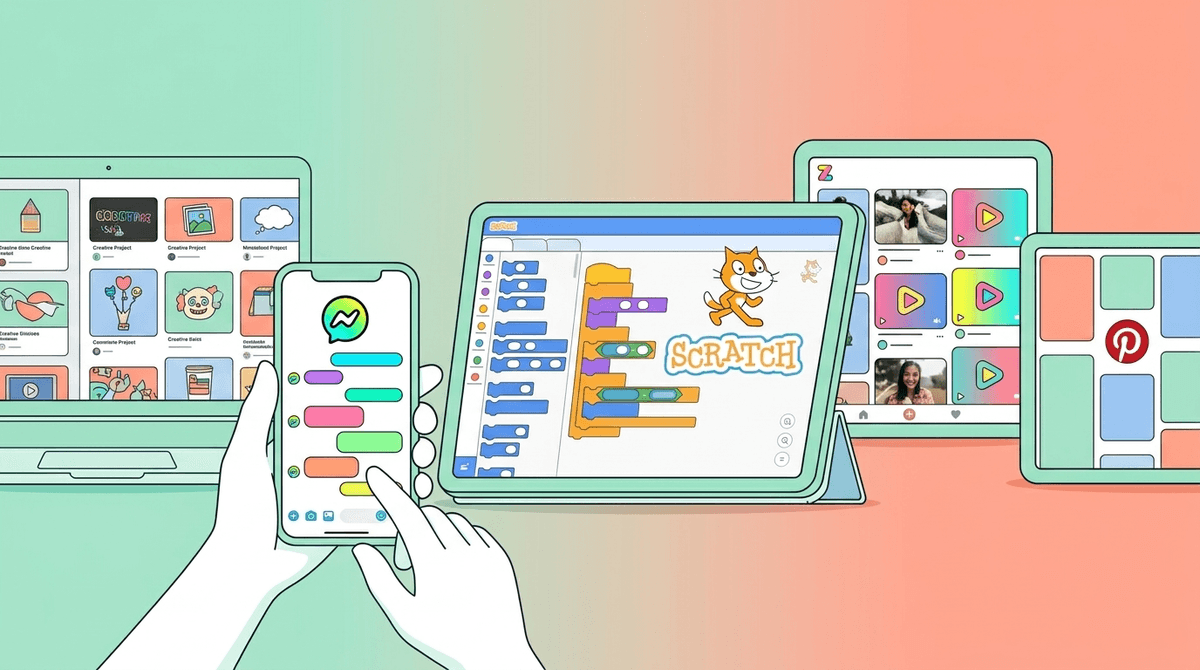
TL;DR: The Quick List
If you’re looking to get your kid off the algorithmic treadmill of TikTok and Instagram, here are the top "Social Oasis" alternatives for 2026:
- For the Littles (Ages 6-10): Zigazoo — Think TikTok but human-moderated and challenge-based.
- For the "I Just Want to Chat" Phase: Messenger Kids — Fully controlled by you, no "discovery" feed.
- For the Creative/Builders: Scratch — A coding community that doubles as a social network.
- For the Aesthetic/Hobbyist: Pinterest — The "least toxic" big feed, focused on ideas rather than faces.
- For the Gamers (Ages 12+): Discord — High-risk but high-reward community building (if set up correctly).
Find the best social media alternative for an 11-year-old
We’ve all been there. You look over and your ten-year-old is three inches deep in a TikTok rabbit hole, watching a "corecore" video that makes zero sense, or worse, some influencer peddling a $50 skin cream they don't need. The "Big Feeds" are designed to keep eyes glued to the glass, using algorithms that value engagement over well-being.
But here’s the reality: kids want to be social. They want to share what they’re making, see what their friends are doing, and feel like they belong to a community. Telling a 2025 middle-schooler "no social media until you're 16" is a valid choice, but for many families, it’s a recipe for being the "weird kid" who doesn't get the jokes at lunch.
The "Social Oasis" search isn't about banning tech; it's about finding platforms where the architecture isn't actively working against your kid's brain. We’re looking for places with human moderation, closed loops (talking to people they actually know), and interest-based connections rather than "clout-based" ones.
If your kid is begging for TikTok, Zigazoo is the answer. It’s a video-sharing app where kids respond to "challenges" (like "show us your LEGO build" or "do a science experiment"). Why it’s an Oasis: Every single video is reviewed by a human moderator before it goes live. There are no comments—only video responses and emoji "stickers." It removes the toxicity of the comment section entirely. The Vibe: Wholesome, slightly chaotic, and very safe.
I know, I know—it's Meta. But Messenger Kids is actually a masterclass in parental controls. There is no "public" profile. You, the parent, approve every single contact. If your kid wants to message a classmate, you have to be Facebook friends with that kid's parent to link them. Why it’s an Oasis: It teaches the "how-to" of digital communication (sending GIFs, making video calls) without the "discovery" element where strangers can find them. The Vibe: A digital playground with a very tall fence.
Learn more about setting up Messenger Kids safely
Most parents think of Scratch as a coding site, but it’s actually one of the world’s largest social networks for kids. Users share projects, "remix" each other's work, and leave comments. Why it’s an Oasis: The community is centered around doing something. Instead of doom-scrolling, they are troubleshooting code or complimenting someone’s pixel art. The moderation is top-notch, and the culture is surprisingly supportive. The Vibe: The "gifted and talented" lounge of the internet.
While technically "big social," Pinterest functions differently. It’s not about "look at me," it’s about "look at this cool thing I want to make/buy/do." For tweens who love aesthetics, room decor, or fashion, it’s a much healthier alternative to the body-image pressure cooker of Instagram. Why it’s an Oasis: The algorithm serves ideas, not people. However, you should still turn off "secret boards" and messaging in the settings to keep it strictly for inspiration. The Vibe: A digital mood board that doesn't make you feel ugly.
Eventually, the "training wheels" apps will feel "babyish" to your kid. When they reach that 12-14 age range, they’ll want something more robust.
Discord is the "town square" for Gen Z. It’s organized into "servers" (private or public groups). If your kid plays Minecraft or Roblox, they will eventually be invited to a Discord server. The Reality Check: This is not a "safe" app out of the box. Public servers can be wild west territory with inappropriate language and content. How to make it an Oasis: Limit your kid to private servers with friends they know in real life. Turn off Direct Messages (DMs) from non-friends. When used this way, it’s a fantastic way for kids to hang out "virtually" while gaming. The Vibe: A basement hangout session that never ends.
If your teen is struggling with the "perfection" of social media, BeReal is a decent compromise. Once a day, everyone gets a notification to take a photo of whatever they are doing right now. Why it’s an Oasis: No filters. No editing. No "influencer" culture. It’s just your friends being boring in real-time. The Vibe: Refreshingly mundane.
Check out our guide on whether BeReal is actually "real"
The reason we’re looking for alternatives isn't just because TikTok has some bad videos. It’s about the architecture of the experience.
- The Big Feeds use "Passive Consumption." You sit there, and the machine feeds you what it thinks will keep you there. This leads to "brain rot" (to use the kids' term) and a loss of agency.
- The Oasis Alternatives usually require "Active Engagement." You have to code a project on Scratch, find a recipe on Pinterest, or respond to a specific challenge on Zigazoo.
When kids are active participants rather than passive consumers, their relationship with the screen changes. They aren't just "on their phone"—they are doing something.
- Ages 6-9: Stick to Zigazoo and Messenger Kids. At this age, there is zero reason for them to have a public-facing profile.
- Ages 10-12: This is the "bridge" phase. Scratch and Pinterest are great here. Start having conversations about "The Scroll"—how it feels in their body when they’ve been looking at a feed for 30 minutes versus when they’ve been building something.
- Ages 13+: This is when the "Big Feeds" usually become legally accessible. Instead of a hard "no," consider a "yes, with conditions." Maybe they can have Discord for their soccer team chat, but TikTok stays off the phone for now.
See how to introduce social media to a 13-year-old
Let’s be real: none of these apps are a "set it and forget it" solution.
- Zigazoo can still have annoying "influencer-lite" behavior from kids.
- Messenger Kids can be a breeding ground for "mean girl" group chat drama.
- Discord is only as safe as the people in the server.
The goal isn't to find an app that is "perfectly safe"—those don't exist because humans are involved. The goal is to find an app where you have the tools to intervene and where the app's business model isn't based on exploiting your kid's dopamine response.
If your kid is dying for Snapchat because "everyone has it," try this approach:
"I know it feels like you're missing out. The reason I'm saying no to Snapchat isn't because I don't trust you; it's because that app is designed to make you feel like you have to be on it 24/7 to keep up. Let’s try Zigazoo or Pinterest for a while. If you can show me you can handle the responsibility of a digital community there, we can talk about the next step in six months."
It’s about gradual release of responsibility. You wouldn't hand a kid the keys to a Ferrari for their first driving lesson; you start in a parking lot with a Honda. These alternatives are your "parking lot."
The "Social Oasis" isn't a myth, but it does require a bit of work to maintain. By steering your kids toward platforms like Scratch or Zigazoo, you’re giving them the social connection they crave without the algorithmic baggage they aren't ready for.
Next Steps:
- Audit the phone: Look at what they are currently using. Is it a "Passive Feed" or an "Active Oasis"?
- Pick one alternative: Download Zigazoo or Pinterest together and explore it.
- Set the "Why": Explain to your kid why you’re choosing these specific apps. (Hint: Use the word "agency"—kids love feeling like they have power over their own brains).