

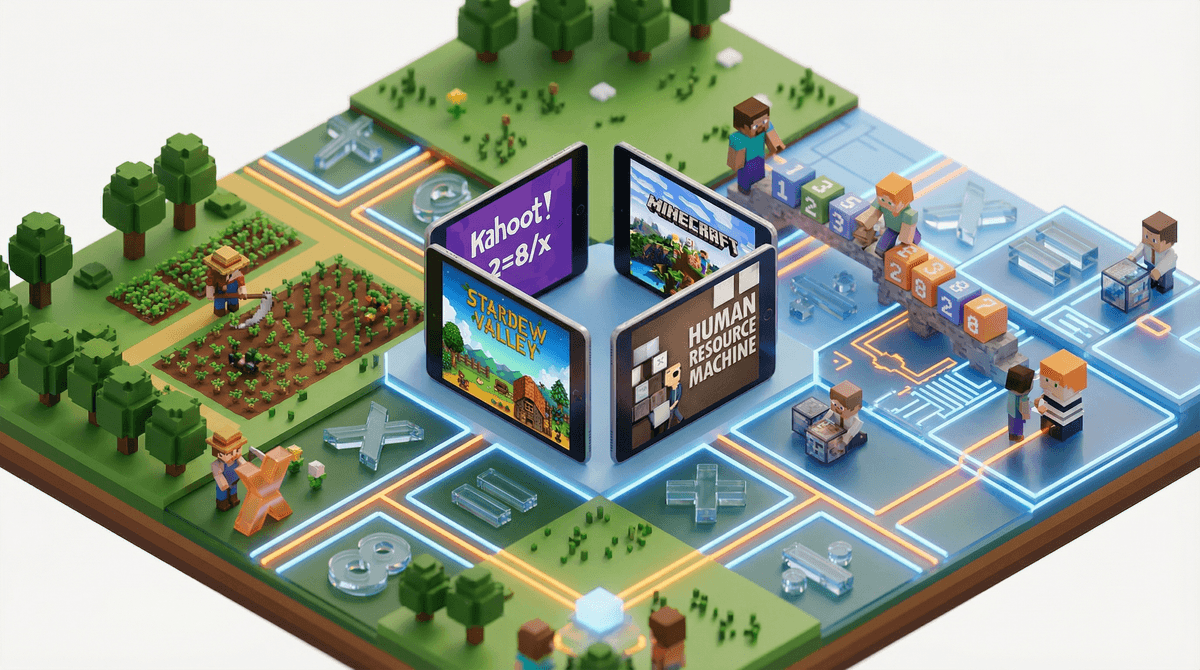
Look, I get it. Your kid can spend three hours building an elaborate farm in Stardew Valley or designing a complex redstone contraption in Minecraft, but the moment you mention "variables" or "solving for x," their brain apparently shuts down.
Here's the thing: algebra isn't actually hard for kids. What's hard is the way we usually teach it—abstract symbols on a worksheet with no context for why anyone would care. But when those same concepts show up in games? Suddenly kids are solving multi-step equations without even realizing it.
The good news is there are games specifically designed to make algebraic thinking feel natural, plus some surprising mainstream games where algebra sneaks in through the back door. And since 55% of families in our community have kids gaming regularly, you might as well make some of that screen time work double duty.
Traditional algebra instruction often starts with "here's a rule, now apply it 30 times." These games flip the script—they let kids discover patterns, test hypotheses, and build intuition before they ever see formal notation.
The best math games don't feel like math class. They feel like puzzles, strategy challenges, or creative building projects. Your kid isn't "doing homework"—they're unlocking new abilities, optimizing their strategy, or beating increasingly complex levels. The algebra is just the tool they need to win.
DragonBox Algebra (Ages 5+)
This is the game that makes parents text their friends saying "WAIT, my 7-year-old just solved an equation?!" It starts with pictures and gradually introduces algebraic notation so smoothly that kids don't even notice the transition. The early levels feel like a puzzle game about balancing boxes. By the end, they're solving actual algebraic equations.
What parents should know: There are different versions for different age ranges. DragonBox Algebra 5+ is perfect for younger kids, while DragonBox Algebra 12+ goes deeper into formal algebra concepts. It's a paid app (around $8), but there's no ads, no in-app purchases, and no surprises.
Minecraft Education Edition (Ages 8+)
If your kid is already one of the 35% playing Minecraft offline or the 25% on servers, you can redirect some of that energy toward the Education Edition, which includes specific math challenges and chemistry labs. But honestly? Regular Minecraft is already teaching algebraic thinking.
Building with redstone requires understanding variables (signal strength), conditional logic (if/then statements), and optimization problems. Kids planning large builds are constantly doing mental algebra: "If I need 64 stone blocks per layer and I'm building 12 layers high..."
Pro tip: Want to learn more about how Minecraft teaches computational thinking?
Kerbal Space Program (Ages 10+)
This rocket-building simulation is basically applied physics and algebra wrapped in an adorable package of little green astronauts. Kids learn about ratios, proportions, trajectories, and optimization—all while trying to get their spacecraft to actually make it to orbit without exploding.
Fair warning: this game has a learning curve. But for kids who love space, engineering, or just blowing things up in creative ways, it's incredibly engaging. And the algebra they're learning? It's the same stuff NASA engineers use.
Desmos Activities (Ages 11+)
Technically not a "game," but Desmos has interactive activities that feel game-like. Polygraph turns graphing into a guess-who style game. Marbleslides has kids manipulating equations to guide marbles through obstacles. It's free, web-based, and teachers love it because it actually works.
Factorio (Ages 12+)
This is the deep end of the pool. Factorio is about building automated factories, which requires understanding ratios, optimization, and resource management at a level that would make an operations research professor proud. Kids end up creating spreadsheets to track production chains. Voluntarily.
It's rated for teens due to mild violence (you're defending against aliens), but the real reason it's for older kids is the complexity. This is for the kid who's ready to really geek out.
You don't need specialized "educational" games for your kid to develop algebraic thinking. Strategy games like Civilization VI involve constant optimization problems. Resource management games like Stardew Valley require planning and proportional reasoning. Even Roblox games like Tower Defense Simulator involve strategic thinking about costs, benefits, and efficiency.
The key is games that require planning, pattern recognition, and systematic thinking—not just reaction time.
Elementary (Ages 6-10): Start with DragonBox and puzzle games that build pattern recognition. Prodigy Math is another option, though it's more traditional "answer math problems to progress" gameplay.
Middle School (Ages 11-13): This is prime time for Minecraft redstone projects, Kerbal Space Program, and Desmos activities. They're ready for games where the math is embedded in complex systems.
High School (Ages 14+): Factorio, Kerbal Space Program, and even coding games like Human Resource Machine that teach algorithmic thinking.
Will these games replace math class? No. Will they make your kid magically love algebra homework? Probably not. But they can build the intuition and pattern recognition that makes formal algebra make sense. They can show kids that mathematical thinking is actually useful and even fun.
And here's the secret: the best time to introduce these games is before your kid starts formal algebra. If they've already spent years building things in Minecraft, optimizing farms in Stardew Valley, or solving puzzles in DragonBox, algebra class feels less like learning a foreign language and more like finally getting the vocabulary for things they already understand.
Not all screen time is created equal. If your kid is going to spend time gaming anyway—and with 55% of families saying their kids game regularly, chances are yours will too—you might as well point them toward games that build skills.
The games that teach algebra best are the ones that don't announce they're teaching algebra. They're the ones where mathematical thinking is just the tool you need to solve interesting problems, build cool things, or beat challenging levels.
If you're just starting: Try DragonBox Algebra 5+ for younger kids or Desmos activities for middle schoolers. They're low-commitment ways to see if your kid responds to math games.
If your kid already games: Look at what they're already playing and see if there are mathematical angles to explore. Building in Minecraft? Suggest a redstone project. Playing Roblox? Try games with strategy and resource management.
If your kid is struggling with algebra: Don't frame these as "homework help." Frame them as "hey, I heard this game is really cool." Let them discover the math on their own terms.
Want personalized game recommendations based on your kid's age and interests? The Screenwise list maker can help you find the right fit for your family.